

Daily Devotional
Sunday, February 25, 2024 (NS), February 12, 2024 (OS)
No Fasting.
| Sunday of the Thirty-Third Week or Sunday of the Publican and the Pharisee Mode Plagal One — Fifth Eothinon |
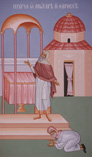
The commemoration of our fathers among the saints, Meletios, Patriarch of Antioch the Great, and Alexis, Metropolitan and Wonder-worker of All Russia.
Scripture Readings
Paschalion — Movable Calendar
Sunday of the Thirty-Third Week or Sunday of the Publican and the Pharisee
Mode Plagal One — Fifth Eothinon
Epistle
The Reading is from the Second Epistle of Saint Paul to Saint Timothy [§ 296]. Child Timothy:
3 10Thou hast closely followed my teaching, conduct, purpose, faith, long-suffering, love, patience, 11persecutions, sufferings, such as happened to me in Antioch, in Iconium, in Lystra—what persecutions I endured! And out of them all the Lord delivered me. 12Yes, and all those who wish to live piously in Christ Jesus shall be persecuted. 13But evil men and cheats shall advance to the worse, leading astray and being led astray. 14But thou, keep on abiding in what thou didst learn and wast assured of, knowing from whom thou didst learn, 15and that from a babe thou hast known the sacred writings, which are able to make thee wise in regard to salvation through faith which is in Christ Jesus.
Gospel
The Reading is from the Holy Gospel according to Saint Luke [§ 89]. The Lord said this parable:
18 10“Two men went up into the temple to pray, the one a Pharisee and the other a tax collector. 11“The Pharisee, having assumed a stance, was praying these things to himself, ‘God, I thank Thee that I am not as the rest of men—rapacious, unjust, adulterers, or even as this one, the tax collector. 12“‘I fast twice a week; I tithe all things, as much as I acquire.’ 13“And the tax collector, having stood afar off, was not willing even to lift up his eyes to the heaven, but kept beating upon his breast, saying, ‘God, be gracious to me the sinner.’ 14“I say to you, this one went down to his house having been justified rather than that one; for everyone who exalteth himself shall be humbled, and the one who humbleth himself shall be exalted.”
Menaion — Fixed Calendar
The commemoration of our fathers among the saints, Meletios, Patriarch of Antioch the Great, and Alexis, Metropolitan and Wonder-worker of All Russia.
Epistle
The Reading is from the Epistle of Saint Paul to the Hebrews [§ 335]. Brethren:
13 17Be obedient to those who lead you, and keep on submitting, for they are watchful for your souls, as those about to render an account, that they may do this with joy, and not groaning; for this would be unprofitable for you. 18Keep on praying for us; for we trust that we have a good conscience, in all things wishing to conduct ourselves well. 19But I beseech you more abundantly to do this, that I might be restored more quickly to you.
20Now the God of peace Who brought up from the dead our Lord Jesus, the Shepherd of the sheep, the great One, in the blood of an everlasting covenant, 21may He render you perfect in every good work, in order to do His will, doing in you that which is well-pleasing before His face, through Jesus Christ, to Whom be glory to the ages of the ages. Amen.
Gospel
The Reading is from the Holy Gospel according to Saint Luke [§ 24]. At that time:
6 17Jesus stood upon a level place. And there was a crowd of
His disciples, and a great multitude of the people from all of Judæa and Jerusalem and the
seacoast of Tyre and Sidon, who came to hear Him, and to be healed of their diseases—
18even those who were troubled by unclean spirits; and they were cured.
19And all the crowd was seeking to touch Him, for power was coming forth from Him and
healing all. 20And He lifted up His eyes to His disciples, and began to say:
“Blessed are the poor, for yours is the kingdom of God.
21“Blessed are ye who hunger now, for ye shall be
filled.
Blessed are ye who weep now, for ye shall laugh.
22“Blessed are ye whenever men hate you, and whenever they
separate you, and reproach you, and cast out your name as evil, on account of the Son of
Man.
23“Rejoice in that day and leap for joy, for behold, your
reward is great in the heavens.”
Synaxarion Readings
Sunday of the Publican and the Pharisee
O Creator of all above and below, as Thou receivest the thrice-holy hymn from the angels, so also from mankind receive the Triodion. He who lives like a Pharisee is far from the Church, for Christ is received within, O ye humble of heart.
With God on this present day we begin the Triodion, the hymns of which were composed by many of our holy and God-bearing fathers, inspired by the Holy Spirit according to their worthiness. The first of all was the great author St. Cosmas of Maiuma, who composed the three odes (symbolic of the Holy and life-creating Trinity) for the Great and Holy Week of the Passion of our Lord and God and Savior Jesus Christ. After him, others of the fathers, including Saints Theodore and Joseph of the Studite Monastery, following his zealous example, arranged the services of the other weeks of the Holy and Great Forty-day Fast, reserving them at first for the use of the Studite Monastery. Furthermore they composed and arranged hymns, seeking them and collecting them from other books of the fathers. Since, according to the Triodion, Sunday, the celebration of the Resurrection, is the first day of the week as well as the last or eighth day, they prescribed the first ode (canticle) of the canon to be sung on the second day of the week, i.e. Monday. The second ode was prescribed for Tuesday, the third day of the week, the third ode for Wednesday, the fourth ode for Thursday, the fifth ode for Friday, and the sixth and seventh odes for Saturday. The rest, the eighth and ninth odes, are prescribed for every day.
It must be known, however, that although it is called the Triodion, it does have services with other than three-ode canons. It is so named because the majority of the services have three-ode canons, especially during Holy Week. For it was our holy fathers’ idea that through the entire Triodion would be commemorated in a concise form all God’s benefits to us from the beginning, using it as a reminder for all of us that we were created by Him, and were exiled from Paradise through the tasting of the fruit, rejecting the commandment that was given to us for our knowledge, and we were cast out through the envy of the arch villain serpent and enemy, who was made to crawl for his arrogance; that we remained cut off from the benefits of Paradise and were led by the devil; that the Son and Logos of God, having suffered in His mercy, bowing the heavens, descended and made His abode in the Virgin and became man for our sake, showing us through His life the ascent into the heavens, through humility first of all, then by fasting and the rejection of evil, and through His other deeds; that He suffered and rose from the dead and ascended once more into heaven, and He sent down the Holy Spirit upon His holy disciples and apostles, who all proclaimed Him to be the Son of God and the most perfect God. And that once more the divine apostles acted through the grace of the most Holy Spirit and gathered all the saints from the ends of the earth through their preaching, filling the world on high, which was the intention of the Creator from the beginning.
Now the purpose of the Triodion intended by the holy fathers on these three present feasts of the Publican and the Pharisee, the Prodigal Son, and the Second Coming is a kind of preparatory lesson and stimulation to prepare ourselves for the spiritual labors of the Fast, having put aside our usual corrupt habits. First of all they present to us the parable of the Publican and the Pharisee, and they call the week following precursory. For those who desire to go off to do military battle first ascertain the time of the battle from the leaders, so that having cleaned and polished their weapons, and preparing well all their other matters, and having removed all obstacles from their path, they earnestly go forth to their labors, taking the necessary supplies. Often before battle they tell anecdotes and tales and parables to incite their hearts to zeal, driving off idleness, fear, despair, and other unworthy feelings. So the divine fathers herald the coming fast against the armies of demons as a struggle which constrains our souls to cleanse ourselves of the poison accumulated over a long period of time. Not yet possessing those benefits, let us strive to obtain them, and arming ourselves properly, so let us embark on the labors of the Fast.
Now the first weapon among the virtues is repentance and humility. And the adversary of attaining the greatest humility is pride and arrogance. So they place before us first of all this present trustworthy parable from the divine Gospel. It encourages us to shun the desire for the pride and arrogance of the Pharisee and to cultivate the opposite desire of the Publican for humility and repentance. For the greatest and most grievous passion is pride and arrogance, since this is how the devil fell from the heavens before the morning star and was cast into darkness. Because of this Adam, the father of our race, was driven from Paradise through partaking of the fruit. Through this example the holy fathers encourage all not to be proud of their successes, but to always be humble. For the Lord sets Himself against the proud, but He gives grace to the humble. Better a man who has sinned, if he knows that he has sinned and repents, than a man who has not sinned and thinks of himself as righteous. For Christ said, “I say to you that the publican went down to his house justified rather than the Pharisee.” This parable reveals that no one should exalt himself, even though he has done good deeds, but rather should always be humble and pray from his heart to God, for even if he should fall into the most serious sin, salvation is not far off.
Through the prayers of all Thy holy hymnographers, O Christ our God, have mercy on us. Amen.
Translated from Triodion, siest ‘Tripesnets: Triod’ Postnaya, Moscow, 1904, by Robert Parent.
Lives of the Saints (Prologue)
February 25th – Civil Calendar
February 12th – Church Calendar
1. St. Meletius, Archbishop of Antioch.
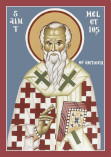 This great and holy man was an outstanding interpreter
and defender of Orthodoxy. The whole of his life was devoted to the fight against the Arian
heresy, which did not recognize the Son of God and blasphemed against the Holy Trinity.
Originally living in Armenia, he was appointed to shepherd the Church of Antioch. In that place,
the struggle between the Orthodox and the heretics was so bitter that the first time St. Meletius
preached to the people in church on the divine Trinity in unity, the deacon, a heretic, ran up to
the bishop and shut his mouth with his hand. Being unable to preach with words, Meletius preached
by signs. Thus, he raised his arms on high, opened three fingers to their fullest extent and
showed them to the people, then closed his hand and raised the one fist. He was three times
removed from his archiepiscopal throne by the heretics, and driven off into Armenia. He took part
in the Second Ecumenical Council in 381, where the Emperor Theodosios showed him especially great
honor. At that council, God showed a mystery through His archbishop. When Meletius was
propounding the doctrine of the Holy Trinity to the Arians, he first raised three fingers,
separated one by one, then brought them together; and at that moment lightning flashed from his
hand before the gaze of all present. At that council, Meletius established Gregory the Theologian
in the seat of Constantinople. While the council was still in session, St. Meletius finished his
earthly course in Constantinople. His relics were taken to Antioch.
This great and holy man was an outstanding interpreter
and defender of Orthodoxy. The whole of his life was devoted to the fight against the Arian
heresy, which did not recognize the Son of God and blasphemed against the Holy Trinity.
Originally living in Armenia, he was appointed to shepherd the Church of Antioch. In that place,
the struggle between the Orthodox and the heretics was so bitter that the first time St. Meletius
preached to the people in church on the divine Trinity in unity, the deacon, a heretic, ran up to
the bishop and shut his mouth with his hand. Being unable to preach with words, Meletius preached
by signs. Thus, he raised his arms on high, opened three fingers to their fullest extent and
showed them to the people, then closed his hand and raised the one fist. He was three times
removed from his archiepiscopal throne by the heretics, and driven off into Armenia. He took part
in the Second Ecumenical Council in 381, where the Emperor Theodosios showed him especially great
honor. At that council, God showed a mystery through His archbishop. When Meletius was
propounding the doctrine of the Holy Trinity to the Arians, he first raised three fingers,
separated one by one, then brought them together; and at that moment lightning flashed from his
hand before the gaze of all present. At that council, Meletius established Gregory the Theologian
in the seat of Constantinople. While the council was still in session, St. Meletius finished his
earthly course in Constantinople. His relics were taken to Antioch.
2. St. Alexis (Alexei), Metropolitan of Moscow.
St. Alexis was a great hierarch of the Russian Church during a difficult period of Cossack warfare with the Russian people. Once in childhood he went bird hunting, and then went to sleep. In a dream he heard a voice that said, ‘Alexis, why rush around so fruitlessly? I will teach you to catch men!’ He became a monk at the age of twenty, and in time became Metropolitan of Moscow. He twice went among the Cossack Horde: once to sooth the wrath of Verdevir Khan against the Russian people, and the second time at the invitation of Amurat Khan, to cure his wife’s blindness. This woman had been blind for three years, but she was healed and her vision restored when Alexis prayed and anointed her with holy water. After a life of great endeavor and fruitfulness, Alexis entered into rest in 1378 at the age of 85, and went to the court of the Lord.
3. Our Holy Mother Mary (Marius).
Mary was a woman with great courage. After the death of her mother, her father desired to become a monk. Mary would not be separated from him, so they decided to go together to a men’s monastery—Mary with short hair and in man’s raiment as a youth. Her father died, and Mary became a monk and received the name Marius. There was an inn near the monastery, and the innkeeper’s daughter fell in love with the pious monk Marius. After pursuing him without success, she accused Marius of unlawful relations with her, because she had known some other man and borne him a son. Mary did not defend herself and was driven forth with scorn from the monastery. With the strange child in her care, she lived for three years in a grove belonging to the monastery, enduring hunger and hatred, and every sort of hardship and privation. As a result of all this, the innkeeper’s daughter became deranged. A little later, Mary died. Immediately after her death it was discovered that the ‘Monk Marius’ was a woman. As soon as the innkeeper’s daughter touched the relics of St. Mary, she was healed of her insanity and confessed her terrible sin. St. Mary entered into rest and went to eternal joy in 508.
4. St. Anthony, Patriarch of Constantinople.
A man of great compassion, he was at first an ascetic and then patriarch in the time of Emperor Leo the Wise (889-912). He professed his father a monk and built a monastery over the relics of St. Callia.
5. St. Callia.
Callia was generous to the poor from pure Christian compassion, both as a young girl and later as a married woman. Her husband was rich, but he was a hard man. Returning on one occasion from his work, he found that his wife had given away all his wealth to the poor. He thereupon killed her. But God glorified this compassionate soul, in that her relics healed many of the sick. Convinced by this of her sanctity, the holy Patriarch Anthony built a monastery over her relics.
FOR CONSIDERATION
St. John Chrysostom quotes the following example from the life of St. Meletius, demonstrating the true nobility of this great hierarch: Meletius was unjustly exiled from Antioch. When the governor got into the coach, seated the saint beside him and then began to drive hurriedly through the square, the citizens rushed from all sides with pebbles, which fell like hail on the governor’s head, the people being loath to part with their archbishop, and being ready to part with life rather than with this saint. But what did the blessed man do? Seeing the stones flying, he covered the governor’s head with his cloak. He thus shamed his enemy by his great meekness and gave his followers a lesson in the goodness we must show to those who insult us; how it is not enough just to do them no evil, but to use our strength to protect them from those dangers that threaten them. On Meletius’ outward appearance, St. Chrysostom writes further: ‘It was truly the greatest delight to see his holy face, and not only when he taught or spoke; when people only looked at him he brought virtue to the soul of the beholder.’
Daily Scripture Readings taken from The Orthodox New Testament, translated and published by Holy Apostles Convent, Buena Vista, Colorado, copyright © 2000, used with permission, all rights reserved.
Daily Prologue Readings taken from The Prologue of Ochrid, by Bishop Nikolai Velimirovic, translated by Mother Maria, published by Lazarica Press, Birmingham, England, copyright © 1985, all rights reserved. Edited by Dormition Skete.