

Daily Devotional
Monday, February 19, 2035 (NS), February 6, 2035 (OS)
No Fasting.
Monday of the Thirty-Fourth Week
The commemoration of the Afterfeast of the Meeting of the Lord, and our holy father among the saints, Bucolos, Bishop of Smyrna, and Photios the Great, Patriarch of Constantinople and the Equal-to-the-apostles.
Scripture Readings
Paschalion — Movable Calendar
Monday of the Thirty-Fourth Week
Epistle
The Reading is from the Second General Epistle of Saint Peter [§ 66]. Beloved:
1 20Know this first, that every prophecy of Scripture cometh not out of private explanation, 21for prophecy was not brought about at any time by the will of man, but holy men of God spoke while borne along by the Holy Spirit.
2 1But false prophets arose among the people, as also there shall be false teachers among you, who shall introduce privily heresies of destruction, even denying the Master Who bought them, and bring upon themselves swift destruction. 2And many shall follow their licentious acts, by reason of whom the way of truth shall be blasphemed. 3And in covetousness, they shall make merchandise of you with feigned words, for whom the judgment of old is not idle, and their destruction slumbereth not. 4For if God spared not angels who sinned, but cast them into Tartarus and delivered them to judgment with cords of darkness which have been kept for them; 5and spared not the ancient world, but preserved Noah, one of eight, a herald of righteousness, after He brought a flood upon a world of ungodly ones; 6and having burned to ashes the cities of Sodom and Gomorrah, He condemned them with destruction, having made them an example to those intending to live impiously; 7and delivered righteous Lot, who was oppressed by the licentious behavior of the lawless 8(for the righteous man, dwelling among them, tortured his righteous soul day after day by seeing and hearing their lawless works)— 9then the Lord knoweth how to deliver the pious out of temptation, and to keep the unjust who are under punishment until a day of judgment.
Gospel
The Reading is from the Holy Gospel according to Saint Mark [§ 59]. The Lord said to His disciples:
13 9“Be taking heed to yourselves: For they shall deliver you up to councils; and ye shall be beaten in their synagogues; and ye shall be made to stand before governors and kings on account of Me, for a testimony to them. 10“And it is needful for the Gospel first to be proclaimed to all the nations. 11“But whenever they lead you away and deliver you up, cease taking thought before what ye should say, neither be meditating. But whatsoever shall be given to you in that hour, be speaking this; for ye are not the ones who speak, but the Holy Spirit. 12“Now brother shall deliver up brother to death, and a father, a child; and children shall rise up against parents, and shall put them to death. 13“And ye shall be hated by all for My name’s sake. But the one who endureth to the end, the same shall be saved.”
Menaion — Fixed Calendar
The commemoration of the Afterfeast of the Meeting of the Lord, and our holy father among the saints, Bucolos, Bishop of Smyrna, and Photios the Great, Patriarch of Constantinople and the Equal-to-the-apostles.
Epistle
For St. Photios:
The Reading is from the Epistle of Saint Paul to the Hebrews [§ 318]. Brethren:
7 26Such a High Priest was fitting for us: holy, guileless, undefiled, Who hath been separated from the sinners and hath become higher than the heavens, 27Who hath no need daily, even as the high priests, to offer up sacrifices, first for his own sins, then for those of the people; for this He did once for all after He offered up Himself. 28For the law appointeth men high priests who have weakness; but the word of the oath, which is after the law, appointeth the Son, Who hath been perfected forever.
8 1Now in reference to the things being spoken of, the chief point is: We have such a High Priest, Who sat down on the right of the throne of the majesty in the heavens, 2a Liturgist of the holies and of the tabernacle, the true one, which the Lord pitched, and not man.
Gospel
The Reading is from the Holy Gospel according to Saint John [§ 36]. The Lord said to the Jews who had come to Him:
10 9“I am the door; by Me if anyone should enter, he shall be saved, and shall go in and go out and find pasture. 10“The thief cometh not, except that he might steal, and slay, and destroy. I came that they may have life, and may have it abundantly. 11“I am the good shepherd. The good shepherd layeth down his life for the sheep. 12“But the hireling, who indeed is not a shepherd, whose own the sheep are not, seeth the wolf coming, and leaveth the sheep and fleeth; and the wolf seizeth them and scattereth the sheep. 13“Now the hireling fleeth, because he is a hireling and careth not about the sheep. 14“I am the good shepherd; and I know those that are Mine, and am known of those that are Mine. 15“Even as the Father knoweth Me, I also know the Father; and I lay down My life for the sheep. 16“And I have other sheep which are not of this fold; them also it is needful for Me to bring, and they shall hear My voice; and there shall be one flock and one Shepherd.”
Lives of the Saints (Prologue)
February 19th – Civil Calendar
February 6th – Church Calendar
1. St. Boukolos (Bucolus), Bishop of Smyrna.
He was a disciple of St. John the Theologian, who consecrated him bishop of the city of Smyrna. There were few baptized Christians in Smyrna, and St. Boukolos shone like a lamp in the pagan darkness. He was adorned with all the virtues, especially gentleness and meekness. Before his death, Boukolos named the famous Polycarp as his successor in the episcopate. Then he peacefully departed this life and went to the Lord.
2. The Holy Martyr Fausta.
Suffering for Christ in the reign of the Emperor Maximian (between 305 and 311), she made her torturers marvel by her heroism and brought them to the Christian Faith. These were the eighty-year-old pagan priest Evilasius, and Maximus the Eparch. When the judge threatened Fausta with even harsher tortures, she asked him to have a picture of her made, showing her enduring all the tortures with which he was threatening her. When it was ready and shown to her, holy Fausta said: ‘As this picture feels no torture, so my body does not feel the torture of your punishments, for my soul is established in the Lord.’ The judge cast her into a cauldron of boiling water, where this thirteen-year-old girl departed this life with prayer on her lips, and went to Paradise.
3. The Holy Martyr Dorothea.
She was an eminent and beautiful maiden from Caesarea in Cappadocia. The administrator of the district, Saprikios, gave Dorothea into the care of two pagan sisters, Christina and Kallista, to turn her from Christ. But it happened the other way around: Dorothea succeeded in bringing both sisters to the Christian Faith. Saprikios in fury ordered that the sisters be tied together back to back, cast into a vat of pitch and then set alight. He then condemned Dorothea to death. She listened to the sentence with joy and cried out: ‘I thank Thee, O Christ, Thou Lover of souls, that Thou callest me to Thy Paradise and leadest me to Thy most holy court!’ A nobleman, Theophilus, who was present laughed at these words and called out to Dorothea: ‘Here, you bride of Christ; send me apples and wild roses from your Bridegroom’s paradise!’ ‘Yes; I’ll do that!’ the martyr replied. When Dorothea was at the place of execution, a handsome youth suddenly appeared with three marvelous apples and three red wild roses. This was an angel from God, and it was winter-time. At Dorothea’s bidding, the angel took them to Theophilus and said: ‘Here is what you asked for.’ When Theophilus received the message and saw the gift, he was very much afraid. Everything within him turned topsy-turvy, and he rejected paganism and became a Christian. He was tortured and killed for Christ, and his soul quickly followed Dorothea’s to the Lord’s Paradise.
4. St. Photius, Patriarch of Constantinople.
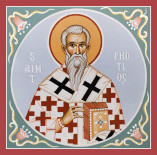 A great light in the Church, he was a
kinsman of the emperor and grandson of the famous Patriarch Tarasios. He was reputed to be
the wisest and most intelligent person in the empire, and was an instructor of many in
Constantinople on subjects that ranged from secular science to the most sublime types of
theology. He was a forceful protector of the Church from the power-seeking of the pope and
other Roman perverters of the Faith. He passed through all the ranks from layman to
patriarch in six days, being made patriarch on the Nativity of Christ in 858. He departed
this life in the Lord in about 895. |
5. Our Holy Fathers Barsanuphius and John.
Great ascetics from Gaza, gifted with insight and wonder-working power, they left us a well-known book of answers to various questions on the spiritual life. They lived in the sixth century.
6. The Holy Martyrs Martha and Mary and their brother Lycarion.
All three were crucified for Christ, then stabbed to death with a lance.
FOR CONSIDERATION
St. Barsanuphius, who spent fifty years shut in his cell forbidding himself the sight of a single man, attained through the grace of God gifts of discernment and clairvoyance. Here are some of the thoughts from his book Answers: ‘Every thought that is not preceded by the silence of humility does not originate in God. All that happens with confusion and bustle is of the devil.’ ‘When you pray, and God is slow to hear you, He does this for your good, to help you learn patience.’ ‘Visible robbers are the servants of invisible robbers in the thoughts.’ ‘The Lord Jesus Christ endured all things and finally ascended onto the holy Cross, which brought about the death of the body and the passions, and a holy and perfect rest.’ ‘The Lord desires you to reverence every man more greatly than yourself.’ When the elder was asked if he would use the services of a paid advocate in a dispute in which the monastery was engaged, he replied: ‘If you buy the advocacy of men, God will not be your advocate (lawyer).’
Daily Scripture Readings taken from The Orthodox New Testament, translated and published by Holy Apostles Convent, Buena Vista, Colorado, copyright © 2000, used with permission, all rights reserved.
Daily Prologue Readings taken from The Prologue of Ochrid, by Bishop Nikolai Velimirovic, translated by Mother Maria, published by Lazarica Press, Birmingham, England, copyright © 1985, all rights reserved. Edited by Dormition Skete.