

Daily Devotional
Sunday, February 18, 2035 (NS), February 5, 2035 (OS)
No Fasting.
| Sunday of the Thirty-Third Week or Sunday of the Publican and the Pharisee Mode Plagal One — Fifth Eothinon |
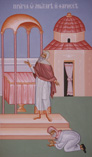
The commemoration of the Afterfeast of the Meeting of the Lord, and the holy Martyr Agatha of Palermo in Sicily, and our father among the saints, Theodosios, Archbishop of Chernigov, the Wonder-worker.
Scripture Readings
Paschalion — Movable Calendar
Sunday of the Thirty-Third Week or Sunday of the Publican and the Pharisee
Mode Plagal One — Fifth Eothinon
Epistle
The Reading is from the Second Epistle of Saint Paul to Saint Timothy [§ 296]. Child Timothy:
3 10Thou hast closely followed my teaching, conduct, purpose, faith, long-suffering, love, patience, 11persecutions, sufferings, such as happened to me in Antioch, in Iconium, in Lystra—what persecutions I endured! And out of them all the Lord delivered me. 12Yes, and all those who wish to live piously in Christ Jesus shall be persecuted. 13But evil men and cheats shall advance to the worse, leading astray and being led astray. 14But thou, keep on abiding in what thou didst learn and wast assured of, knowing from whom thou didst learn, 15and that from a babe thou hast known the sacred writings, which are able to make thee wise in regard to salvation through faith which is in Christ Jesus.
Gospel
The Reading is from the Holy Gospel according to Saint Luke [§ 89]. The Lord said this parable:
18 10“Two men went up into the temple to pray, the one a Pharisee and the other a tax collector. 11“The Pharisee, having assumed a stance, was praying these things to himself, ‘God, I thank Thee that I am not as the rest of men—rapacious, unjust, adulterers, or even as this one, the tax collector. 12“‘I fast twice a week; I tithe all things, as much as I acquire.’ 13“And the tax collector, having stood afar off, was not willing even to lift up his eyes to the heaven, but kept beating upon his breast, saying, ‘God, be gracious to me the sinner.’ 14“I say to you, this one went down to his house having been justified rather than that one; for everyone who exalteth himself shall be humbled, and the one who humbleth himself shall be exalted.”
Menaion — Fixed Calendar
The commemoration of the Afterfeast of the Meeting of the Lord, and the holy Martyr Agatha of Palermo in Sicily, and our father among the saints, Theodosios, Archbishop of Chernigov, the Wonder-worker.
Epistle
For the Hierarch:
The Reading is from the Epistle of Saint Paul to the Hebrews [§ 335]. Brethren:
13 17Be obedient to those who lead you, and keep on submitting, for they are watchful for your souls, as those about to render an account, that they may do this with joy, and not groaning; for this would be unprofitable for you. 18Keep on praying for us; for we trust that we have a good conscience, in all things wishing to conduct ourselves well. 19But I beseech you more abundantly to do this, that I might be restored more quickly to you.
20Now the God of peace Who brought up from the dead our Lord Jesus, the Shepherd of the sheep, the great One, in the blood of an everlasting covenant, 21may He render you perfect in every good work, in order to do His will, doing in you that which is well-pleasing before His face, through Jesus Christ, to Whom be glory to the ages of the ages. Amen.
Gospel
The Reading is from the Holy Gospel according to Saint Luke [§ 24]. At that time:
6 17Jesus stood upon a level place. And there was a crowd of
His disciples, and a great multitude of the people from all of Judæa and Jerusalem and the
seacoast of Tyre and Sidon, who came to hear Him, and to be healed of their diseases—
18even those who were troubled by unclean spirits; and they were cured.
19And all the crowd was seeking to touch Him, for power was coming forth from Him and
healing all. 20And He lifted up His eyes to His disciples, and began to say:
“Blessed are the poor, for yours is the kingdom of God.
21“Blessed are ye who hunger now, for ye shall be
filled.
Blessed are ye who weep now, for ye shall laugh.
22“Blessed are ye whenever men hate you, and whenever they
separate you, and reproach you, and cast out your name as evil, on account of the Son of
Man.
23“Rejoice in that day and leap for joy, for behold, your
reward is great in the heavens.”
Synaxarion Readings
Sunday of the Publican and the Pharisee
O Creator of all above and below, as Thou receivest the thrice-holy hymn from the angels, so also from mankind receive the Triodion. He who lives like a Pharisee is far from the Church, for Christ is received within, O ye humble of heart.
With God on this present day we begin the Triodion, the hymns of which were composed by many of our holy and God-bearing fathers, inspired by the Holy Spirit according to their worthiness. The first of all was the great author St. Cosmas of Maiuma, who composed the three odes (symbolic of the Holy and life-creating Trinity) for the Great and Holy Week of the Passion of our Lord and God and Savior Jesus Christ. After him, others of the fathers, including Saints Theodore and Joseph of the Studite Monastery, following his zealous example, arranged the services of the other weeks of the Holy and Great Forty-day Fast, reserving them at first for the use of the Studite Monastery. Furthermore they composed and arranged hymns, seeking them and collecting them from other books of the fathers. Since, according to the Triodion, Sunday, the celebration of the Resurrection, is the first day of the week as well as the last or eighth day, they prescribed the first ode (canticle) of the canon to be sung on the second day of the week, i.e. Monday. The second ode was prescribed for Tuesday, the third day of the week, the third ode for Wednesday, the fourth ode for Thursday, the fifth ode for Friday, and the sixth and seventh odes for Saturday. The rest, the eighth and ninth odes, are prescribed for every day.
It must be known, however, that although it is called the Triodion, it does have services with other than three-ode canons. It is so named because the majority of the services have three-ode canons, especially during Holy Week. For it was our holy fathers’ idea that through the entire Triodion would be commemorated in a concise form all God’s benefits to us from the beginning, using it as a reminder for all of us that we were created by Him, and were exiled from Paradise through the tasting of the fruit, rejecting the commandment that was given to us for our knowledge, and we were cast out through the envy of the arch villain serpent and enemy, who was made to crawl for his arrogance; that we remained cut off from the benefits of Paradise and were led by the devil; that the Son and Logos of God, having suffered in His mercy, bowing the heavens, descended and made His abode in the Virgin and became man for our sake, showing us through His life the ascent into the heavens, through humility first of all, then by fasting and the rejection of evil, and through His other deeds; that He suffered and rose from the dead and ascended once more into heaven, and He sent down the Holy Spirit upon His holy disciples and apostles, who all proclaimed Him to be the Son of God and the most perfect God. And that once more the divine apostles acted through the grace of the most Holy Spirit and gathered all the saints from the ends of the earth through their preaching, filling the world on high, which was the intention of the Creator from the beginning.
Now the purpose of the Triodion intended by the holy fathers on these three present feasts of the Publican and the Pharisee, the Prodigal Son, and the Second Coming is a kind of preparatory lesson and stimulation to prepare ourselves for the spiritual labors of the Fast, having put aside our usual corrupt habits. First of all they present to us the parable of the Publican and the Pharisee, and they call the week following precursory. For those who desire to go off to do military battle first ascertain the time of the battle from the leaders, so that having cleaned and polished their weapons, and preparing well all their other matters, and having removed all obstacles from their path, they earnestly go forth to their labors, taking the necessary supplies. Often before battle they tell anecdotes and tales and parables to incite their hearts to zeal, driving off idleness, fear, despair, and other unworthy feelings. So the divine fathers herald the coming fast against the armies of demons as a struggle which constrains our souls to cleanse ourselves of the poison accumulated over a long period of time. Not yet possessing those benefits, let us strive to obtain them, and arming ourselves properly, so let us embark on the labors of the Fast.
Now the first weapon among the virtues is repentance and humility. And the adversary of attaining the greatest humility is pride and arrogance. So they place before us first of all this present trustworthy parable from the divine Gospel. It encourages us to shun the desire for the pride and arrogance of the Pharisee and to cultivate the opposite desire of the Publican for humility and repentance. For the greatest and most grievous passion is pride and arrogance, since this is how the devil fell from the heavens before the morning star and was cast into darkness. Because of this Adam, the father of our race, was driven from Paradise through partaking of the fruit. Through this example the holy fathers encourage all not to be proud of their successes, but to always be humble. For the Lord sets Himself against the proud, but He gives grace to the humble. Better a man who has sinned, if he knows that he has sinned and repents, than a man who has not sinned and thinks of himself as righteous. For Christ said, “I say to you that the publican went down to his house justified rather than the Pharisee.” This parable reveals that no one should exalt himself, even though he has done good deeds, but rather should always be humble and pray from his heart to God, for even if he should fall into the most serious sin, salvation is not far off.
Through the prayers of all Thy holy hymnographers, O Christ our God, have mercy on us. Amen.
Translated from Triodion, siest ‘Tripesnets: Triod’ Postnaya, Moscow, 1904, by Robert Parent.
Lives of the Saints (Prologue)
February 18th – Civil Calendar
February 5th – Church Calendar
1. The Holy Martyr Agatha.
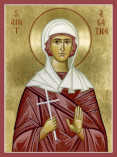 This glorious virgin and martyr for Christ was born in the
Sicilian town of Palermo of noble and prosperous parents. When Emperor Decius launched a
persecution of Christians, St. Agatha was arrested and brought to judgement before Quintian, the
judge. He saw Agatha’s beauty and desired her for his wife. When he suggested this to her,
she replied that she was the bride of Christ and could not be faithless to her Betrothed. The
judge condemned her to cruel torture: Agatha was flogged, mocked, bound to a tree and beaten till
the blood flowed. After that, the judge again urged her to deny Christ and so escape further
torture, to which Christ’s bride replied: ‘These tortures are of great help to me. As
wheat cannot come to the granary until it is cleansed of its chaff, so my soul cannot enter
Paradise unless my body has first been broken by torture.’ Then the torturer ordered that
her breasts be cut off, and that she then be thrown into prison. The holy Apostle Peter appeared
to her in the prison and restored her to physical wholeness and health. She was once again taken
out for torture and again cast back into prison, where she gave her soul to God in the town of
Catania in the year 251. After her death, her torturer, Quintian, set out to appropriate her
lands; but on the way, the horses became maddened under him and his soldiers. They were savaged
on the face, thrown onto the ground and trampled to death. Thus God’s punishment came
swiftly upon him for his ferocious crime against St. Agatha.
2. The Holy Martyr Theodula.
She suffered for Christ in the time of Diocletian, the impious Roman emperor. During her tortures, Theodula brought one of her torturers, Helladius, to his senses and to the Christian Faith. When Helladius openly confessed his faith in Christ, he was beheaded. Theodula showed great courage at her trial, for which the judge considered her witless. To this, she retorted: ‘It is you who are witless, for you forget the one true God and bow down to lifeless stones.’ The judge put her to cruel torture, which Theodula endured with heroism, making her torturers marvel and bringing them to Christ. Among these were two eminent citizens, Makarius and Evagrius. With these two and many others, Theodula was thrown into a red-hot furnace, where they all finished this life with honor and were made worthy of the kingdom of Christ.
3. St. Polyefktos, Patriarch of Constantinople.
For his great mind, his zeal for the Faith and his power of oratory, he was called a second Chrysostom. The Russian Princess Olga came to Constantinople in the time of Patriarch Polyefktos and Emperor Constantine Porphyrogenitus, and was baptized there in 957. The patriarch baptized her, and the emperor stood godfather. St. Polyefktos prophesied: ‘Blessed art thou among Russian women, for thou hast desired the light and cast away darkness; the sons of Russia will bless thee to the last generation.’ From being a simple monk, Polyefktos was raised to the patriarchate in 946, and remained on the patriarchal throne until his death in 970.
FOR CONSIDERATION
The great Abba Ischyrion was asked by his monks: ‘What have we accomplished?’ ‘We have fulfilled the commandments of God,’ replied Ischyrion. ‘And what will those who come after us accomplish?’ ‘They will accomplish what we have accomplished, but only half as much as we.’ ‘And those after them?’ ‘Those in the last days will have no monastic training, but such assaults and temptations will come upon them that they will, through these trials, be revealed in the kingdom of God as greater than us and than our fathers.’
Daily Scripture Readings taken from The Orthodox New Testament, translated and published by Holy Apostles Convent, Buena Vista, Colorado, copyright © 2000, used with permission, all rights reserved.
Daily Prologue Readings taken from The Prologue of Ochrid, by Bishop Nikolai Velimirovic, translated by Mother Maria, published by Lazarica Press, Birmingham, England, copyright © 1985, all rights reserved. Edited by Dormition Skete.