

Daily Devotional
Friday, May 12, 2034 (NS), April 29, 2034 (OS)
Fast Day, but Wine and Olive Oil Allowed.
Friday of the Fifth Week
The commemoration of the holy Apostles of the Seventy, Jason and Sosipater, and their companions (commemorated on Sl. calendar on the 28th of April). The commemoration of the holy Nine Martyrs of Kyzicus, Theognis, Rufus, Antipater, Theostichos, Artemas, Magnos, Theodotos, Thavmasios, and Philemon (commemorated on Gk. calendar on the 28th of April).
Scripture Readings
Paschalion — Movable Calendar
Friday of the Fifth Week
Epistle
The Reading is from the Acts of the Apostles [§ 36]. In those days:
15 5There rose up certain of those from the sect of the Pharisees who believed, saying, “It is necessary to circumcise them, and to command them to keep the law of Moses.”
6And the apostles and the presbyters were gathered together to see about this matter. 7And after much discussion took place, Peter rose up and said to them, “Men, brethren, ye know that from former days God Himself chose among us for the nations to hear by my mouth the word of the Gospel, and to believe. 8“And God, the Knower of hearts, bore witness to them, giving them the Holy Spirit, even as also to us; 9“and He made no distinction between both us and them, having purified their hearts by faith. 10“Now then why tempt ye God by putting a yoke upon the neck of the disciples which neither our fathers nor we were able to bear? 11“But through the grace of the Lord Jesus Christ, we believe we are to be saved in like manner as they.” 12And all the multitude became silent, and were listening to Barnabas and Paul relating how many signs and wonders God wrought among the nations through them. 13And after they became silent, Iakovos answered, saying, “Men, brethren, hear me. 14“Symeon related how God first visited to take from the nations a people for His name. 15“And to this agree the words of the prophets, even as it hath been written: 16“‘“After these things I will return, and will build again the tabernacle of David which is fallen, and I will build again the things which have been dug down, and I will set it up [cf. Amos 9:11], 17“‘“so that the residue of men might seek after the Lord, even all the nations upon whom My name hath been called upon them,” saith the Lord Who doeth all these things [cf. Amos 9:12].’ 18“Known to God are all His works from eternity. 19“Wherefore I judge that we are not to trouble those who from the nations are turning to God, 20“but that we write to them to abstain from the pollutions of the idols, and from fornication, and from what is strangled, and from blood. 21“For Moses from generations of old hath in every city those proclaiming him, since he is read every sabbath day.” 22Then it seemed good to the apostles and to the presbyters, with the whole Church, to send chosen men from among them to Antioch with Paul and Barnabas, namely, Judas surnamed Barsavas, and Silas, leading men among the brethren, 23having written by their hand thus: “The apostles and the presbyters and the brethren to those brethren who are of the nations in Antioch and Syria and Cilicia: Greetings. 24“Whereas we have heard that certain from among us who went out troubled you with words, upsetting your souls, saying, ‘Be circumcised and keep the law’—to whom we gave no such command— 25“it seemed good to us, having come to be of one accord, to send chosen men to you with our beloved Barnabas and Paul, 26“men who have handed over their lives for the name of our Lord Jesus Christ. 27“We have sent forth therefore Judas and Silas, who shall themselves also relate verbally the same things. 28“For it seemed good to the Holy Spirit, and to us, to lay upon you no further burden than these necessary things: 29“that ye abstain from sacrifices to idols, and from blood, and from what is strangled, and from fornication; from which, if ye keep yourselves, ye shall do well. Fare-well.”
30So when they were dismissed, they went to Antioch; and after they gathered together the multitude, they delivered the epistle. 31And having read it, they rejoiced for the consolation. 32Both Judas and Silas, being themselves also prophets, by much discourse exhorted the brethren and confirmed them. 33And after they continued for a time, they were sent forth in peace from the brethren to the apostles. 34But it seemed good to Silas to abide there.
Gospel
The Reading is from the Holy Gospel according to Saint John [§ 37]. The Lord said to those Jews who had come to Him:
10 17“On this account My Father loveth Me, because I lay down My soul, that I might take it again. 18“No one taketh it from Me, but I lay it down of Myself. I have authority to lay it down, and I have authority to take it again. This commandment I received from My Father.” 19A division therefore again arose among the Jews on account of these words. 20And many of them were saying, “He hath a demon and is mad; why hear ye Him?” 21Others were saying, “These are not the words of one who is possessed by a demon. A demon is not able to open the eyes of the blind, is he?”
22And it came to be the feast of the dedication in Jerusalem, and it was winter. 23And Jesus was walking about in the temple in Solomon’s porch. 24Then the Jews came round about Him and were saying to Him, “Until when dost Thou lift up our soul? If Thou art the Christ, tell us openly.” 25Jesus answered them, “I told you, and ye believe not. The works which I do in the name of My Father, these bear witness concerning Me. 26“But ye believe not; for ye are not of My sheep, even as I said to you. 27“The sheep, those that are Mine, hear My voice, and I know them, and they follow Me. 28“And I give them eternal life.”
Menaion — Fixed Calendar
The commemoration of the holy Apostles of the Seventy, Jason and Sosipater, and their companions (commemorated on Sl. calendar on the 28th of April). The commemoration of the holy Nine Martyrs of Kyzicus, Theognis, Rufus, Antipater, Theostichos, Artemas, Magnos, Theodotos, Thavmasios, and Philemon (commemorated on Gk. calendar on the 28th of April).
No readings given.
Lives of the Saints (Prologue)
May 12th – Civil Calendar
April 29th – Church Calendar
1. St. Basil of Ostrog.
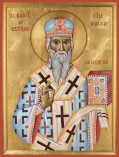 Basil was born in Popovo Selo in Herzegovina,
of simple and devout parents. From his youth he was filled with love for the Church of God, and
when he grew up he went to the monastery of the Dormition of the Mother of God at Trebinje, and
became a monk. As such, he quickly became known for his serious and rare ascetic life, for he
loaded himself with ascetic practices, each harder than the last. He was later chosen and
consecrated as Bishop of Zahum and Skenderia, much against his will. As a bishop, he first lived
in the monastery at Tvrdoš, whence, as a good pastor, he confirmed his flock in the
Orthodox Faith, keeping it from the cruelty of the Turks and the guile of the Latins. But when he
was too pressed-upon by his enemies, and when Tvrdoš* was destroyed by the Turks, Basil
moved to Ostrog, where he lived in strict asceticism, protecting his flock by his unceasing and
loving prayers. He went peacefully to the Lord in the 16th century, leaving his whole and healing
body, incorrupt and wonder-working, to the present day. The miracles at the grave of St. Basil
are without number. Both Christians and Moslems hasten to his relics and find healing of the
gravest sicknesses and sufferings. A great national gathering takes place there every year at
Pentecost.
* Author’s Note: A new church, on the ruins of the old Tvrdoš, has been built in our day by Nikolai Runjevac, from the village of Poljica near Trebinje—a wonderful foundation in the sight of God and His people.
2. The Nine Holy Martyrs of Kyzikos.
These nine courageous martyrs, burning with love for Christ, refused to offer sacrifice to idols or to deny Christ the Lord, for which they were harshly tortured and finally beheaded. In the time of the Emperor Constantine, a church was built in Kyzikos in honor of these martyrs, and their incorrupt relics were laid there. Their names were: Theognes, Roufos, Antipater, Theostichos, Artemas, Magnos, Theodotos, Thaumasios and Philemon. They all scorned the temporal for the sake of the eternal, and the corruptible for the incorruptible. Therefore the Lord brought them into His eternal family and crowned them with wreaths of unfading glory. They suffered with honor and were glorified in the 3rd century.
3. Our Holy Father Memnon the Wonder-worker.
From his youth, Memnon gave himself to fasting and prayer, and purified himself so greatly that he became a dwelling-place of the Holy Spirit. He cured incurable illnesses and worked many other miracles. He appeared during storms at sea and saved boats from destruction. He entered peacefully into rest in the Lord in the second century, and went to His heavenly courts.
FOR CONSIDERATION
Nothing can be hidden from the omniscient God. To Him is known at every moment what is being done on earth, both in the external and in the internal, spiritual world. Not a single intention, not a single wish, not a single thought of his can a man hide from God. How can that which cannot be hidden from holy men be hidden from God? The great Tsar Ivan the Formidable came one day to church. In the church, Blessed Basil the Fool for Christ was at prayer. The tsar was indeed physically present in the church, but his mind was on Sparrow Hill, not far from Moscow, on which a palace had been begun. Throughout the service, Ivan was thinking of how to continue and complete his palace on that hill. After the service, the tsar saw Basil, and asked him where he had been. ‘In church,’ replied Basil, and immediately asked the tsar: ‘And where were you, my tsar?’ ‘I, too, have been in church,’ replied the tsar. But to this, the discerning saint made answer: ‘You are not speaking the truth, my little Ivan, for I saw you in thought walking on Sparrow Hill and building a palace there!’
Daily Scripture Readings taken from The Orthodox New Testament, translated and published by Holy Apostles Convent, Buena Vista, Colorado, copyright © 2000, used with permission, all rights reserved.
Daily Prologue Readings taken from The Prologue of Ochrid, by Bishop Nikolai Velimirovic, translated by Mother Maria, published by Lazarica Press, Birmingham, England, copyright © 1985, all rights reserved. Edited by Dormition Skete.