

Daily Devotional
Thursday, May 11, 2034 (NS), April 28, 2034 (OS)
No Fasting.
Thursday of the Fifth Week
The commemoration of the holy Nine Martyrs of Kyzicus, Theognis, Rufus, Antipater, Theostichos, Artemas, Magnos, Theodotos, Thavmasios, and Philemon (commemorated on Sl. calendar on the 29th of April). The commemoration of the holy Apostles of the Seventy, Jason and Sosipater, and their companions (commemorated on Gk. calendar on the 29th of April). The commemoration of the holy Martyrs Maximos, Quintillian, and Dada at Dorostolum (commemorated on Gk. calendar on the 13th of April).
Scripture Readings
Paschalion — Movable Calendar
Thursday of the Fifth Week
Epistle
The Reading is from the Acts of the Apostles [§ 35]. In those days:
For Gk. usage, Acts 14:20-15:5; for Sl. usage, Acts 14:20-27.
14 20Paul went away with Barnabas to Derbe. 21And having preached the Gospel to that city and having made a considerable number of disciples, they returned to Lystra, and Iconium, and Antioch, 22adding strength to the souls of the disciples, exhorting them to continue in the faith, and saying that “through many temptations it is necessary for us to enter into the kingdom of God.” 23And after they ordained presbyters for them in every church, and prayed with fasting, they committed them to the Lord in Whom they had believed. 24And after they passed through Pisidia, they came to Pamphylia. 25And having spoken the word in Perga, they came down to Attaleia. 26And from that place they sailed off to Antioch, from which place they had been commended to the grace of God for the work which they fulfilled. 27And after they came and gathered together the Church, they reported how much God did with them, and that He opened to the nations a door of faith. 28And they were spending there not a little time with the disciples.
15 1And certain men, having come down from Judæa, were teaching the brethren, “Except ye be circumcised after the custom of Moses, ye are not able to be saved.” 2Then after there arose no little disputation for Paul and Barnabas with them, they appointed Paul and Barnabas and certain others from among them to go up to Jerusalem, to the apostles and presbyters, about this question. 3They indeed therefore were sent forth under escort by the Church and were passing through Phœnicia and Samaria, telling in detail the conversion of the nations; and they were causing great joy to all the brethren. 4And having come into Jerusalem, they were received by the Church and the apostles and the presbyters, and they reported how much God did with them.
Gospel
The Reading is from the Holy Gospel according to Saint John [§ 35]. The Lord said to those Jews who had come to Him:
9 39“For judgment I came into this world, in order that they who see not may see; and they who see might become blind.” 40And those of the Pharisees who were with Him heard these things, and said to Him, “We are not also blind, are we?” 41Jesus said to them, “If ye were blind, ye should not have sin; but now ye say, ‘We see’; therefore your sin remaineth.
10 1“Verily, verily, I say to you, the one who entereth not by the door into the fold of the sheep, but goeth up from another place, that one is a thief and a robber. 2“But the one who entereth by the door is a shepherd of the sheep. 3“To this one the doorkeeper openeth, and the sheep hear his voice; and he calleth his own sheep by name and leadeth them out. 4“And whenever he should put forth his own sheep, he goeth before them; and the sheep follow him, because they know his voice. 5“But a stranger in no wise will they follow, but will flee from him, because they know not the voice of strangers.” 6This parable Jesus spoke to them; but they understood not what it was which He spoke to them. 7Then said Jesus to them again, “Verily, verily, I say to you that I am the door of the sheep. 8“All, as many as came before Me, are thieves and robbers; but the sheep heard them not. 9“I am the door; by Me if anyone should enter, he shall be saved, and shall go in and go out and find pasture.”
Menaion — Fixed Calendar
The commemoration of the holy Nine Martyrs of Kyzicus, Theognis, Rufus, Antipater, Theostichos, Artemas, Magnos, Theodotos, Thavmasios, and Philemon (commemorated on Sl. calendar on the 29th of April). The commemoration of the holy Apostles of the Seventy, Jason and Sosipater, and their companions (commemorated on Gk. calendar on the 29th of April). The commemoration of the holy Martyrs Maximos, Quintillian, and Dada at Dorostolum (commemorated on Gk. calendar on the 13th of April).
No readings given.
Lives of the Saints (Prologue)
May 11th – Civil Calendar
April 28th – Church Calendar
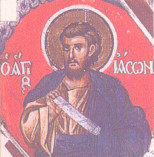
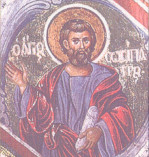
1. The Holy Apostles Jason and Sosipater, and the Virgin Kerkyra.
|
The first two were among the Seventy Apostles, and the last was the daughter of the king of the island of Corfu. The Apostle Paul mentions Jason and Sosipater (Rom. 16:21), and calls them his kinsmen. Jason was born in Tarsus, as was the Apostle Paul himself, and Sosipater in Achaea. The first was nominated by the apostles as Bishop of Tarsus and the second as Bishop of Iconium. Travelling and preaching the Gospel, these two apostles came to the island of Corfu, where they succeeded in building a church dedicated to St. Stephen the Protomartyr and in bringing some unbelievers to the Church. The king of the island threw them into prison, where there were seven robbers already imprisoned: Satorninus, Jakischolus, Faustian, Januarius, Marsalus, Evphrasius and Mamminus. The apostles brought all seven of them to the Christian Faith, making wolves into lambs. The king commanded that these seven be put to death in boiling pitch, and they thus received the wreath of martyrdom. Seeking to disgrace Jason and Sosipater, the king had them dragged through the streets by a horse at a speed calculated to be slow enough to bruise them without killing them. When the king’s daughter, Kerkyra, saw this, she looked upon the wretchedness of her father with disdain, and discovering the reason for it, she visited them in the prison, where she was converted. She gave all her jewels away to the poor and proclaimed herself a Christian to her father. The king was filled with wrath against his daughter and shut her up in a separate prison. Then, failing to turn her from Christ, he ordered that the prison be burned down. The prison burned to the ground, but the maiden remained alive. Seeing this wonder, many of the people were baptized. The furious king ordered that his daughter be bound to a tree and killed with arrows. Those who had come to believe in Christ fled from the terrible king to a nearby island and hid themselves. The king set off in a boat to arrest them, but his boat overturned in the sea and thus the unrighteous perished, as Pharaoh aforetime. The succeeding king, Donatios, continued in the persecution. He ordered Sosipater to be put to death. It was presumed that Jason would follow his comrade in death, but the king decided to question the surviving partner first. A gnawing sense of guilt precipitated the meeting of the two, at which Jason succeeded in converting Donatios to the Christian Faith. Not long after this, the twelve-year-old daughter of Donatios was stricken with a fatal illness, but was cured when Jason knelt in prayer on her behalf. Jason continued to work for our Savior until his death at the age of sixty on April 28th, the day on which Sosipater had died for Christ. |
|
2. The Holy Martyrs Maximus, Dada and Quintillian.
Suffering in the time of Diocletian, they were condemned and tortured by the commander Tarquinius. After imprisonment and torture, they were beheaded.
3. The Holy Martyr Tibald.
A Slav from Pannonia, he was terribly tortured for the Faith in the time of Diocletian, and suffered in Tsibal.
FOR CONSIDERATION
The mystery of our salvation is fulfilled in God’s appearing among men in human flesh. Meliton of Sardis writes: ‘The works of Christ after His Baptism showed and demonstrated to the world that His divinity is hidden within His flesh. Being God, He was also perfect man. He revealed His two natures to us: His divinity by His miracles, performed in the three years after His Baptism, and His humanity through those thirty years when bodily nature hid the signs of His divinity, although He was truly the pre-eternal God.’ The means of uniting the divinity with the humanity is difficult to comprehend, but the event of the appearing of God among men is perfectly comprehensible from the point of view of God’s love for man. As an event, the world is not more comprehensible—it can be said to be even less comprehensible than the event of events, the incarnation of God.
Daily Scripture Readings taken from The Orthodox New Testament, translated and published by Holy Apostles Convent, Buena Vista, Colorado, copyright © 2000, used with permission, all rights reserved.
Daily Prologue Readings taken from The Prologue of Ochrid, by Bishop Nikolai Velimirovic, translated by Mother Maria, published by Lazarica Press, Birmingham, England, copyright © 1985, all rights reserved. Edited by Dormition Skete.