

Daily Devotional
Saturday, April 22, 2034 (NS), April 9, 2034 (OS)
No Fasting.
Saturday of the Second Week
The commemoration of the Martyr Efpsychios of Cæsarea in Cappadocia.
Scripture Readings
Paschalion — Movable Calendar
Saturday of the Second Week
Epistle
The Reading is from the Acts of the Apostles [§ 15]. In those days:
5 21The apostles, having heard that, entered into the temple during the early morning and began teaching. But the high priest came and those with him, and they called together the sanhedrin and all the council of elders of the sons of Israel, and sent off to the prison to have them brought. 22But after the officers came and found them not in the prison, they returned and reported, 23saying, “Indeed we found the prison shut with all security, and the guards standing outside before the doors; but after we opened them, we found no one inside.” 24Now when the priest and the captain of the temple-guard and the chief priests heard these words, they were quite at a loss concerning them and what this would become. 25But a certain one came and reported to them, saying, “Behold, the men whom ye yourselves put in the prison are standing in the temple and teaching the people.” 26Then the captain went with the officers and brought them without violence, for they were fearing the people, lest they should be stoned. 27And after they brought them, they stood them in the sanhedrin. And the high priest questioned them, 28saying, “We did charge you by a command not to teach on this name, did we not? And behold, ye have made Jerusalem full of your teaching, and intend to bring the blood of this Man upon us.” 29But Peter and the apostles answered and said, “It is needful to obey God rather than men. 30“The God of our fathers raised up Jesus, Whom ye yourselves laid hands upon and hanged on a tree. 31“This One did God exalt with His right hand to be a Prince and Savior, to give repentance to Israel and forgiveness of sins. 32“And we are His witnesses of these words, and also the Holy Spirit Whom God gave to those who obey Him.” 33Now after they heard that, their hearts were sawn asunder, and they were taking counsel to kill him.
Gospel
The Reading is from the Holy Gospel according to Saint John [§ 19]. At that time:
6 14The people, having seen what sign Jesus did, began to say, “This is truly the Prophet Who cometh into the world.” 15Then Jesus, having known that they were about to come and seize Him in order that they might make Him king, withdrew again to the mountain Himself alone.
16And when it became evening, His disciples went down to the sea; 17and having embarked into the ship, they were going across the sea to Capernaum. And already it had become dark, and Jesus had not come to them. 18And the sea was stirred up by a great wind blowing. 19Then after they had rowed about twenty-five or thirty stadia, they see Jesus walking on the sea and drawing near to the ship; and they became afraid. 20But He saith to them, “I am; cease being afraid.” 21Then they were willing to receive Him into the ship; and straightway the ship came to be at the land to which they were going.
22On the morrow, the crowd which stood on the other side of the sea saw that there was no other boat there, except that one into which His disciples entered, and that Jesus did not enter together with His disciples into the little boat, but that His disciples went away alone— 23but there came little boats from Tiberias, near the place where they ate the bread after the Lord gave thanks. 24When the crowd therefore saw that Jesus was not there, nor His disciples, they themselves also embarked into the ships and came to Capernaum, seeking Jesus. 25And after they found Him on the other side of the sea, they said to Him, “Rabbi, when didst Thou arrive here?” 26Jesus answered them and said, “Verily, verily, I say to you, ye seek Me, not because ye saw signs, but because ye ate of the loaves and were filled. 27“Cease working for the meat which perisheth, but for the food which abideth to everlasting life, which the Son of Man shall give to you; for this One did God the Father seal.”
Menaion — Fixed Calendar
The commemoration of the Martyr Efpsychios of Cæsarea in Cappadocia.
No readings given.
Lives of the Saints (Prologue)
April 22nd – Civil Calendar
April 9th – Church Calendar
1. The Holy Martyr Efpsychios (Eupsychius).
He was of gentle birth and was reared in faith and devotion. In the time of the Emperor Julian the Apostate, when St. Basil the Great was governing the Church in Caesarea, Efpsychios married a girl of good family. But he was not given even one day to live in wedlock, for, on his wedding day itself, there was a pagan festival with sacrifices to the idol of Fortune. Efpsychios went out with some others and smashed all the idols in the temple, then pulled down the temple itself. Julian was furious, and commanded that the culprits be beheaded, that many Christians be taken into the army, that an enormous levy be imposed on Christians, the proceeds of which were to be used to rebuild the Temple of Fortune, and that the town cease to be called Caesarea (as it had been named by Claudius Caesar), and revert to its former name, Maza. Efpsychios was first bound to a tree and cruelly tortured, and then beheaded, in 362. A little after this time, the wicked Emperor Julian visited that town on his way to Persia, against which he was waging war. St. Basil went to meet him, bearing three barley loaves as a sign of honor and welcome. The emperor ordered that, as a return gift, the saint be given a fistful of hay. Basil said to the Emperor: ‘You ridicule us now, O king; we bring you bread, by which we are fed, and you give us miserable food which you, with all your power, are not able to turn into nourishment for men!’ To this the emperor replied: ‘You can be sure that I will feed you with this hay when I return from Persia!’ But the wicked apostate did not return alive from Persia, but perished there by a fitting and unnatural death.
2. Our Holy Father Vadim the Martyr.
In the time of the Persian King Sapor, Vadim, abbot of a monastery and a man famed for his grace, was thrown into prison with seven of his disciples. With him in prison was a Prince Nirsan, also a Christian. Every day they were taken out and flogged. Prince Nirsan was afraid, and promised to forsake his faith and worship the sun. This was pleasing to Sapor, and he promised Nirsan all the possessions of Vadim’s monastery if he would, with his own hands, behead Vadim. Nirsan agreed to this. With trembling hands, terrified by the dignity of St. Vadim’s face, he let the sword fall several times on the holy man’s neck, barely succeeding in beheading him. But, very quickly after that, he fell into despair and ran himself through with his own sword; thus receiving at his own hands the punishment for slaying a righteous man. St. Vadim suffered in 376.
3. New-martyrs Raphael, Nicholas, and Irene of Mytilene
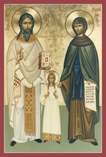 On the island of Mytilene (Lesbos) in the Aegean Sea,
there was an ancient monastery in the fifteenth century. Its archimandrite was Father Raphael,
and there also lived there the Hierodeacon Nicholas and other monks. During their lifetime, the
city of Constantinople fell to the Turks (in 1453), and the Muslims continued their incursions
into the surrounding areas, and soon they also wrested control of Mytilene away from the
Genovese. In 1463, on this island there was an uprising, and Turkish reprisals against the
Christian islanders were brutal. The mayor of the village of Thermi, Basil, together with his
wife and daughter, and also the teacher Theodore, ran up to the monastery to warn the fathers of
the danger, but were instantly arrested there by a company of Turks. It was Great Thursday, and
the Muslims subjected the inhabitants of the monastery to torments for several days. In order to
force the mayor to reveal the whereabouts of the other rebels, the Turks tortured his
twelve-year-old daughter, Irene, before her parents’ eyes; finally she was burned alive in a
large earthenware jar. Then they slaughtered her parents and beheaded the teacher. Finally, on
the evening of Bright Tuesday, they took Saint Raphael and, tying him to a tree by his hair,
severed his head from his body by cutting through his jaws with a saw. Saint Nicholas, who was
tied to a tree and forced to watch, died of a heart attack when he witnessed this horrific
execution of his beloved elder. The Turks threw the bodies of the saints into the spring, set
fire to the monastery, and left. After many centuries, the locals only had a vague memory of what
had happened at that ruined monastery. But God, Who never forgets the exploits of His saints,
deigned to reveal those holy martyrs in modern times, and when some builders happened to dig up
some of the sacred relics in 1959, the martyrs appeared to many different islanders in visions
for the next several years in order to reveal the location of their relics and tell the story of
what had happened to them. These miraculous revelations sent by the Church Triumphant are a great
consolation to the Orthodox faithful of the last times, manifesting a living connection between
the Faith we hold today and the Faith of those who have gone before.
FOR CONSIDERATION
It is said of Pericles that he was a man of almost perfect human form, except that his head was rather too long and narrow-like, so that he invited ironic smiles whenever he appeared bare-headed. To conceal this shortcoming of this great man of his people, Greek sculptors always portrayed him wearing a helmet. If pagans thus strove to conceal the shortcomings of their fellows, how much more should we Christians do so! ‘In honor preferring one another’ (Rom. 12:10), the apostle commands all who follow Christ. How can we say that we follow Him in meekness and purity if we poison the air every day with our talk of others’ sins and weaknesses? To conceal your own virtues and the shortcomings of others—in that lies the greatest spiritual wisdom.
Daily Scripture Readings taken from The Orthodox New Testament, translated and published by Holy Apostles Convent, Buena Vista, Colorado, copyright © 2000, used with permission, all rights reserved.
Daily Prologue Readings taken from The Prologue of Ochrid, by Bishop Nikolai Velimirovic, translated by Mother Maria, published by Lazarica Press, Birmingham, England, copyright © 1985, all rights reserved. Edited by Dormition Skete.