

Daily Devotional
Friday, April 21, 2034 (NS), April 8, 2034 (OS)
Fast Day, but Wine and Olive Oil Allowed.
Friday of the Second Week
The commemoration of the holy Apostles Herodion, Agavos, Rufus, Phlegon, Asyncritos, and Hermes of the Seventy, and those with them.
Scripture Readings
Paschalion — Movable Calendar
Friday of the Second Week
Epistle
The Reading is from the Acts of the Apostles [§ 13]. In those days:
5 1A certain man, by name Ananias, with Sapphire his wife, sold a property, 2and appropriated for themselves part of the price, his wife also being privy to it. And he brought a certain part, and laid it at the feet of the apostles. 3But Peter said, “Ananias, why did Satan fill thy heart for thee to deceive the Holy Spirit, and to appropriate part of the price of the land? 4“While it remained, it did remain thine own, did it not? And after it was sold, was it not in thine own authority? Why didst thou put this thing in thy heart? Thou didst not lie to men, but to God.” 5And Ananias, hearing these words, fell down and expired. And great fear came to be upon all who heard these things. 6And the younger men rose up and wrapped him round, and carried him out, and buried him. 7And there came to pass an interval of about three hours, and his wife, who knew not what had happened, entered. 8And Peter began to speak to her, “Tell me whether ye yourselves sold the land for so much?” And she said, “Yes, for so much.” 9And Peter said to her, “Why was it agreed together by you to tempt the Spirit of the Lord? Behold, the feet of those who buried thy husband are at the door, and they shall carry thee out.” 10And immediately she fell down at his feet and expired. And the young men entered and found her dead. And they carried her out and buried her by her husband. 11And great fear came to be upon the whole church and upon all those who heard these things.
Gospel
The Reading is from the Holy Gospel according to Saint John [§ 17]. The Lord said to the Jews having come to Him:
5 30“I am not able to do anything of Myself. Even as I hear, I judge; and My judgment is just, because I seek not Mine own will, but the will of the One Who sent Me, the Father. 31“If I bear witness concerning Myself, My witness is not true. 32“It is Another Who beareth witness concerning Me, and I know that the testimony which He beareth witness to concerning Me is true. 33“Ye have sent away to John, and he hath borne witness to the truth. 34“But I receive not testimony from man. But I say these things that ye might be saved. 35“That one was the lamp that burneth and shineth, and ye became willing to rejoice for an hour in his light. 36“But I have the testimony greater than that of John; for the works which the Father gave to Me in order that I should finish them, the very works which I do, bear witness concerning Me that the Father hath sent Me forth. 37“And the Father Who sent Me, Himself hath borne witness concerning Me. Ye have neither heard His voice at any time, nor have seen His form. 38“And ye have not His word abiding in you, for He Whom that One sent forth, this One ye believe not. 39“Keep on searching the Scriptures, for in them ye think to have eternal life; and these are they which testify concerning Me. 40“And yet ye are not willing to come to Me in order that ye may have life. 41“I receive not glory from man. 42“But I know you, that ye have not the love of God in yourselves. 43“I have come in the name of My Father, and ye receive Me not; if another should come in his own name, that one ye will receive. 44“How are ye able to believe, who receive glory from one another, and seek not the glory which is from the only God? 45“Cease thinking that I will accuse you to the Father; there is one who accuseth you—Moses, in whom ye have hoped. 46“For if ye had believed Moses, ye would have believed Me; for concerning Me that one wrote. 47“But if ye believe not the writings of that one, how shall ye believe My words?”
6 1After these things Jesus went away across the Sea of Galilee, which is the Sea of Tiberias. 2And a great crowd was following Him, because they had been seeing the signs which He brought about upon those who were sick.
Menaion — Fixed Calendar
The commemoration of the holy Apostles Herodion, Agavos, Rufus, Phlegon, Asyncritos, and Hermes of the Seventy, and those with them.
No readings given.
Lives of the Saints (Prologue)
April 21st – Civil Calendar
April 8th – Church Calendar
1. The Holy Apostles Herodion, Agabus, Rufus, Asyncritus, Phlegon and Hermas.
They were all among the Seventy, and are all mentioned by St. Paul in his Epistles. Herodion was a kinsman of Paul’s: ‘Salute Herodion my kinsman,’ he writes to the Romans (16:11). Herodion suffered greatly at the hands of the Jews as Bishop of Neoparthia; he was beaten about the head, stoned on the mouth and stabbed in the legs. When they had left him for dead, St. Herodion arose and continued to serve the apostles. He helped the Apostle Peter in Rome, and was beheaded along with many other Christians on the same day that St. Peter was crucified.
St. Agabus had a spirit of prophecy. Two of his prophecies are recorded in the Acts of the Apostles. First, he prophesied a great famine throughout the world, which came to pass in the time of Claudius Caesar (Acts 11:28). The second was when he met the Apostle Paul in Caesarea. Paul was on his way to Jerusalem, and Agabus took St. Paul’s girdle and bound himself hand and foot, saying: ‘Thus saith the Holy Spirit: so shall the Jews at Jerusalem bind the man that owneth this girdle’ (21:11).
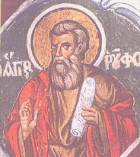 St. Rufus was Bishop of Thebes in Greece. The Apostle Paul
mentions him also: ‘Salute Rufus, chosen in the Lord’ (Rom. 16:13). |
St. Asyncritus (Rom. 16:14) was Bishop of Hyrcania in Asia.
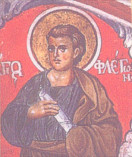 St. Phlegon, who is mentioned in the same place as St.
Rufus, was bishop in the Thracian city of Marathon. |
St. Hermas, mentioned with the others, was bishop in Dalmatia.
All these, with bee-like industry, spread the Gospel, suffering greatly for the love of Christ. They all went to the eternal kingdom of their beloved Christ.
2. St. Niphon, Bishop of Novgorod.
He was adorned with zeal in the building and repairing of churches and with great courage in opposing tyrannical princes. Thirteen days before his death, St. Theodosius appeared to him and predicted his imminent departure to the other world. He entered into rest in 1156.
3. St. Celestine, Bishop of Rome.
A great zealot for the Orthodox Faith, he wrote an epistle against the Nestorian heresy at the time of the Third Ecumenical Council. He entered peacefully into rest in 432.
FOR CONSIDERATION
There is a heroism that is more than heroism, and an asceticism that is more than asceticism. St. Epiphanios of Cyprus once invited Hilarion the Great to lunch, and to show even greater honor to his guest, brought baked chicken to the table and offered it to him. Hilarion said to him: ‘Please excuse me; from the time I became a monk I have eaten nothing slaughtered.’—to which Epiphanios retorted: ‘And I, since becoming a monk, have never lain down on my bed without forgiving all my enemies!’ Hilarion exclaimed in wonder: ‘Yours, holy bishop, is a greater virtue than mine.’ This is an important teaching for us all. Fasting is a thing of primary importance, but forgiveness of insults is greater. A man trains himself by fasting for greatness of soul, and shows this greatness of soul by forgiveness. The latter surpasses the former, but is not attained without the former.
Daily Scripture Readings taken from The Orthodox New Testament, translated and published by Holy Apostles Convent, Buena Vista, Colorado, copyright © 2000, used with permission, all rights reserved.
Daily Prologue Readings taken from The Prologue of Ochrid, by Bishop Nikolai Velimirovic, translated by Mother Maria, published by Lazarica Press, Birmingham, England, copyright © 1985, all rights reserved. Edited by Dormition Skete.