

Daily Devotional
Wednesday, April 12, 2034 (NS), March 30, 2034 (OS)
No Fasting.
Bright Week - No Fasting All Week
Wednesday of the Renewal Week
The commemoration of our venerable Father John, the author of The Ladder, and the holy Apostles Sosthenes, Apollos, Kephas, Cæsar, and Epaphroditos of the Seventy, and our holy father among the saints, Sophronios the Wonder-worker, Bishop of Irkutsk.
Scripture Readings
Paschalion — Movable Calendar
Wednesday of the Renewal Week
Epistle
The Reading is from the Acts of the Apostles [§ 5]. In those days:
Gk. usage, Acts 2:22-38; Sl. usage, Acts 2:22-36.
2 22Peter spoke to the people. “Men, Israelites, hear these words: Jesus the Nazaræan, a Man from God, Who hath been shown forth to you by works of power and wonders and signs, which God did by Him in your midst, even as ye yourselves know— 23“this One, given up by the determinate counsel and foreknowledge of God—ye took and affixed to the Cross by lawless hands and did slay, 24“Whom God raised up, having loosed the throes of death, inasmuch as it was not possible for Him to be held by it. 25“For David saith in regard to Him, ‘I was foreseeing the Lord before my face continually, because He is on my right, that I should not be shaken [Ps. 15(16):8]. 26“‘Therefore my heart was gladdened, and my tongue exulted; moreover my flesh also shall rest upon hope [Ps. 15(16):9], 27“‘for Thou wilt not leave behind my soul in Hades, nor wilt Thou give Thy Holy One to see corruption [Ps. 15(16):10]. 28“‘Thou madest known to me the paths of life; Thou shalt fill me full with good cheer with Thy countenance [Ps. 15(16):11].’ 29“Men, brethren, it is allowed to speak with freedom of speech to you concerning the Patriarch David, that he both died and was buried, and his sepulcher is among us until this day. 30“Therefore being a prophet—and knowing that God swore with an oath to him that from the fruit of his loins, according to his flesh, He would raise up the Christ to sit upon his throne— 31“he foresaw and spoke concerning the resurrection of the Christ, that His soul was not left behind in Hades, nor did His flesh see corruption. 32“This Jesus did God raise up, of Whom we are all witnesses. 33“Therefore having been exalted to the right of God, and having received from the Father the promise of the Holy Spirit, He poured out this which ye now see and hear. 34“For David did not ascend into the heavens, but he saith himself, ‘The Lord said to my Lord, “Sit Thou on My right, 35“‘“until I should place Thine enemies as a footstool of Thy feet [Ps. 109(110):1].”’ 36“Assuredly therefore, let all the house of Israel know that God made Him, this same Jesus Whom ye crucified, both Lord and Christ.”
Gospel
The Reading is from the Holy Gospel according to Saint John [§ 4]. At that time:
1 35John was standing, and two of his disciples. 36And having looked at Jesus walking, he saith, “Behold, the Lamb of God!” 37And the two disciples heard Him speaking, and they followed Jesus. 38And Jesus turned, and beheld them following, and saith to them, “What seek ye?” And they said to Him, “Rabbi” (which is to say, being interpreted, Teacher), “where art Thou staying?” 39He said to them, “Come and see.” Then they went and saw where He was staying. And they stayed with Him that day; and it was about the tenth hour. 40Andrew, the brother of Simon Peter, was one of the two who heard this from John, and followed Him. 41This same one first findeth his own brother Simon, and saith to him, “We have found the Messiah” (which is, being interpreted, the Christ), 42and he led him to Jesus. And having looked at him, Jesus said, “Thou art Simon, the son of Jonas. Thou shalt be called Kephas” (which is interpreted, a stone).
43On the morrow Jesus intended to go forth into Galilee; and He findeth Philip, and saith to him, “Follow thou Me.” 44Now Philip was from Bethsaida, of the city of Andrew and Peter. 45Philip findeth Nathanael, and saith to him, “We have found the One of Whom Moses in the law, and the prophets, wrote—Jesus the son of Joseph, Who is from Nazareth.” 46And Nathanael said to him, “Out of Nazareth can there be any good thing?” Philip saith to him, “Come and see.” 47Jesus saw Nathanael coming toward Him, and saith concerning him, “Behold, truly an Israelite in whom is no guile.” 48Nathanael saith to Him, “From what place knowest Thou me?” Jesus answered and said to him, “Before Philip called thee, when thou wast under the fig tree, I saw thee.” 49Nathanael answered, and saith to Him, “Rabbi, Thou art the Son of God; Thou art the King of Israel.” 50Jesus answered and said to him, “Because I said to thee, ‘I saw thee underneath the fig tree,’ believest thou? Thou shalt see greater things than these.” 51And He saith to him, “Verily, verily, I say to thee, henceforth ye shall see the heaven having been opened, and the angels of God ascending and descending upon the Son of Man.”
Menaion — Fixed Calendar
The commemoration of our venerable Father John, the author of The Ladder, and the holy Apostles Sosthenes, Apollos, Kephas, Cæsar, and Epaphroditos of the Seventy, and our holy father among the saints, Sophronios the Wonder-worker, Bishop of Irkutsk.
Epistle
For the venerable Father:
The Reading is from the Epistle of Saint Paul to the Galatians [§ 213]. Brethren:
5 22The fruit of the Spirit is love, joy, peace, long-suffering, kindness, goodness, faith, 23meekness, self-control; against such things there is no law. 24But they who are of the Christ crucified the flesh with the passions and the lusts. 25If we live by the Spirit, let us also be walking by the Spirit. 26Let us not become vainglorious, provoking one another, envying one another.
6 1Brethren, even if a man should be overtaken in some transgression, ye, the spiritual ones, be restoring such a one in the spirit of meekness, looking out for thyself, lest thou also be tempted. 2Keep on bearing one another’s burdens, and thus fill up the law of the Christ.
For the Hierarch:
The Reading is from the Epistle of Saint Paul to the Hebrews [§ 318]. Brethren:
7 26Such a High Priest was fitting for us: holy, guileless, undefiled, Who hath been separated from the sinners and hath become higher than the heavens, 27Who hath no need daily, even as the high priests, to offer up sacrifices, first for his own sins, then for those of the people; for this He did once for all after He offered up Himself. 28For the law appointeth men high priests who have weakness; but the word of the oath, which is after the law, appointeth the Son, Who hath been perfected forever.
8 1Now in reference to the things being spoken of, the chief point is: We have such a High Priest, Who sat down on the right of the throne of the majesty in the heavens, 2a Liturgist of the holies and of the tabernacle, the true one, which the Lord pitched, and not man.
Gospel
For the venerable Father:
The Reading is from the Holy Gospel according to Saint Luke [§ 51]. The Lord said to His disciples:
10 16“The one who heareth you heareth Me, and the one who rejecteth you rejecteth Me, and the one who rejecteth Me rejecteth the One Who sent Me forth.”
17And the seventy returned with joy, saying, “Lord, even the demons are being made subject to us in Thy name.” 18And He said to them, “I was beholding Satan as lightning having fallen out of the heaven. 19“Behold, I give you the authority to tread upon serpents and scorpions, and upon all the power of the enemy; and nothing in anywise shall injure you. 20“However cease rejoicing in this, that the spirits are being made subject to you; but be rejoicing that your names were written in the heavens.” 21In the same hour Jesus rejoiced in the Spirit, and said, “I give thanks to Thee, O Father, Lord of the heaven and of the earth, that Thou didst hide these things from the wise and intelligent, and didst reveal them to babes. Yea, Father, for thus it was well-pleasing before Thee.”
For the Hierarch:
The Reading is from the Holy Gospel according to Saint Matthew [§ 11]. The Lord said to His disciples:
5 14“Ye are the light of the world. A city situated on the top of a mountain cannot be hid. 15“Nor do they light a lamp and put it under the bushel, but upon the lampstand, and it giveth light to all those in the house. 16“Thus, let your light shine before men, that they might see your good works, and might glorify your Father Who is in the heavens.
17“Do not begin to think that I came to abolish the law or the prophets; I came not to abolish, but to fulfill. 18“For verily I say to you, until the heaven and the earth shall have passed away, one iota or one tittle in no wise shall pass away from the law, until all shall have taken place. 19“Whosoever then shall break one of the least of these commandments, and shall teach men so, he shall be called least in the kingdom of the heavens; but whosoever shall do and teach them, this one shall be called great in the kingdom of the heavens.”
Lives of the Saints (Prologue)
April 12th – Civil Calendar
March 30th – Church Calendar
1. Our Holy Father John Climacus (of the Ladder).
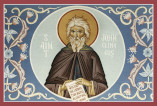 The author of the famous
‘Ladder,’ he came from an unknown place to Mount Sinai as a sixteen-year-old boy and
remained there, first as a novice, then as a hermit and finally as abbot of Sinai, until he died
at the age of eighty, in about 649. His biographer, the monk Daniel, says of him: ‘He
brought his body up to Mount Sinai, but his spirit he brought to the Mount of Heaven’. He
spent nineteen years in obedience to his spiritual father, Martyrios. Anastasios of Mount Sinai,
who saw John once as a young man, foretold that he would be abbot of Mount Sinai. After the death
of his spiritual father, John took himself off to a cave, where he lived for twenty years in
strict asceticism. His disciple, Moses, fell asleep one day in the cool shade of a huge rock.
John was at prayer in his cell, and perceiving that his disciple was in danger, began to pray for
him. Moses came up to him later, fell to his knees and began to thank him for saving him from
certain death. And he related how he had heard John calling him in his sleep and had jumped up at
the very moment that a rock fell. Had he not jumped out of the way, the rock would certainly have
killed him. At the importunate urging of the brethren, John accepted the abbacy, and guided their
souls to salvation with loving zeal. He once heard a monk reproach him for being too verbose. He
was not in the least angered, but was silent for an entire year, not uttering a single word until
the brethren begged him to speak. He then began to instruct them with the wisdom with which God
had endowed him. Once 600 pilgrims came to Mount Sinai. At supper they all noticed an agile young
man dressed as a Jew who was serving at table and giving orders to the other servants, taking
charge of everything. Suddenly, he disappeared. While everyone was pondering this and asking
questions among themselves, John said: ‘Do not bother to look for him; that was the prophet
Moses serving you in his own home.’ During the time that he was silent in his cave, John
wrote many instructive books, of which the most famous, ‘The Ladder,’ is much read to
this day. It describes the way to raise the soul to God as if on a ladder. Before his death, John
appointed his own brother, George, to the abbacy, but George began to grieve greatly at the
approaching parting with John. Then John said that, if he were found worthy to stand close to God
in the next world, he would pray that George be taken up to heaven in the same year. And so it
came to pass. After ten months, George also fell asleep and departed to take his place among
heaven’s citizens alongside his brother John.
2. Commemoration of an Uncondemning Monk.
This monk died joyfully because he had never in his life condemned anyone. He was lazy, careless, disinclined to prayer, but throughout his entire life he had never judged anyone. And when he lay dying, he was full of joy. The brethren asked him how he could die so joyfully with all his sins, and he replied: ‘I have just seen the angels, and they showed me a page with all my many sins. I said to them: “The Lord said: ‘Judge not, that ye be not judged.’ I have never judged anyone and I hope in the mercy of God, that He will not judge me.” And the angels tore up the sheet of paper.’ Hearing this, the monks wondered at it and learned from it.
FOR CONSIDERATION
If the humbling of oneself before men is needful that one might be exalted before God, and temporal toil is the prerequisite of immortal life, what does it matter if some shake their heads and laugh at your self-abasement? John the Hesychast was ten years bishop on Ascalon, after which time he realized that worldly honors were hindering him, so he disguised himself as a simple monk and went to the Monastery of St. Sava the Sanctified. He was given the task of collecting and carrying wood and cooking lentils for the workmen. When he was discovered there also, he shut himself in his cell and lived there for forty-seven years on cabbage. You see how the fathers fled earthly honors. Yet, how many people in our day engage in a foolhardy struggle for them, squandering their souls for the sake of dust and ashes.
Daily Scripture Readings taken from The Orthodox New Testament, translated and published by Holy Apostles Convent, Buena Vista, Colorado, copyright © 2000, used with permission, all rights reserved.
Daily Prologue Readings taken from The Prologue of Ochrid, by Bishop Nikolai Velimirovic, translated by Mother Maria, published by Lazarica Press, Birmingham, England, copyright © 1985, all rights reserved. Edited by Dormition Skete.