

Daily Devotional
Tuesday, April 11, 2034 (NS), March 29, 2034 (OS)
No Fasting.
Bright Week - No Fasting All Week
Tuesday of the Renewal Week
The commemoration of Hieromartyr Mark, Bishop of Arethusa, and Kyril the deacon, and many others with them, and the holy Martyrs Jonas and Varachysios of Persia.
Scripture Readings
Paschalion — Movable Calendar
Tuesday of the Renewal Week
Epistle
The Reading is from the Acts of the Apostles [§ 4]. In those days:
2 14Peter, having taken his stand with the eleven, lifted up his voice and spoke out to them, “Men, Jews, and all those who inhabit Jerusalem, let this be known to you, and hearken to my words. 15“For these are not drunk, as ye suppose, for it is the third hour of the day. 16“But this is that which hath been spoken by the Prophet Joel, 17“‘And it shall be in the last days,’ saith God, ‘I will pour out of My Spirit upon all flesh; and your sons and your daughters shall prophesy, and your young men shall see visions, and your old men shall dream dreams [cf. Joel 2:28]; 18“‘and even upon My bondmen and upon My bondwomen in those days I will pour out of My Spirit [cf. Joel 2:29],’ and they shall prophesy. 19“‘And I will show wonders in the heaven above, and signs on the earth below, blood and fire and vapor of smoke [cf. Joel 2:30]. 20“‘The sun shall be turned into darkness, and the moon into blood, before that great and notable day of the Lord come [Joel 2:31]. 21“‘And it shall be that everyone, whosoever shall call upon the name of the Lord, shall be saved [Joel 2:32].’”
Gospel
The Reading is from the Holy Gospel according to Saint Luke [§ 113]. At that time:
24 12Peter arose and ran to the sepulcher; and having stooped to look, he saw the linen cloths lying alone, and departed to his home, wondering at that which had come to pass.
13And behold, two of them were going on the same day to a village, being sixty stadia from Jerusalem, which is named Emmaus. 14And they were conversing with one another about all these things which had taken place. 15And it came to pass, while they conversed and discussed, Jesus Himself drew near and was going together with them. 16But their eyes were held, so as not to recognize Him. 17And He said to them, “What words are these which ye exchange with one another, as ye walk and are sad in countenance?” 18And the one whose name was Cleopas answered and said to Him, “Art Thou sojourning alone as a stranger in Jerusalem, and hast not known the things which came to pass in it in these days?” 19And He said to them, “What kind of things?” And they said to Him, “The things concerning Jesus the Nazaræan, Who was a man, a prophet, mighty in deed and word before God and all the people, 20“how both the chief priests and our rulers delivered Him up to a judgment of death, and crucified Him. 21“But we were hoping that He was the One Who was about to redeem Israel; but, beside all these things, this passeth as the third day today since these things took place. 22“Yea, and certain women from among us astonished us, who were early at the sepulcher. 23“And not having found His body, they came, declaring also to have seen a vision of angels who say, ‘He is living.’ 24“And certain of those with us went away to the sepulcher, and found it thus, even as also the women said; but Him they did not see.” 25And He said to them, “O ye without understanding and slow in heart to believe in all things which the prophets spoke! 26“It was needful for the Christ to have suffered these things and to have entered into His glory, was it not?” 27And beginning from Moses and from all of the prophets, He went on interpreting to them in all the Scriptures the things concerning Himself. 28And they drew near to the village where they were going; and He was making as if to be going further. 29And they constrained Him, saying, “Stay with us, for it is toward evening, and the day hath waned.” And He went in to stay with them. 30And it came to pass, as He reclined at table with them, He took bread, and blessed it, and broke it, and was giving it to them. 31And their eyes were opened, and they recognized Him; and He disappeared from them. 32And they said to one another, “Our heart was burning in us as He was speaking to us in the way and as He was opening to us the Scriptures, was it not?” 33And they rose up the same hour and returned to Jerusalem, and found the eleven gathered together, and those with them, 34saying, “The Lord was raised indeed, and appeared to Simon.” 35And they began relating those things that occurred in the way, and how He was known to them in the breaking of the bread.
Menaion — Fixed Calendar
The commemoration of Hieromartyr Mark, Bishop of Arethusa, and Kyril the deacon, and many others with them, and the holy Martyrs Jonas and Varachysios of Persia.
No readings given.
Lives of the Saints (Prologue)
Paschalion — Movable Calendar
Saints Raphael, Nicholas and Irene
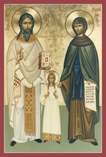 Archimandrite Raphael,
Abbot of the Theotokos Monastery, and Hierodeacon Nicholas, settled on Lesvos (Mytilene) after
the Fall of the City. In 1463, Muslims attacked on Great Friday. Archimandrite Raphael was pulled
and tugged by his hair and beard along the rock-strewn ground. He was struck with clubs, spears,
lances, and swords, while his hands were tied behind his back. He was stabbed all over and cast
down paralyzed. His tongue was severed, and he was then suspended upside down from a large walnut
tree, repeatedly beaten and whipped for 24 hours. He was cut down from the tree and stripped of
his clothing from the waist up. After being positioned on his knees, five savage Muslims took up
a saw and began cutting away his lower jaw. Nearly unconscious, he had his head placed on a
square icon, where they struck him thrice on his mouth, extracting his lower jaw, thus separating
his head from his body on Bright Tuesday, then the 9th of April.
Deacon Nicholas, bound to a smaller walnut tree, witnessed these
terrifying scenes. He, too, was stabbed, but he did not die immediately. It was only after his
terror-stricken tender heart had borne the startling sight of his wounds and the punishments of
the others, that he suffered cardiac arrest.
Twelve-year-old Irene was seized and had boiling water poured into
her mouth. One of her delicate hands was severed, the limb being tossed before the parents. The
stump of her arm was bleeding profusely, as they chopped away one of her little feet. The lass
was then pushed down into an earthen jar, where she was burned alive after being doused with
flammable liquids and torching her bodice. As she stood trapped in the flaming cask, she lifted
up her eyes heavenward and called upon Christ, commending her soul into the hands of the Lord.
In 1959 and in the early 1960’s miraculous visions of the
martyrs were granted to the islanders. The recovery of their relics has been the occasion of
countless miracles and pilgrimages.
Menaion — Fixed Calendar
April 11th – Civil Calendar
March 29th – Church Calendar
1. St. Mark the Confessor, Bishop of Arethusa in Syria.
St. Gregory the Theologian and Blessed Theodoretus have given us an account of his sufferings. According to these accounts, Mark destroyed some pagan temples and brought many to the Christian Faith during the reign of the Emperor Constantine. But when the Emperor Julian came to the throne and quickly became an apostate from the Faith, some of the inhabitants of Arethusa renounced Christ and lapsed into paganism. They rose up against Mark because he had demolished the temple and demanded that he either rebuild it or pay them a very large sum of money. As Mark refused to do either, he was flogged and flayed and dragged through the streets. They then cut off his ears with strong, fine threads, stripped him naked, smeared him with honey and left him bound to a tree in the summer heat for the wasps, mosquitoes and hornets to eat. The martyr of Christ endured all this without complaint. He was quite old, and his face shone like an angel of the Lord. The pagans lowered the price of their temple again and again, finally demanding a quite insignificant amount which Mark could easily have given. But he refused to give even a single coin for that purpose. His endurance made a great impression on the citizens, and they began to admire him for it and to feel sorry for him, and gradually reduced the price of their temple to nothing just to allow him to remain alive. Finally, they let him go free, and one by one, all came to him to receive instruction and become Christians again. A deacon, Kyril, also suffered at this time for a similar cause in Heliopolis at the foot of Mount Lebanon. He had broken some idols at the time of the liberation of Christianity and was cruelly tortured under Julian for this. The pagans were so enraged with him that, after they had killed him, they tore out his teeth and ripped open his stomach. Many others suffered on the same day as St. Kyril. The evil pagans cut their bodies into small pieces, coated them with barley and fed them to the pigs. But retribution came swiftly upon them; all their teeth fell out and their mouths emitted an unbearable stench.
2. Our Holy Father John the Hermit.
He was the son of Juliana, a Christian woman of Armenia. While still a child, he left his mother and ran off to the desert. He was utterly aflame with love for Christ the Lord. In the beginning he entrusted himself to the guidance of a spiritual father, Pharmutios, who was so pleasing to God that an angel brought him bread every day. John later left him and withdrew into solitude. He let himself down into a dry well and lived there for a full ten years in fasting, prayer and vigils. St. Pharmutios used to bring him some of the angel’s bread, for the angel of God did not wish to bring bread to the young John in person, lest he grow proud through this, so he sent it through Pharmutios, his spiritual father. After ten years of arduous asceticism in this well, St. John went to the Lord and his relics revealed wonder-working power. He lived and was glorified by God and men in the 4th century.
FOR CONSIDERATION
The spiritists of our time accept every appearance from the spiritual world as sent by God and immediately boast that it has been ‘revealed’ to them. I was myself acquainted with an eighty-year-old monk who was respected by everyone as a great spiritual guide. When I asked him if he had ever seen any being from the spiritual world in his lifetime, he answered me: ‘No, never; and praise be to God for His mercy!’ Seeing my astonishment at this, he said: ‘I have constantly prayed to God that nothing should ever appear to me, lest I fall into illusion and accept a devil disguised as an angel. And, until now, God has heard my prayer.’ One noted example serves to show how humble and cautious were the elders in this respect: A devil clothed in angelic light appeared to a certain brother and declared to him: ‘I am the archangel Gabriel, who has been sent to you.’ The brother replied to this greeting: ‘You must have been sent to someone else: I’m not worthy to see angels,’ and the devil instantly became invisible and disappeared.
Daily Scripture Readings taken from The Orthodox New Testament, translated and published by Holy Apostles Convent, Buena Vista, Colorado, copyright © 2000, used with permission, all rights reserved.
Daily Prologue Readings taken from The Prologue of Ochrid, by Bishop Nikolai Velimirovic, translated by Mother Maria, published by Lazarica Press, Birmingham, England, copyright © 1985, all rights reserved. Edited by Dormition Skete.