

Daily Devotional
Sunday, April 9, 2034 (NS), March 27, 2034 (OS)
No Fasting.
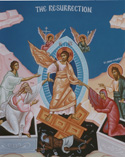
| The Holy and Great Sunday of Pascha |
The commemoration of the holy Martyr Matrona of Thessalonica.
Scripture Readings
Paschalion — Movable Calendar
The Holy and Great Sunday of Pascha
Epistle
The Reading is from the Acts of the Apostles [§ 1].
1 1The first account indeed I made for myself concerning all which, O Theophilos, Jesus began both to do and teach, 2until the day in which He was taken up, after He gave command to the apostles whom He chose for Himself through the Holy Spirit, 3to whom also He presented Himself alive after He had suffered by many proofs, being seen by them during forty days and speaking the things concerning the kingdom of God. 4And being assembled together with them, He ordered them not to depart from Jerusalem, but to wait for the promise of the Father, “which,” He said, “ye heard of Me; 5“for John indeed baptized with water, but ye shall be baptized in the Holy Spirit not many days after these.” 6Indeed therefore, after they came together, they kept on questioning, saying, “Lord, dost Thou at this time restore the kingdom to Israel?” 7And He said to them, “It is not yours to know times or seasons which the Father Himself put in His own authority. 8“But ye shall receive power, after the Holy Spirit is come upon you; and ye shall be witnesses to Me both in Jerusalem, and in all Judæa and Samaria, and unto the ends of the earth.”
Gospel
In the Liturgy
The Reading is from the Holy Gospel according to Saint John [§ 1].
1 1In the beginning was the Logos, and the Logos was with God, and the Logos was God. 2This One was in the beginning with God. 3All things came into being through Him, and without Him not even one thing came into being that hath come to be. 4In Him was life, and the Life was the light of men. 5And the light shineth in the darkness, and the darkness overcame it not.
6There came to be a man who was sent forth from God, whose name was John. 7This same came for a witness, in order that he might bear witness concerning the Light, that all might believe through Him. 8He was not that One, the Light, but was sent that he might bear witness concerning the Light. 9That was the true Light, which giveth light to every man coming into the world. 10He was in the world, and the world came into being through Him, and the world knew Him not. 11He came to His own, and His own received Him not. 12But as many as received Him, to them He gave power to become children of God, to those who believe in His name: 13who were begotten not of blood, nor of the will of the flesh, nor of the will of man, but of God. 14And the Logos became flesh and tabernacled among us, and we beheld His glory, the glory as of an only-begotten from the Father, full of grace and truth. 15John beareth witness concerning Him, and hath cried out, saying, “This One was He of Whom I said, ‘The One Who cometh after me hath come to be before me, for He was before me.’” 16And of His fullness we all received, and grace for grace; 17for the law was given through Moses, but the grace and the truth came to be by Jesus Christ.
In Vespers
The Reading is from the Holy Gospel according to Saint John [§ 65].
20 19When it was evening on that day, the first of the week—and the doors were closed where the disciples were gathered together for fear of the Jews—Jesus came and stood in the midst, and saith to them, “Peace be to you.” 20And after He said this, He showed them His hands and His side. Then were the disciples glad, after they saw the Lord. 21Then Jesus said to them again, “Peace be to you; even as the Father hath sent Me forth, I also send you.” 22And after He said this, He breathed on them, and saith to them, “Receive ye the Holy Spirit: 23“if ye forgive the sins of any, they are forgiven to them; if ye retain the sins of any, they are retained.” 24But Thomas, one of the twelve, who is called Didymos, was not with them when Jesus came. 25The other disciples therefore were saying to him, “We have seen the Lord.” But he said to them, “Unless I should see in His hands the mark of the nails, and put my finger into the mark of the nails, and put my hand into His side, in no wise will I believe.”
Menaion — Fixed Calendar
The commemoration of the holy Martyr Matrona of Thessalonica.
No readings given.
Lives of the Saints (Prologue)
April 9th – Civil Calendar
March 27th – Church Calendar
1. The Holy Martyr Matrona.
She was an orphan, and a servant in the house of a Jew in Thessalonica. The wife of this Jew constantly derided Matrona for her faith in Christ, and urged her to cast Christ aside and go to the synagogue. But the humble Matrona went about her work conscientiously, not replying to her mistress and secretly praying to Christ our God. On one occasion the Jewess discovered that Matrona had gone to church unbeknown to her, and demanded, in a great rage, to know why she had gone to the church and not the synagogue. ‘Because God is alive in the Christian Church, but He has departed from the synagogues of the Jews,’ replied Matrona. Enraged by such a courageous answer, the Jewess thrashed her and locked her in a dark chamber, and in addition to that had her bound. But the next day she found her unbound by the power of God and kneeling in prayer, praising God. Then she locked her up again for the second time until she died of hunger. Then that wicked woman took the body of the holy maiden and threw it to the ground from the top of her house. Christians took the body of the martyr and buried it. The bishop, Alexander, when he had learned of the many miracles worked by the holy martyr, built a church over her grave. As for the evil Jewess, she soon received her just reward, when, standing on the same spot from which she had thrown Matrona’s body, she slipped and fell onto the cobbled pavement and was smashed to pieces.
2. Our Holy Father John the Clairvoyant.
He was a carpenter until the age of twenty-five, when, urged on by an unquenchable desire for constant prayer, he took himself off into the desert, where he lived until his death; that is, until the age of ninety. He lived in the body as one without a body. He could look into the heart of every person who came near him and could discover his name, and his thoughts and desires. He foretold the outcome of the Emperor Theodosios’ battles to him; prophesied to nobles, to monks, to anyone at all who was in need, to uncover what was hidden from them in the darkness of future days. A certain prince asked him to receive his wife, who wished to see him. The holy man was not willing to satisfy empty curiosity, so he appeared in a dream to the prince’s wife, and she saw him just as he was. And when the woman described her dream to her husband, he affirmed that such was the appearance of the holy man. He taught every visitor about humility, which is the basic virtue, and always drew his examples from life. He taught how pride makes war against a man of exalted character and brings him to dust and to terrible sins. He endured great assaults from evil spirits. Once Satan appeared to him with a great crowd of demons in the form of shining angels. They pressed him to bow down before Satan, lying to him and telling him that it was Christ. But he answered with great wisdom: ‘Every day I bow down to Jesus Christ my King; if it were He, it would not be necessary for me to bow down to Him at this particular moment.’ After these words, the evil forces disappeared like smoke. He died peacefully, kneeling in prayer, at the age of ninety.
3. Our Holy Father Paphnutios.
He was a disciple of St. Anthony the Great. The holiness of his life brought many sinners (for example, St. Thaïs, Oct 8th) back to the path of repentance, for he was more like a bodiless angel than a carnal man. He entered into rest towards the end of the fourth century.
FOR CONSIDERATION
‘He who thinks evil, in him is no cleanness,’ says St. Simeon the New Theologian, and adds: ‘For how can there be a clean heart in one who fouls it with unclean thoughts, as a mirror is darkened by dust?’ Do you see, then, the inaccessible height on which the Christian religion stands in relation to all other religions and worldly theories? He who contemplates evil has in some manner done evil, and is at fault before God and his own soul. It is an insult to God and a loss to self. To be Christian in the true sense means to make an enormous effort to cleanse our hearts and minds from evil thoughts. On what an effort it is, there is a vast amount of teaching (which in our day remains an almost entirely closed book, even to Christians) and a wealth of true experience on the part of holy men and women who have justified this teaching. To cleanse oneself from evil and impure thoughts, this root of all evil, was the goal of all the great ascetics, cave-dwellers and hesychasts.
Daily Scripture Readings taken from The Orthodox New Testament, translated and published by Holy Apostles Convent, Buena Vista, Colorado, copyright © 2000, used with permission, all rights reserved.
Daily Prologue Readings taken from The Prologue of Ochrid, by Bishop Nikolai Velimirovic, translated by Mother Maria, published by Lazarica Press, Birmingham, England, copyright © 1985, all rights reserved. Edited by Dormition Skete.