

Daily Devotional
Saturday, April 8, 2034 (NS), March 26, 2034 (OS)
Fast Day. Wine permitted, but not olive oil.
Holy Week
| Holy and Great Saturday |

The commemoration of the Leave-taking of the Annunciation, and the Synaxis of the Archangel Gabriel.
Scripture Readings
Paschalion — Movable Calendar
Holy and Great Saturday
Epistle
In the Orthros
The Reading is from the First Epistle of Saint Paul to the Corinthians [§ 133]. Brethren:
Note two Readings, one from 1 Cor. 5:6-8 and Gal. 3:13, 14.
Begin with First Corinthians [§ 133]:
5 6A little leaven leaveneth the whole dough. 7Purge out therefore the old leaven, that ye may be a new dough, even as ye are unleavened. For also Christ, our Passover, was sacrificed for us; 8therefore let us be keeping festival, not with old leaven, nor with the leaven of malice and wickedness, but with the unleavened loaves of sincerity and of truth.
Conclude with Galatians [§ 206]:
3 13Christ redeemed us from the curse of the law, having become a curse for us (for it hath been written: “Cursed is everyone who hangeth on a tree [Deut. 21:23]”), 14that the blessing of Abraham might come to pass to the nations in Christ Jesus, in order that we might receive the promise of the Spirit through faith.
In the Divine Liturgy
The Reading is from the Epistle of Saint Paul to the Romans [§ 91]. Brethren:
6 3As many as were baptized into Christ Jesus were baptized into His death. 4Therefore we were buried with Him by the baptism into the death, that even as Christ was raised from the dead through the glory of the Father, thus also we should walk in newness of life. 5For if we have been planted together in the likeness of His death, certainly also we shall be of the resurrection, 6knowing this, that our old man was crucified with Him, that the body of sin might be rendered inactive, in order to no longer serve sin. 7For the one who died hath been justified from sin. 8Now if we died with Christ, we believe that we shall also live with Him, 9knowing that Christ Who was raised from the dead dieth no more; death no longer hath dominion over Him. 10For the death which He died, He died to sin once for all; but the life which He liveth, He liveth to God. 11Thus reckon ye also yourselves to be dead indeed to sin, but alive to God in Christ Jesus our Lord.
Gospel
In the Orthros
The Reading is from the Holy Gospel according to Saint Matthew [§ 114].
27 62On the morrow, which is after the preparation, the chief priests and the Pharisees were gathered together to Pilate, 63saying, “Sir, we were reminded that that deceiver said while He was yet alive, ‘I am being raised after three days.’ 64“Command therefore that the tomb be made secure until the third day, lest perchance His disciples come by night and steal Him, and say to the people, ‘He was raised from the dead’; and the last deceit shall be worse than the first.” 65And Pilate said to them, “Ye have a guard; go your way and make it as secure for yourselves as ye know how.” 66And they went and made the tomb secure, having sealed the stone with the guard being present.
In the Liturgy
The Reading is from the Holy Gospel according to Saint Matthew [§ 115].
28 1Late on the sabbath, at the dawning toward the first day of the week, there came Mary Magdalene and the other Mary to see the tomb. 2And behold, a great earthquake occurred; for an angel of the Lord descended out of heaven, and came and rolled away the stone from the door, and sat upon it. 3And his appearance was as lightning, and his garment white as snow. 4And those keeping guard, because of their fear of him, were shaken and became as dead men. 5And the angel answered and said to the women, “Cease being afraid, for I know that ye seek Jesus Who hath been crucified. 6“He is not here; for He was raised, even as He said. Come, see the place where the Lord was lying. 7“And go quickly and say to His disciples that He was raised from the dead. And behold, He goeth before you into Galilee; there shall ye see Him. Behold, I have told you.” 8And they went out quickly from the sepulcher with fear and great joy, and ran to bring tidings to His disciples. 9But as they were going to bring tidings to His disciples, then behold, Jesus met them, saying, “Rejoice ye.” And they approached and laid hold of His feet, and made obeisance to Him. 10Then Jesus saith to them, “Cease being frightened. Go and bring tidings to My brethren that they should go into Galilee, and there shall they see Me.” 11Now when they were going, behold, some of the guard came into the city and reported to the chief priests all the things that came to pass. 12And after they were gathered together with the elders and took counsel, they gave a considerable amount of money to the soldiers, 13saying, “Say, ‘His disciples came by night and stole Him while we were sleeping.’ 14“And if this should be heard before the governor, we will persuade him and make you free from care.” 15And they took the money and did as they were taught. And this report was spread abroad by the Jews until today.
16Now the eleven disciples went into Galilee, to the mountain where Jesus appointed them. 17And having seen Him, they made obeisance to Him; but some doubted. 18And Jesus approached and spoke to them, saying, “All authority is given to Me in heaven and on earth. 19“Go therefore and make disciples of all the nations, baptizing them in the name of the Father, and of the Son, and of the Holy Spirit, 20“teaching them to observe all things whatsoever I commanded you; and behold, I am with you all the days until the completion of the age.” Amen.
Menaion — Fixed Calendar
The commemoration of the Leave-taking of the Annunciation, and the Synaxis of the Archangel Gabriel.
Epistle
The Reading is from the Epistle of Saint Paul to the Hebrews [§ 305]. Brethren:
2 2If the word spoken by angels was confirmed, and every transgression and disobedience received a just recompense, 3how shall we escape, if we neglect so great a salvation, which received a beginning to be spoken of by the Lord, and was confirmed to us by those who heard, 4God also bearing them witness with both signs and wonders, and various works of power, and by distributions of the Holy Spirit, according to His will?
5For not to angels did He subject the coming inhabited world about which we speak; 6but one bore witness somewhere, saying, “What is man that Thou art mindful of him or the Son of Man that Thou visitest Him [Ps. 8:4]? 7“Thou didst make Him for a short time less than the angels; Thou didst crown Him with glory and honor [Ps. 8:5], 8“Thou didst subject all things under His feet [Ps. 8:6].” For in subjecting all things to Him, He left nothing not subject to Him. But now we see not yet all things subjected to Him. 9But we see Jesus, Who for a short time was made less than the angels on account of the suffering of death, crowned with glory and honor, so that He, by the grace of God, should taste death for everyone. 10For it was becoming to Him, because of Whom are all things and by means of Whom are all things, bringing many sons to glory, to have perfected the originator of their salvation through sufferings.
Gospel
The Reading is from the Holy Gospel according to Saint Luke [§ 51]. The Lord said to His disciples:
10 16“The one who heareth you heareth Me, and the one who rejecteth you rejecteth Me, and the one who rejecteth Me rejecteth the One Who sent Me forth.”
17And the seventy returned with joy, saying, “Lord, even the demons are being made subject to us in Thy name.” 18And He said to them, “I was beholding Satan as lightning having fallen out of the heaven. 19“Behold, I give you the authority to tread upon serpents and scorpions, and upon all the power of the enemy; and nothing in anywise shall injure you. 20“However cease rejoicing in this, that the spirits are being made subject to you; but be rejoicing that your names were written in the heavens.” 21In the same hour Jesus rejoiced in the Spirit, and said, “I give thanks to Thee, O Father, Lord of the heaven and of the earth, that Thou didst hide these things from the wise and intelligent, and didst reveal them to babes. Yea, Father, for thus it was well-pleasing before Thee.”
Lives of the Saints (Prologue)
April 8th – Civil Calendar
March 26th – Church Calendar
1. The Holy Archangel Gabriel.
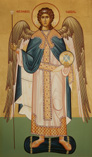 The herald of the incarnation of the Son of God, he is one of the seven
great archangels who stand before the throne of God. The names of these seven are: Michael,
Gabriel, Raphael, Uriel, Salathiel, Jegudiel and Barachiel (and to these is sometimes added an
eighth, Jeremiel). Each has his own particular service, but all are equal in honor. Archangel
Gabriel revealed to Zacharias the birth of the Forerunner, and said of himself: ‘I am
Gabriel that stand in the presence of God’ (Lk. 1:19). His name, Gabriel, signifies
‘man of God’. Speaking about the Annunciation, the holy fathers comment that an angel
with such a name was sent to signify Who He was, and of what nature He was, Who would be born of
the most pure Virgin. He would be the Man of God, the God-Man, the strong and mighty God. Others
have found that it was this same Gabriel who announced the conception of the Virgin Mary to
Joachim and Anna, and that it was he who taught Moses in the wilderness to write the Book of
Genesis. Why did God not send Michael? For the reason that Michael’s service is the
suppression of the enemies of God’s truth, while Gabriel’s is the annunciation of the
salvation of the human race.
2. The Hieromartyr Irenaeus, Bishop of Sirmium (Srem).
It is thought that he was a Slav, and was married and had children before becoming a bishop. He suffered for Christ in the time of Maximian, under Probus, the governor. His kinsmen stood around him during his frightful sufferings, beseeching him with tears to spare himself and them; in other words, to renounce Christ. But this glorious hieromartyr preferred the wounds he received for Christ to all the good things of this world. A certain gardener in Sirmium, Seren, also suffered at this time under Probus, and also one Afrius in Regia. Since Irenaeus would not renounce his faith, Probus commanded that he be thrown from a bridge into the River Sava, where this pastor of Christ’s flock died and took his place among the citizens of heaven. He suffered with honor in 304.
3. Our Holy Father Malchus, the disobedient monk.
Malchus was an agricultural worker in the neighborhood of Antioch, and from his youth his whole spirit was directed towards God. He became a monk, but it happened one time that he disobeyed his spiritual father by deciding to return to his homeland in order to convert his family. While traveling in a caravan, they were attacked by marauders, and the Arabs took him for a slave. While he was in slavery they forced him to take a negress to wife. However, he brought her to the Christian Faith and lived with her as a brother with his sister. They conspired together and escaped from slavery, but the Arabs nearly recaptured them. They hid in a cave in which they saw a lioness with her cubs, and were very greatly afraid. But God preserved them; the lioness did not harm them but killed an Arab who tried to enter the cave and seize the runaways. Reaching his home country, Malchus gave his wife to a women’s monastery and went himself to a men’s monastery. He lived for many years, exercising himself in asceticism, and took his place among the inhabitants of heaven in the fourth century.
FOR CONSIDERATION
When a miracle occurs, may it cause you joy rather than embarrassment. God has put His finger there, sometimes to reward, sometimes to punish, sometimes to encourage His faithful people and sometimes to lead sinners into the way of salvation.
When you see a locomotive, or some other similar steam engine, you know that there is a driver hidden somewhere inside. And there is nothing strange, is there, in the driver’s making his presence known by putting his head out of the cab or waving his arm, fluttering his handkerchief, throwing something out or making some other sign? You know that none of these things interfere with the functioning of the locomotive or damage the smallest screw in it. Why, then, do the faithless say that God interferes with the functioning of earthly machines by His wonders? Because they are dull-witted. But the faithful rejoice at God’s signs like children who stand transfixed at the sight of a locomotive, who are delighted when the driver—a man like themselves—sticks out of the cab. Oh, what a delight it is to us when, out of this inarticulate universe that roars around us, someone like us pops up, and that someone a Being Who knows us and loves us. When a miracle occurs, know that One like us greets us and says: ‘Don’t be afraid; I am behind all this.’ St. Basil the New performed many miracles. He healed sicknesses by his prayers and read men’s destinies like an open book. Through the man pleasing to Him, as always, God demonstrated His love and power towards men, that the faithful might be the more strongly confirmed in their faith, and the faithless put to shame and brought to faith.
Daily Scripture Readings taken from The Orthodox New Testament, translated and published by Holy Apostles Convent, Buena Vista, Colorado, copyright © 2000, used with permission, all rights reserved.
Daily Prologue Readings taken from The Prologue of Ochrid, by Bishop Nikolai Velimirovic, translated by Mother Maria, published by Lazarica Press, Birmingham, England, copyright © 1985, all rights reserved. Edited by Dormition Skete.