

Daily Devotional
Monday, April 3, 2034 (NS), March 21, 2034 (OS)
Fast Day. No Meat, Fish, Dairy, Eggs, Alcohol or Olive Oil Allowed.
Holy Week
| Holy and Great Monday |
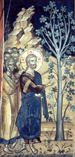
The commemoration of our holy father among the saints, Iakovos the Confessor, Bishop of Catania.
Scripture Readings
Paschalion — Movable Calendar
Holy and Great Monday
Epistle
There is no Epistle Reading this day because of Holy Week.
Gospel
In the Orthros
The Reading is from the Holy Gospel according to Saint Matthew [§ 84]. At that time:
21 18As Jesus returned into the city, He hungered. 19And having seen a single fig tree in the way, He came to it and found nothing on it, except leaves only, and said to it, “Let there be no more fruit from thee forever.” And forthwith the tree was withered. 20And after the disciples saw it, they wondered, saying, “How was the fig tree withered forthwith?” 21And Jesus answered and said to them, “Verily I say to you, if ye have faith and doubt not, ye shall not only do that which was done to the fig tree, but even if ye should say to this mountain, ‘Be thou taken away, and be thou cast into the sea,’ it shall come to pass. 22“And all things, whatsoever ye ask in prayer, believing, ye shall receive.”
23And after He came into the temple, the chief priests and the elders of the people came to Him as He taught, saying, “By what authority doest Thou these things? And who gave Thee this authority?” 24And Jesus answered and said to them, “I also will question you for one word, which if ye tell Me, I also will tell you by what authority I am doing these things. 25“The baptism of John—from what place was it? From heaven or from men?” And they were reasoning with themselves, saying, “If we should say, ‘From heaven,’ He will say to us, ‘Why then did ye not believe him?’ 26“But if we should say, ‘From men,’ we fear the multitude; for all hold John as a prophet.” 27And they answered and said to Jesus, “We know not.” And He said to them, “Neither do I tell you by what authority I am doing these things. 28“But what think ye? A certain man had two children, and he came to the first and said, ‘Child, go today and work in my vineyard.’ 29“And he answered and said, ‘I will not’; but afterward he felt regret and went forth. 30“And he came to the second and spoke in like manner. And he answered and said, ‘I go, sir’; and he went not forth. 31“Which of the two did the will of the father?” They say to Him, “The first.” Jesus saith to them, “Verily I say to you that the tax collectors and the harlots go into the kingdom of God before you. 32“For John came to you in the way of righteousness, and ye believed him not; but the tax collectors and the harlots believed him; and ye, having seen, felt no regret afterward in order to believe him.
33“Hear another parable: There was a certain man, a master of a house, who planted a vineyard, and put a hedge around it, and dug a wine-vat in it in which to press grapes, and built a tower. And he let it out to vinedressers, and went abroad. 34“And when the season of the fruits drew near, he sent forth his slaves to the vinedressers to receive his fruits. 35“And the vinedressers took his slaves, and indeed beat one, and killed another, and stoned another. 36“Again he sent forth other slaves, more than the first; and they did to them in like manner. 37“But afterwards he sent his son to them, saying, ‘They will respect my son.’ 38“But after the vinedressers saw the son, they said among themselves, ‘This is the heir. Come, let us kill him, and let us gain possession of his inheritance.’ 39“And they took him, and cast him out of the vineyard, and slew him. 40“Whenever the lord, therefore, of the vineyard should come, what shall he do to those vinedressers?” 41They say to Him, “He will evilly destroy those evil men, and will let out the vineyard to other vinedressers who shall render to him the fruits in their seasons.” 42Jesus saith to them, “Did ye never read in the Scriptures, ‘The stone which the builders rejected, this became the head of the corner; this came to be from the Lord, and it is marvellous in our eyes [Ps. 117(118):22, 23; cf. Is. 28:16]’? 43“On this account I say to you that the kingdom of God shall be taken away from you, and it shall be given to a nation producing the fruits of it.”
In the Liturgy of the Presanctified Gifts
The Reading is from the Holy Gospel according to Saint Matthew [§ 98]. At that time:
24 3As Jesus sat upon the Mount of Olives, His disciples came to Him privately, saying, “Tell us, when shall these things be, and what shall be the sign of Thy coming, and of the completion of the age?” 4And Jesus answered and said to them, “Be taking heed, lest anyone lead you astray. 5“For many shall come in My name, saying, ‘I am the Christ’; and they shall lead astray many. 6“But ye are going to hear of wars and rumors of wars; keep on looking out and cease being clamorous; for all these things must come to pass, but the end is not yet. 7“For nation shall be stirred up against nation, and kingdom against kingdom. And there shall be famines, and plagues, and earthquakes, in place after place. 8“But all these are a beginning of birth pangs. 9“Then they shall deliver you up to affliction, and shall kill you; and ye shall be hated by all the nations for My name’s sake. 10“And then many shall be made to stumble, and shall deliver up one another, and shall hate one another. 11“And many false prophets shall be raised up, and shall lead astray many. 12“And because lawlessness shall have been multiplied, the love of the multitude shall grow cold. 13“But the one who endureth to the end, this one shall be saved. 14“And this Gospel of the kingdom shall be proclaimed in all the inhabited world, for a testimony to all the nations; and then shall the end come. 15“Whenever ye therefore see ‘the abomination of the desolation [cf. Dan. 9:27, 12:11],’ which was spoken of by Daniel the prophet, standing in the holy place”—the one who readeth, let him understand— 16“then let those in Judæa flee to the mountains. 17“The one on the housetop, let him not come down to take away anything out of his house. 18“And the one in the field, let him not return back to take up his clothes. 19“And woe to those who are with child and to those who give suck in those days. 20“But be praying that your flight might not take place in winter, neither on a sabbath. 21“For then there shall be great affliction, such as hath not been from the beginning of the world until the present, no, nor ever shall be. 22“And if those days were not shortened, no flesh would be saved; but for the elect’s sake those days shall be shortened. 23“Then if anyone should say to you, ‘Behold, here is the Christ,’ or ‘Here,’ do not begin to believe it. 24“For false christs and false prophets shall be raised up, and they shall produce great signs and wonders, so as to lead astray, if possible, even the elect. 25“Behold, I have told you beforehand. 26“If then they should say to you, ‘Behold, He is in the desert,’ do not begin to go forth; ‘Behold, He is in the secret chambers,’ do not begin to believe it. 27“For even as the lightning cometh forth from the east and appeareth as far as the west, so also shall be the coming of the Son of Man. 28“For wheresoever the corpse may be, there will the eagles be gathered together.
29“And straightway after the affliction of those days shall the sun be darkened, and the moon shall not give her light, and the stars shall fall from the heaven, and the powers of the heavens shall be shaken. 30“And then shall the sign of the Son of Man appear in the heaven, and then the tribes of the earth shall mourn, and they shall see the Son of Man coming on the clouds of the heaven with power and great glory. 31“And He shall send forth His angels with a great sound of a trumpet, and they shall gather together His elect from the four winds, from the uttermost parts of the heavens unto their extremities. 32“Now learn the parable from the fig tree: Whenever its branch at once should become tender and put forth leaves, ye know that the summer is near. 33“Thus also ye, whenever ye see all these things, know ye that it is near, even at the doors. 34“Verily I say to you, in no wise shall this generation pass away until all these things shall have taken place. 35“The heaven and the earth shall pass away, but My words in no wise shall pass away.”
Menaion — Fixed Calendar
The commemoration of our holy father among the saints, Iakovos the Confessor, Bishop of Catania.
No readings given.
Lives of the Saints (Prologue)
April 3rd – Civil Calendar
March 21st – Church Calendar
1. St. Iakovos, Bishop and Confessor.
Neither his birthplace nor the place of his episcopate are known. It is known only that he fulfilled the law of Christ, living in strict asceticism, in fasting and prayer and that, in the time of Kopronymos, he endured much hardship and suffering at the hands of the iconoclasts: hunger, imprisonment and ridicule of every sort. He finally gave his soul to God, Whom he had faithfully served in this life. He lived and suffered in the eighth century.
2. Our Holy Father Cyril (Beryllus), Bishop of Catania in Sicily.
Born in Antioch and a pupil of the Apostle Peter, he governed Christ’s flock well. He had the gift of working wonders by prayer: for example, by his prayers he turned some bitter and undrinkable water—in a place where there was no other water in summer—into sweet, drinkable water. He entered peacefully into rest.
3. St. Thomas, Patriarch of Constantinople.
He lived in the reigns of the Emperors Maurice and Phokas, and in the time of Patriarch John the Faster and Patriarch Kyriakos. Singled out by St. John for his great devotion and zeal, he was made patriarchal vicar by that saint, and after the death of Kyriakos, was chosen as patriarch. In his time an unusual event occurred: once when there was a procession with crosses carried, they began to sway and to hit against each other. The people marvelled at this; and when the patriarch heard it attested, he asked Theodore the Sykeote, a famous ascetic and clairvoyant, to explain what it forebode. Theodore prayed to God and revealed to the patriarch that it indicated a great misfortune that would come on the Church and on the Greek state through internal religious and political discord. Christians would fight and would exterminate each other. And all this came quickly to pass. Thomas begged Theodore to pray to God for him, that God would take him before this happened. ‘Do you command me to come to you, or shall we meet in the other world before God?’ So wrote Theodore to the patriarch, indicating by this that both he and the patriarch would die soon. And that same day the patriarch fell ill and died, and St. Theodore died very soon after. St. Thomas died and went to the Lord in 610.
4. Our Holy Father Serapion.
A companion of St. Anthony the Great, he lived in the Nitrian desert, in charge of the monastery of Arsina which contained 11,000 monks. Palladius and Sozomen gave him the title ‘the Great’. He entered into rest in about 366. St. Serapion wrote: ‘Do not think that sickness is grave; only sin is grave.... Sickness leads us only to the tomb, but sin follows the sinner beyond it’.
FOR CONSIDERATION
You will hear the following justification for enrichment from many who seek it: When you are rich, you can do many good deeds! Do not believe them, for they delude both you and themselves. St. John Climacus knew well the most hidden motives of the human soul when he said: ‘Love of money begins with the assumption that it produces charity, and ends with hatred for the poor.’ This is confirmed in every lover of money, both the very rich and the less rich. People usually say: ‘If I had the money, I would do this and that good deed.’ Do not believe them. Let them not believe themselves. Let them look, as in a mirror, at those who have money and do not do this or that good deed. So would they be if they acquired money. The wise John says again: ‘Do not say that you must collect (money) for the poor, that you may attain to the kingdom of God through these alms. For the kingdom can be bought for two farthings. Indeed the widow in the Gospel did buy it for two farthings, but the rich man, before whose door Lazarus lay, was not able to buy it with all his wealth. If you have nothing to give to the wretched, pray to God that He will give to them, and by that you give alms and purchase the kingdom of heaven. When St. Basil the New prophesied to the empress, the wife of the Emperor Constantine Porphyrogenitus, that she would bear first a daughter and then a son, the empress offered him much gold. The saint refused it. But the empress swore in the name of the Holy Trinity that he should take it. Then St. Basil took three gold pieces and gave them to Theodore, his poor servant, saying: ‘We don’t want many of these thorns—they prick horribly!’
Daily Scripture Readings taken from The Orthodox New Testament, translated and published by Holy Apostles Convent, Buena Vista, Colorado, copyright © 2000, used with permission, all rights reserved.
Daily Prologue Readings taken from The Prologue of Ochrid, by Bishop Nikolai Velimirovic, translated by Mother Maria, published by Lazarica Press, Birmingham, England, copyright © 1985, all rights reserved. Edited by Dormition Skete.