

Daily Devotional
Sunday, April 2, 2034 (NS), March 20, 2034 (OS)
Fast Day, but Fish, Wine and Olive Oil Allowed.
Holy Week
| Palm Sunday |
The commemoration of the holy fathers slain at the Monastery of St. Savvas the Sanctified, the Martyrs John, Sergius, Patrick, and others.
Scripture Readings
Paschalion — Movable Calendar
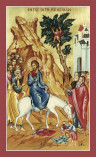
Palm Sunday
Epistle
The Reading is from the Epistle of Saint Paul to the Philippians [§ 247]. Brethren:
4 4Be rejoicing in the Lord always; again I will say, be rejoicing. 5Let your reasonableness be known to all men. The Lord is near: 6Cease being anxious about anything, but in everything by prayer and by entreaty, with giving of thanks, let your requests be made known to God. 7And the peace of God, which surpasseth all understanding, shall guard your hearts and your minds in Christ Jesus.
8For the rest, brethren, whatsoever things are true, whatsoever things are worthy of respect, whatsoever things are just, whatsoever things are pure, whatsoever things are pleasing, whatsoever things are of good report, if there is any virtue and if there is any praise, be considering these things. 9And what ye learned and received and heard and saw in me, these things be practising; and the God of peace shall be with you.
Gospel
In the Orthros
The Reading is from the Holy Gospel according to Saint Matthew [§ 83]. At that time:
21 1When Jesus drew near to Jerusalem, and came to Bethphage, toward the Mount of Olives, then Jesus sent forth two disciples, 2saying to them, “Go into the village, the one opposite you; and straightway ye shall find an ass which hath been tied, and a colt with her. Loose them and bring them to Me. 3“And if anyone should say anything to you, ye shall say, ‘The Lord hath need of them’; and straightway he will send them.” 4Now all this came to pass in order that it might be fulfilled that which was spoken by the prophet, saying, 5“Say to the daughter of Sion [Is. 62:11], ‘Behold thy King cometh to thee, meek, and mounted on an ass, and a colt, the foal of a beast of burden [cf. Zach. 9:9].’” 6And the disciples went and did even as Jesus commanded them, 7and brought the ass and the colt, and put their garments upon them, and He sat down upon them. 8And the greater part of the crowd spread their garments in the way; and others were cutting branches from the trees and were strewing them in the way. 9And the crowds, those going before and those following, were crying out, saying, “Hosanna, to the Son of David; blessed is He Who cometh in the name of the Lord [cf. Ps. 117(118):25(26)]; hosanna in the highest.” 10And after He entered into Jerusalem, all the city was shaken, saying, “Who is this?” 11And the crowds were saying, “This is Jesus the Prophet, the One from Nazareth of Galilee.”...
15But after the chief priests and the scribes saw the wonders which He did, and the children crying out in the temple and saying, “Hosanna, to the Son of David,” they were indignant, 16and said to Him, “Hearest Thou what these say?” And Jesus saith to them, “Yes; did ye never read, ‘Out of the mouth of babes and sucklings Thou hast perfected praise for Thyself [Ps. 8:2]’?” 17And He left them behind and went out of the city to Bethany, and He lodged there.
In the Liturgy
The Reading is from the Holy Gospel according to Saint John [§ 41].
12 1Six days before the passover, Jesus came to Bethany, where Lazarus was who had died, whom He raised from the dead. 2So they made a supper for Him there, and Martha was serving; but Lazarus was one of those reclining at table with Him. 3Then Mary, having taken a pound of very precious perfumed ointment of pure spikenard, anointed the feet of Jesus, and wiped His feet with her hair. And the house was filled with the odor of the perfumed ointment. 4Then one of His disciples, Judas Iscariote, Simon’s son, who was about to deliver Him up, saith, 5“Why was this perfumed ointment not sold for three hundred denarii and given to the poor?” 6But he said this, not that he was caring for the poor, but because he was a thief, and had the money box, and was taking away what was put in it. 7Then Jesus said, “Let her alone, for the day of My laying out for burial hath she kept it. 8“For ye have the poor among yourselves always, but Me ye have not always.” 9A great crowd of the Jews therefore knew that He was there, and they came not because of Jesus only, but also in order that they might see Lazarus, whom He raised from the dead. 10But the chief priests took counsel that they might put to death Lazarus also, 11because by reason of him many of the Jews were going away and were believing in Jesus.
12On the morrow a great crowd which came to the feast, after they heard that Jesus was coming into Jerusalem, 13took the palm branches of the palm trees, and went out to meet Him, and were crying, “Hosanna, blessed is He Who cometh in the name of the Lord, the King of Israel [cf. Ps. 117(118):25(26)].” 14And Jesus, having found a young ass, sat upon it, even as it is written: 15“Cease fearing, O daughter of Sion, behold, thy King cometh, sitting on a colt of an ass [cf. Zach. 9:9].” 16But the disciples knew not these things at the first; but when Jesus was glorified, then they remembered that these things were written in reference to Him, and that these things they did to Him. 17Then the crowd that was with Him when He called Lazarus out of the grave and raised him from the dead bore witness. 18On this account the crowd also went to meet Him, because it heard that He had done this sign.
Menaion — Fixed Calendar
The commemoration of the holy fathers slain at the Monastery of St. Savvas the Sanctified, the Martyrs John, Sergius, Patrick, and others.
No readings given.
Lives of the Saints (Prologue)
April 2nd – Civil Calendar
March 20th – Church Calendar
1. Our Holy Father John, and those martyred with him from the Community of St. Sava the Sanctified near Jerusalem.
This famous monastery, both visited by St. Sava of Serbia and endowed by various Serbian rulers, is still in existence today. Several times fallen to the savage Arabs, plundered and left empty, it has always been restored by the providence of God. In the time of the reign of Constantine and Irene it fell to the Arabs and was plundered. The monks would not flee, but took counsel together with their abbot, Thomas, saying: ‘We have fled from the world into this wilderness for the love of Christ; it would be shame to us now to flee from the wilderness from fear of men. If we are killed here, we shall be killed through love for Christ, for Whose sake we have come here to live.’ And, so deciding, they awaited unarmed the armed Arabs, as lambs before wolves. The Arabs killed some of them with arrows, and others they shut into the cave of St. Sava and lit a fire at the entrance to suffocate them in the smoke. And thus many of them died as martyrs for the sake of Christ and went to the kingdom of Him Whom they had loved and for the sake of Whose love they had perished. They suffered with honor before Pascha in 796, in the time of Patriarch Elias of Jerusalem. But a just punishment quickly fell on their savage destroyers. Returning to their tents, they began to quarrel, and in the ensuing battle killed each other off.
2. The Holy Martyr Photine.
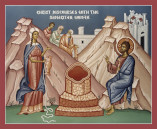 This was that Samaritan woman who had the rare fortune to speak with the Lord
Christ Himself at Jacob’s Well in Sychar (Jn. 4). Coming to faith in the Lord, she then
came to belief in His Gospel, together with her two sons, Victor and Josiah, and five sisters who
were called Anatolia, Phota, Photida, Paraskeve and Kyriake. They went to Carthage in Africa. But
they were arrested and taken to Rome in the time of the Emperor Nero, and thrown into prison. By
the providence of God, Domnina, Nero’s daughter, came into contact with St. Photine and was
brought by her to the Christian Faith. After imprisonment, they all suffered for Christ. Photine,
who first encountered the light of truth by a well, was thrown into a well, where she died and
entered into the immortal kingdom of Christ.
FOR CONSIDERATION
God does not punish sinners because it gives Him pleasure to annihilate man. If that had given Him pleasure, He would not have formed man out of nothing. But He punishes sinners for more important reasons, of which two are obvious to us. Firstly, that by punishment He may set the sinner aright and lead him onto the way of salvation, and secondly, that others may see and be fearful of sinning. St. Isaac thinks the same when he says: ‘A truly wise man is like God, for he punishes a man, not in order to be revenged for sin, but either to correct the man or to make others fearful.’ An undisciplined young man, who blasphemed against God and against his parents, suddenly went out of his mind. The whole town in which this young man lived saw this as God’s punishment, and was possessed by the fear of God. The young man was kept under restraint for three years. But his mother wept bitterly and prayed to God for her son. One year, on the Feast of the Holy Spirit, the mother took her mad son to the monastery of St. Basil at Ostrog. After prayers there, the mad boy was healed and came to himself. After that he repented and became an exemplary man and a true Christian.
Daily Scripture Readings taken from The Orthodox New Testament, translated and published by Holy Apostles Convent, Buena Vista, Colorado, copyright © 2000, used with permission, all rights reserved.
Daily Prologue Readings taken from The Prologue of Ochrid, by Bishop Nikolai Velimirovic, translated by Mother Maria, published by Lazarica Press, Birmingham, England, copyright © 1985, all rights reserved. Edited by Dormition Skete.