

Daily Devotional
Monday, May 19, 2031 (NS), May 6, 2031 (OS)
No Fasting.
Monday of the Sixth Week
The commemoration of the holy and Righteous Job the much-suffering.
Scripture Readings
Paschalion — Movable Calendar
Monday of the Sixth Week
Epistle
The Reading is from the Acts of the Apostles [§ 39]. In those days:
For Gk. usage, see Acts 17:1-9; for Sl. usage, Acts 17:1-15.
17 1After Paul and Silas traveled through Amphipolis and Apollonia, they came to Thessalonica, where there was a synagogue of the Jews. 2And according to what was customary to Paul, he went in to them, and for three sabbaths was discoursing with them from the Scriptures, 3laying open and setting forth that it was needful for the Christ to have suffered, and to have risen from the dead, and that “this Jesus Whom I proclaim to you is the Christ.” 4And some of them were persuaded and were allotted to Paul and Silas—both of the Greeks who were reverent, a great multitude, and of the chief women not a few. 5But those Jews who were not persuaded became jealous, and took to themselves certain evil men of the market-loungers, and formed a crowd, and made an uproar in the city; and having taken a stand against the house of Jason, they were seeking to bring them out to the people. 6But not having found them, they were dragging Jason and certain brethren before the rulers of the city, crying out, “These who have upset the inhabited world are present here also, 7“whom Jason hath received. And these all practise contrary to the decrees of Cæsar, saying there is another king—Jesus.” 8And they agitated the crowd and the rulers of the city when they heard these things. 9And after they took bail from Jason and the rest, they dismissed them. 10And the brethren straightway by night sent off to Verea both Paul and Silas, who, having arrived, went into the synagogue of the Jews. 11Now these, who received the word with all readiness and who daily examined the Scriptures if these things were so, were more noble than those in Thessalonica. 12Many indeed therefore from among them believed, and of the Greek women, those of noble rank, and of the men, not a few. 13But when the Jews of Thessalonica came to know that in Verea also the word of God was proclaimed by Paul, they came there also stirring up the crowds. 14And then straightway the brethren sent forth Paul to go as far as the sea; but both Silas and Timothy were staying behind there. 15And those who conducted Paul brought him as far as Athens; and having received a command for Silas and Timothy that they should come to him as quickly as possible, they went forth.
Gospel
The Reading is from the Holy Gospel according to Saint John [§ 40]. At that time:
11 47The chief priests and the Pharisees gathered together for a session of the sanhedrin, and were saying, “What are we doing? For this Man is doing many signs. 48“If we should let Him thus alone, all will believe in Him; and the Romans shall come and take away both our place and the nation.” 49But a certain one of them, Caiaphas, being high priest of that year, said to them, “Ye know nothing at all, 50“nor consider that it is expedient for us that one man should die for the people, and not that the whole nation should perish.” 51But he said this not of himself; but being high priest that year, he prophesied that Jesus was about to die for the nation; 52and not for the nation only, but that He also should gather together into one the children of God who have been scattered abroad. 53Then from that day they took counsel together among themselves, in order that they might put Him to death. 54Jesus therefore was no longer walking openly among the Jews, but went away from that place into the country near the wilderness, to a city called Ephraim, and there He stayed with His disciples.
Sl. usage adds Jn. 11:55-57.
55And the passover of the Jews was near, and many went up to Jerusalem out of the country before the passover, in order that they might purify themselves. 56Then were they seeking Jesus and were speaking with one another, as they stood in the temple, “What think ye, that He will come to the feast?” 57Now both the chief priests and the Pharisees had given a command, that if anyone should know where He is, he should make it known, in order that they might lay hold of Him.
Menaion — Fixed Calendar
The commemoration of the holy and Righteous Job the much-suffering.
Epistle
The Reading is from the Epistle of Saint Paul to the Galatians [§ 213]. Brethren:
5 22The fruit of the Spirit is love, joy, peace, long-suffering, kindness, goodness, faith, 23meekness, self-control; against such things there is no law. 24But they who are of the Christ crucified the flesh with the passions and the lusts. 25If we live by the Spirit, let us also be walking by the Spirit. 26Let us not become vainglorious, provoking one another, envying one another.
6 1Brethren, even if a man should be overtaken in some transgression, ye, the spiritual ones, be restoring such a one in the spirit of meekness, looking out for thyself, lest thou also be tempted. 2Keep on bearing one another’s burdens, and thus fill up the law of the Christ.
Gospel
The Reading is from the Holy Gospel according to Saint Matthew [§ 43]. The Lord said to His disciples:
11 27“All things were delivered to Me by My Father. And no one doth fully know the Son, except the Father; nor doth anyone fully know the Father, except the Son, and he to whomsoever the Son is willing to reveal Him. 28“Come to Me, all ye who labor and are burdened, and I will give you rest. 29“Take up My yoke upon you and learn from Me, for I am meek and humble in heart; and ye shall find rest to your souls. 30“For My yoke is good and My burden is light.”
Lives of the Saints (Prologue)
May 19th – Civil Calendar
May 6th – Church Calendar
1. Holy, Righteous, and Long-suffering Job.
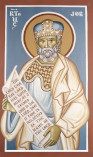 Job was a descendant of Esau the grandson of
Abraham, and lived in Arabia about 2,000 years before Christ. His father’s name was Zareth
and his mother’s Bosora; his full name was Jobab. He was an honorable and God-fearing man,
and was very rich. But when he reached the age of seventy-nine, God permitted heavy temptation
from Satan to fall on him, as is written in detail in the Book of Job. In one day, Job lost all
his great possessions and his sons and daughters. Then a great sickness fell on him, from which
his whole body was covered with sores from top to toe, and Job lay on a rubbish heap outside the
town and scoured his boils with sherds of broken pottery. But Job did not complain of God, but
patiently endured all his sufferings to the end. Therefore the Lord restored his health and gave
him riches greater than he had had before, and there were born to him seven sons and three
daughters; as many as he had had before. And Job lived for 248 years, glorifying and praising
God. Job is regarded as the model of patient endurance of every suffering that God sends us, and
is a type of the suffering Christ.
2. The Holy Martyr Barbaros.
Barbaros was a soldier in the time of Julian the Apostate. When the imperial commander Bacchus led the Roman army against the Franks, Barbaros was in that army, a secret Christian. In this battle there appeared a hero on the Frankish side, like the earlier Goliath, and he challenged the Romans to send one of their number out to single combat. The commander told Barbaros to go. Barbaros prayed in his heart to the living Lord, went out and conquered this giant. As a result, the Frankish army was confused and overcome. Then the commander made a great triumph, and ordered that sacrifice be made to idols. But, at this sacrificing, he noticed that Barbaros was standing to one side. When he asked him why, Barbaros revealed that he was a Christian. The commander informed the emperor, and the emperor commanded that Barbaros be put to the harshest torture, which Barbaros endured with rare courage and composure. At the time of his martyrdom, many marvels were seen and many soldiers, seeing them, embraced the Christian Faith. Among these was the commander Bacchus himself, with Callimachus and Dionysius. All three of them were beheaded for the name of Christ, and after them, Barbaros, in 362. Their souls went to the kingdom of Christ the immortal King.
FOR CONSIDERATION
Abba Isaias said of himself: ‘I see myself as a horse wandering without a rider. Whoever finds it sits thereon and trots on it whither he wishes. When the rider leaves the horse, a second takes it and does the same, then a third and so forth.’ This great ascetic, of whom all said with wonder that he had achieved perfection, said this of himself either out of humility or from the memory of the time of his imperfection. This saying is true in relation to every Christian who walks spiritually ungirt and unbridled. No sooner has one passion dismounted than another mounts. As soon as one has worn him out and left him in despair, another mounts him, with a diminished capacity to make him happy. Such a man has no rider to guide him in the right path without deviating either to the right or left. The only friendly rider, to be welcomed with joy, is a holy and powerful Christian spirit.
Daily Scripture Readings taken from The Orthodox New Testament, translated and published by Holy Apostles Convent, Buena Vista, Colorado, copyright © 2000, used with permission, all rights reserved.
Daily Prologue Readings taken from The Prologue of Ochrid, by Bishop Nikolai Velimirovic, translated by Mother Maria, published by Lazarica Press, Birmingham, England, copyright © 1985, all rights reserved. Edited by Dormition Skete.