

Daily Devotional
Sunday, May 18, 2031 (NS), May 5, 2031 (OS)
No Fasting.
| Sixth Sunday of Pascha, or the Sunday of the Blind Man Mode Plagal One — Eighth Eothinon |
The commemoration of the Great-martyr Irene of Magedon.
Scripture Readings
Paschalion — Movable Calendar
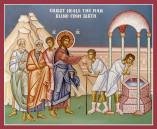
Sixth Sunday of Pascha, or the Sunday of the Blind Man
Mode Plagal One — Eighth Eothinon
Epistle
The Reading is from the Acts of the Apostles [§ 38]. In those days:
16 16It came to pass, as we went to prayer, that a certain young girl, possessing a spirit of Python, met us, who was producing much business for her masters by divining. 17She followed after Paul and us, and cried out, saying, “These men are slaves of God, the Most High, who proclaim to us the way of salvation.” 18And she kept doing this for many days. But Paul was worn out, and turned around to the spirit, and said, “I command thee in the name of Jesus Christ to come out from her.” And he came out the same hour. 19And after her masters saw that the hope of their business was gone, they laid hold of Paul and Silas, and dragged them into the marketplace before the rulers. 20And they brought them to the magistrates, and said, “These men, being Jews, exceedingly trouble our city, 21“and declare customs, which are not allowed for us to receive, nor to do, being Romans.” 22And the crowd rose together against them; and the magistrates tore off their garments, and kept on commanding to beat them with rods. 23And after they laid on them many stripes, they cast them into prison, ordering the jailer to guard them securely, 24who, having received such an order, cast them into the inner prison and secured their feet in the stocks. 25And at midnight Paul and Silas were praying and singing hymns to God; and the prisoners were listening to them. 26And suddenly there occurred a great earthquake, so that the foundations of the prison were shaken; and immediately all the doors were opened and the bonds of all were loosed. 27The jailer, having been awakened out of sleep and seeing the doors of the prison opened, drew a sword, and was about to kill himself, believing the prisoners to have escaped. 28But Paul cried out with a loud voice, saying, “By no means begin to do any evil to thyself; for we are all here.” 29And after he asked for lights, he leaped in and became tremulous, falling down before Paul and Silas. 30And having brought them forth outside, he said, “Sirs, what is necessary for me to do in order that I might be saved?” 31And they said, “Believe on the Lord Jesus Christ, and thou shalt be saved, thou and thy house.” 32And they spoke to him the word of the Lord, and to all those in his house. 33And having taken them in that hour of the night, he washed their wounds. And he was baptized, he and all his, immediately. 34And having brought them into his house, he set a table before them, and rejoiced, having believed in God, with all his house.
Gospel
The Reading is from the Holy Gospel according to Saint John [§ 34]. At that time:
9 1As Jesus passed by, He saw a man who was blind from birth. 2And His disciples asked Him, saying, “Rabbi, who sinned, this one or his parents, that he should be born blind?” 3Jesus answered, “Neither this one sinned nor his parents, but in order that the works of God should be made manifest in him. 4“It is needful for Me to be working the works of the One Who sent Me while it is day; night cometh when no one is able to be working. 5“Whenever I may be in the world, I am the light of the world.” 6Having said these things, He spat on the ground, and made clay out of the spittle, and anointed the eyes of the blind one with the clay, 7and said to him, “Go, wash in the pool of Siloam” (which is interpreted, Sent forth). He went therefore and washed, and came seeing.
8Then the neighbors and those who saw him that was formerly blind were saying, “This is the one who sat and begged, is it not?” 9Some were saying, “This is he”; but others, “He is like him.” But that one kept on saying, “I am he.” 10Then they began to say to him, “How were thine eyes opened?” 11That one answered and said, “A Man Who is called Jesus made clay and anointed mine eyes, and said to me, ‘Go to the pool of Siloam, and wash.’ And I went and washed, and received sight.” 12Then they said to him, “Where is that Man?” He said, “I know not.”
13They brought him who was once blind to the Pharisees. 14And it was a sabbath when Jesus made the clay and opened his eyes. 15Then again the Pharisees also began asking him how he received sight. And he said to them, “He put clay upon mine eyes, and I washed, and I see.” 16Therefore some of the Pharisees were saying, “This Man is not from God, because He keepeth not the sabbath.” Others were saying, “How is a man, a sinner, able to do such signs?” And there was a division among them. 17They say to the blind one again, “What sayest thou concerning Him, in that He opened thine eyes?” And he said, “He is a prophet.” 18Then the Jews did not believe concerning him, that he was blind and received sight, until which time they called the parents of him who received sight. 19And they asked them, saying, “Is this your son, whom ye say that he was born blind? How then doth he now see?” 20His parents answered them and said, “We know that this is our son, and that he was born blind; 21“but how he now seeth, we know not, or who opened his eyes, we know not; he is of age; ask him. He shall speak for himself.” 22The parents said these things because they were fearing the Jews; for already the Jews had agreed among themselves that if anyone should confess Him to be the Christ, he would be expelled from the synagogue. 23For this reason his parents said, “He is of age; ask him.” 24Then a second time they called the man who was blind, and said to him, “Give glory to God; we know that this Man is a sinner.” 25Then that one answered and said, “If He is a sinner, I know not; one thing I know, that though I was blind, now I see.” 26But they said to him again, “What did He do to thee? How did He open thine eyes?” 27He answered them, “I told you already, and ye did not hear; why again do ye wish to hear it? Ye do not also wish to become His disciples, do ye?” 28Then they reviled him, and said, “Thou art a disciple of that One; but we are disciples of Moses. 29“We know that God hath spoken to Moses; but this One, we do not know from what place He is.” 30The man answered and said to them, “Why in this is a marvellous thing, that ye do not know from what place He is, and yet He opened mine eyes. 31“Now we know that God heareth not sinners, but if anyone be serving God and doing His will, He heareth this one. 32“From of old it was not heard that anyone opened the eyes of one who hath been born blind. 33“If this One were not from God, He could do nothing.” 34They answered and said to him, “In sins thou wast born, all of thee, and dost thou teach us?” And they cast him out. 35Jesus heard that they cast him out; and having found him, He said to him, “Believest thou in the Son of God?” 36That one answered and said, “And Who is He, Sir, that I might believe in Him?” 37And Jesus said to him, “Thou hast both seen Him and the One Who talketh with thee is that One.” 38And he said, “I believe, O Lord.” And he made obeisance to Him.
Menaion — Fixed Calendar
The commemoration of the Great-martyr Irene of Magedon.
No readings given.
Lives of the Saints (Prologue)
May 18th – Civil Calendar
May 5th – Church Calendar
1. The Holy and Great Martyr Irene.
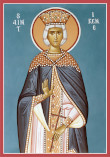 She lived in the Balkans in apostolic times, in the town
of Magedon where her father Licinius was governor of a small region. She was born a pagan of
pagan parents. Penelope—for that was her pagan name—learned the Christian Faith from her teacher,
Appelianus. St. Timothy, the disciple of the Apostle Paul, baptized her and her lady-in-waiting,
and brought her a letter from the Apostle Paul to read. She infuriated her father by her
embracing Christianity, and he intended to have her trampled to death by horses. The horses
turned on him, however, slaying him. She prayed to God on behalf of her father, who had just
tried to kill her, and the Lord resurrected him. He subsequently embraced Christianity. Irene was
tortured in different ways by four kings, other than her father, but God saved her through His
angels. King Sedekias had her cast headlong into a deep pit full of snakes and reptiles. The
saint persevered there for fourteen days, and emerged unscathed. Then the same king attempted to
saw off her feet, but the sword broke against her body as against stone. This same king once
again bound her to the wheel of a water-mill, then let the water in to drown her, but the water
would not flow, but stood still, and the maiden remained whole and alive. After Sedekias was
ousted from his domain, Sapor, his son, marched against those who deposed his father. St. Irene
met Sapor and his army in the city of Magedon. By her prayers, his entire army was stricken
blind. Again, she prayed and their eyesight was restored by divine grace. Nonetheless, the
ungrateful ones shod her with nails, loaded a sack of sand onto her, put a bridle on her and
commanded that she be led like an animal far outside the city. ‘Truly I am as a beast
before Thee, O Lord!’ said the holy martyr as she ran bridled behind her torturers. But an
angel of God caused an earthquake, and the earth opened and swallowed up ten thousand
infidels—but brought thirty thousand to the Faith. Despite this, the king persisted in his
paganism, for which he was smote by an angel of the Lord. Surviving all these tortures, by which
an enormous number of pagans were brought to Christianity, Irene went to the city of Kallinikos,
where she preached the Christian Faith. The local king, Numerian, tried to kill her, throwing her
into three burning metal oxen one after the other. But the maiden was preserved and remained
alive, and many saw and believed. The eparch, Vavdonos, sought to kill her by putting her onto a
burning grid, but this did not harm St. Irene, and brought him to the true Faith. She then went
to the city of Constantina, where Shapur II the Great, King of the Persians, had her head cut
off. But she was resurrected by an angel of God. The king, seeing this, together with many of the
people, believed in Christ and was baptized. And thus St. Irene, by her sufferings and miracles,
brought over 100,000 pagans to faith in Christ. At last she laid herself in a grave and commanded
Appelianus, her former teacher, to close it. After four days, when the grave was opened, her body
was not in it. Thus God glorified forever the maiden and martyr Irene, who had sacrificed all and
endured all, that God should be the more greatly glorified among men.
2. Ss. Martin and Heraclius.
Slavs, they were persecuted by heretical Arians in Illyria. Sent into exile, these knights of Orthodoxy finished their earthly course in the 4th century and went to the Lord.
FOR CONSIDERATION
Prayer with words is of no use if the heart does not participate. God only hears prayer from the heart. Abba Zoilos of the Thebaid, returning once from Mount Sinai, met a monk who complained that in the monastery, they were greatly suffering from drought. Zoilos asked: ‘Why don’t you pray to God, and implore Him?’ The monk replied: ‘We have prayed and implored, but there is no rain!’ To this Zoilos answered: ‘It is obvious that you are not praying from the heart. Do you want to be convinced that this is so?’ And, thus speaking, the elder raised his hands to heaven and began to pray, and abundant rain fell onto the earth. Seeing this, the marveling monk fell to the ground before the elder and did him reverence, but the elder, fearing the praise of men, quickly fled from him. ‘Ask, and it shall be given you,’ said the Lord Himself. But vain are mouthfuls of prayers if the heart is empty. God does not stand and listen to the lips, but to the heart. Let the heart be filled with prayer and the lips be silent. God will hear and receive the prayer, for He only hearkens to heartfelt prayer.
Daily Scripture Readings taken from The Orthodox New Testament, translated and published by Holy Apostles Convent, Buena Vista, Colorado, copyright © 2000, used with permission, all rights reserved.
Daily Prologue Readings taken from The Prologue of Ochrid, by Bishop Nikolai Velimirovic, translated by Mother Maria, published by Lazarica Press, Birmingham, England, copyright © 1985, all rights reserved. Edited by Dormition Skete.