

Daily Devotional
Sunday, March 16, 2031 (NS), March 3, 2031 (OS)
Fast Day, but Shellfish, Wine and Olive Oil Allowed.
Holy & Great Fast
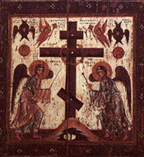
| The Sunday of the Third Week of the Great Fast or Sunday of the Veneration of the Cross. Mode Plagal Two — Sixth Eothinon |
The commemoration of the holy Martyrs Evtropios, Kleonikos, and Vasiliskos.
Scripture Readings
Paschalion — Movable Calendar
The Sunday of the Third Week of the Great Fast or Sunday of the Veneration of the Cross.
Mode Plagal Two — Sixth Eothinon
Epistle
The Reading is from the Epistle of Saint Paul to the Hebrews [§ 311]. Brethren:
4 14Having then a great High Priest Who hath passed through the heavens, Jesus the Son of God, let us be holding fast our confession. 15For we do not have a High Priest Who is not able to sympathize with our weaknesses, but One Who hath been tempted in all respects according to our likeness, without sin. 16Let us therefore be coming with boldness to the throne of grace, that we might receive mercy and find grace for help in due season.
5 1For every high priest being taken from among men is being appointed on behalf of men in things pertaining to God, that he may offer both gifts and sacrifices for sins, 2who is able to feel in due measure with those who are ignorant and led astray, since he himself also is compassed about with weakness. 3And by reason of this he ought, even for the people, so also for himself, to offer for sins. 4And no one taketh the honor to himself, but he who is called by God, even as also Aaron. 5Thus also the Christ glorified not Himself to become a high priest, but the One Who said to Him, “Thou art My Son, today I have begotten Thee [Ps. 2:7].” 6Even as He saith also in another place, “Thou art a priest forever according to the order of Melchisedek [Ps. 109(110):4].”
Gospel
The Reading is from the Holy Gospel according to Saint Mark [§ 37]. The Lord said:
8 34“Whosoever is willing to follow after Me, let him deny himself, and take up his cross, and keep on following Me. 35“For whosoever will save his life shall lose it; but whosoever will lose his life on account of Me and of the Gospel, this same one shall save it. 36“For what shall it profit a man, if he should gain the whole world, and lose his soul? 37“Or what shall a man give as an exchange for his soul? 38“For whosoever is ashamed of Me and My words in this generation, the adulterous and sinful one, also the Son of Man shall be ashamed of him, whenever He should come in the glory of His Father with the holy angels.”
9 1And He was saying to them, “Verily I say to you, that there are some of those standing here who in no wise shall taste of death, until they see the kingdom of God having come in power.”
Menaion — Fixed Calendar
The commemoration of the holy Martyrs Evtropios, Kleonikos, and Vasiliskos.
No readings given.
Synaxarion Readings
Synaxarion for the Third Sunday of Great Lent
Adoration of the Precious and Life-giving Cross
“Let all the earth venerate the Cross, through which it has learned to worship Thee, the Logos.”
On this third Sunday of the Great Fast we celebrate the veneration of the precious and life-giving Cross. Since during the forty days of the Fast we are also in a way crucified, mortified to the passions, contrite, abased, and sorrowful, the precious and life-giving Cross is offered to us as refreshment and confirmation, calling to mind the Passion of our Lord Jesus Christ and comforting us. If our God was crucified for our sake, how great should be our effort for His sake, since our afflictions have been assuaged through the Lord’s tribulations, and by the commemoration and the hope of the Cross of glory. For as our Savior in ascending the Cross was glorified through dishonor and grief, so should we also endure our sorrows, in order to be glorified with Him. Also, as those who have traveled a long hard road, weighed down by the labors of their journey, in finding a shady tree, take their ease for a moment and then continue their journey rejuvenated, so now in this time of the Fast, this sorrowful and laborious journey, the holy fathers have planted the life-giving Cross for our relief and refreshment, to encourage and make easier the labors that lie ahead. Or as when there is a royal procession, the king’s scepter and banners precede him, and then he himself appears, radiant and joyous in his victory, causing his subjects to rejoice with him. So then our Lord Jesus Christ, desiring to show His sure victory over death and His glory on the day of the Resurrection, sends His scepter before Himself, the sign of His kingship, the life-giving Cross, to gladden and refresh us, as it greatly fortifies and enables us to be prepared to receive the King with all possible strength and to praise Him in His radiant victory.
This week lies at the middle of the holy Forty Day Fast. The Fast is like a bitter source because of our contrition and the sadness and sorrow for sin that it brings. And as Moses plunged the branch in the bitter waters of Marah, making them sweet, so God, Who has led us through the spiritual Red Sea away from Pharaoh, through the life-giving wood of the precious and life-giving Cross, sweetens the bitterness of the Forty Day Fast and comforts us as those who were in the wilderness, until the time when by His Resurrection He will lead us to the spiritual Jerusalem. And since the Cross is called, and indeed is, the Tree of Life, it is fitting that the holy fathers have planted the Tree of the Cross in the middle of the Great Fast to commemorate both Adam’s tasting of its sweet fruit and of its being taken from us in favor of the Tree of the Cross, tasting of which we shall in no way die but will have even greater life.
Through the power of Thy Cross, O Christ our God, preserve us also from the temptations of the evil one. And make us worthy to venerate Thy divine Passion and life-bearing Resurrection, having radiantly traversed the great length of the Fast, and have mercy on us, as Thou art good and lovest mankind. Amen.
Translated from Triodion, siest ‘Tripesnets: Triod’ Postnaya, Moscow, 1904, by Robert Parent.
Lives of the Saints (Prologue)
March 16th – Civil Calendar
March 3rd – Church Calendar
1. The Holy Martyrs Eftropios, Kleonikos and Vasiliskos.
They were comrades of St. Theodore the Tyro. When glorious Theodore gloriously laid down his life, they remained behind in prison. They were not condemned for a long time because of the courage of the imperial governor of the town of Amaseia. When a new governor arrived, more inhuman than his predecessor, he ordered these three to be brought before him. All three were young men; Eftropios (Eutropius) and Kleonikos (Cleonicus) were brothers and Vasiliskos (Basiliscus) a kinsman of Theodore’s. But all three were, through their brotherly love, as blood-brothers. And they therefore said to the governor: ‘As the Holy Trinity is indivisible, so are we indivisible in faith and inseparable in love.’ All flattery on the governor’s part was in vain, as were all his efforts to bribe Eftropios. He first invited him to dine with him, which Eftropios refused with a quotation from the Psalms: ‘Blessed is the man who walked not in the counsel of the ungodly,’ after which he offered him vast wealth—150 liters of silver—which Eftropios likewise refused, reminding the governor that Judas lost his soul for silver. After all these attempts, followed by interrogation and torture, the first two were condemned to be crucified, for which they gave thanks to Christ that He had counted them worthy to die the death He had died; and the third, Vasiliskos, was beheaded. They all entered into the kingdom of joy, where their commander, Theodore, was waiting for them, glorified before Christ the Lord and Victor. They suffered with honor in 308.
2. St. Piama of Egypt.
For the sake of Christ she refused to marry, and gave herself to asceticism in her mother’s house. She took only a little food every other day, and spent her time in prayer and meditation, being gifted with insight. She departed this life peacefully, commending her soul to the Lord, in about the year 377.
3. An Unknown Girl in Alexandria.
She was from a wealthy house, having a good father who suffered much and had a difficult death, and an evil mother who had an easy life, died in peace and was buried with honor. In uncertainty whether to live by the example of her father or her mother, this maiden had a vision in which the state of her father and of her mother were shown to her. She saw her father in the kingdom of God, and her mother in darkness and torment. This determined her to devote her whole life to God, and like her father, follow the commandments of God without regard to any opposition or misfortune that she might have to endure. And she followed the commandments of God to the end, with His help, and was made worthy of the kingdom of heaven, in which she was reunited with her beloved father.
FOR CONSIDERATION
Speaking on a human level, Christ raised Himself to primacy in the Church, the world and human history by obedience. No one can be a good superior who has not gone through the school of obedience. Adam lost his power and primacy over the animals and the natural elements in the hour when he showed himself disobedient to God. ‘Obedience begets obedience; if a man listens to God, then God listens to him,’ said Abba Moses. However, it is obvious that God listens to man more than man does to God, when one counts up how many times a day people sin against the commandments of God. The fact that the immortal God listens to us corruptible beings more than we do to Him should fill with shame anyone with any conscience remaining. When St. Eftropios was martyred with his two friends, he prayed to God: ‘Come to our aid, as Thou camest to the aid of Thy servant Theodore!’ At that, the earth quaked and the obedient Lord revealed Himself with the angels and St. Theodore. And the Lord said to the sufferers: ‘During the time of your torture, I stood before your faces, witnessing your endurance. Your names will be written in the Book of Life.’
Daily Scripture Readings taken from The Orthodox New Testament, translated and published by Holy Apostles Convent, Buena Vista, Colorado, copyright © 2000, used with permission, all rights reserved.
Daily Prologue Readings taken from The Prologue of Ochrid, by Bishop Nikolai Velimirovic, translated by Mother Maria, published by Lazarica Press, Birmingham, England, copyright © 1985, all rights reserved. Edited by Dormition Skete.