

Daily Devotional
Tuesday, February 11, 2031 (NS), January 29, 2031 (OS)
No Fasting.
Tuesday of the Thirty-Fifth Week
29. The commemoration of the translation of the relics of Hieromartyr Ignatios the God-bearer.
Scripture Readings
Paschalion — Movable Calendar
Tuesday of the Thirty-Fifth Week
Epistle
The Reading is from the First General Epistle of Saint John [§ 72]. Brethren:
For Gk. usage, see 1 Jn. 3:9-22; for Sl. usage, see 1 Jn. 3:10-20, beginning in the middle of verse 10, “My beloved: Everyone who doeth not righteousness....”
3 9Everyone who hath been born of God doeth no sin, because His seed abideth in him; and he is not able to sin, because he hath been born of God. 10In this are manifest the children of God and the children of the devil. Everyone who doeth not righteousness is not of God, and neither is the one who loveth not his brother. 11Because this is the message which ye heard from the beginning, that we be loving one another, 12not as Cain, who was of the evil one and slew his brother. And on account of what did he slay him? Because his works were evil, but those of his brother righteous. 13Cease marvelling, my brethren, if the world hate you. 14We know that we have passed over out of death into life, because we love the brethren. The one not loving his brother abideth in death. 15Everyone who hateth his brother is a manslayer, and ye know that every manslayer hath not eternal life abiding in him. 16In this we have come to know love, because He laid down His life for us; and we ought to lay down our lives for the brethren. 17But whosoever may have the world’s means of livelihood, and may observe his brother having need, and shutteth up from him his compassion from the inward parts, how doth the love of God abide in him? 18My little children, let us not be loving in word, neither in tongue, but in deed and in truth. 19And in this we know that we are of the truth, and shall persuade our hearts before Him, 20that if our heart be condemning us, God is greater than our heart and knoweth all things. 21Beloved, if our heart be not condemning us, we have boldness toward God. 22And whatsoever we may ask, we receive from Him, because we keep His commandments and do the things that are pleasing before Him.
Gospel
The Reading is from the Holy Gospel according to Saint Mark [§ 64]. At that time:
14 10Judas the Iscariote, one of the twelve, went away to the chief priests, in order that he might deliver Him up to them. 11And after they heard it, they were glad and promised to give him money; and he was seeking how he might opportunely deliver Him up.
12And on the first day of the unleavened bread, when they used to slay the passover, His disciples said to Him, “Where dost Thou wish that we go and prepare, that Thou mightest eat the passover?” 13And He sendeth forth two of His disciples, and saith to them, “Go ye into the city, and a man shall meet you bearing an earthenware vessel of water; follow him. 14“And wheresoever he should enter, say to the master of the house, ‘The Teacher saith, “Where is the lodging-place, where I shall eat the passover with My disciples?”’ 15“And he will show you a large upper room, which hath been furnished and prepared; there make ready for us.” 16And His disciples went away, and came into the city, and found it even as He said to them; and they made ready the passover. 17And evening having come to pass, He cometh with the twelve. 18And as they reclined at table and ate, Jesus said, “Verily I say to you, that one of you who is eating with Me shall deliver Me up.” 19And they began to be grieved, and to say to Him, one by one, “It is not I, is it?” And another, “It is not I, is it?” 20But He answered and said to them, “It is one of the twelve, who dippeth with Me in the dish. 21“The Son of Man indeed goeth even as it hath been written concerning Him, but woe to that man by whom the Son of Man is delivered up! Good were it for that man if he had not been born.” 22And as they ate, Jesus took bread, blessed it, and broke it, and gave to them, and said, “Take, eat; this is My body.” 23And He took the cup, and gave thanks, and gave it to them; and they all drank of it. 24And He said to them, “This is My blood, that of the new covenant, which is being poured out for many. 25“Verily I say to you that in no wise will I drink any more of the fruit of the vine, until that day when I drink it new in the kingdom of God.”
26And having sung a hymn, they went out to the Mount of Olives. 27And Jesus saith to them, “Ye all shall be made to stumble because of Me during this night, for it hath been written: ‘I will smite the Shepherd, and the sheep shall be scattered abroad [cf. Zach. 13:7].’ 28“But after I have risen, I will go before you into Galilee.” 29But Peter said to Him, “Though all shall be made to stumble, yet not I.” 30And Jesus saith to him, “Verily I say to thee that today, during the night, before the cock crow twice, thou shalt deny Me thrice.” 31But he kept on speaking more vehemently, “If it should be necessary for me to die with Thee, in no wise will I deny Thee.” And in like manner also, they all were speaking.
32And they came to a place which was named Gethsemane; and He saith to His disciples, “Sit here while I pray.” 33And He taketh along with Him Peter and Iakovos and John, and began to be amazed and sorely troubled. 34And He saith to them, “My soul is very sad unto death. Tarry here and be watching.” 35And having gone forth a little, He fell upon His face on the ground, and was praying that, if it were possible, the hour might pass from Him. 36And He was saying, “Abba, Father, all things are possible to Thee. Take away this cup from Me; but not what I will, but what Thou wilt.” 37And He cometh and findeth them sleeping, and saith to Peter, “Simon, sleepest thou? Wast thou not able to watch one hour? 38“Be watching and praying that ye enter not into temptation; the spirit indeed is willing, but the flesh is weak.” 39And again He went away and prayed, saying the same utterance. 40And having returned, He found them again sleeping; for their eyes were weighed down, and they knew not what they should answer Him. 41And He cometh the third time, and saith to them, “Sleep on for what time remaineth and be taking your rest! It is enough, the hour hath come; behold, the Son of Man is being delivered up into the hands of the sinners. 42“Rouse yourselves, let us be going; behold the one delivering Me up hath drawn near.”
Menaion — Fixed Calendar
29. The commemoration of the translation of the relics of Hieromartyr Ignatios the God-bearer.
Epistle
The Reading is from the Epistle of Saint Paul to the Hebrews [§ 325]. Brethren:
10 32Remind yourselves of the former days in which, after ye were illuminated, ye endured a great contest of sufferings: 33partly, being made a show of both by reproaches and affliction; and partly, having become partners of those who conducted themselves thus. 34For ye also sympathized with those in bonds and ye yourselves accepted the seizure of your possessions with joy, knowing in yourselves that ye have in the heavens a better and abiding possession. 35Do not begin therefore to cast away your boldness which hath great recompense. 36For ye have need of patience, that, after ye do the will of God, ye might receive for yourselves the promise. 37“For yet a very little while, the One Who cometh will come, and will not delay [cf. Hab. 2:3]. 38“Now the just shall live by faith; and if one should draw himself back, My soul hath no pleasure in him [cf. Hab. 2:4].”
for Sl. usage, see [Heb. 4:14-5:6].
Gospel
The Reading is from the Holy Gospel according to Saint Mark [§ 41]. At that time:
9 33 Jesus and His disciples came to Capernaum. And when He was in the house, He was questioning them, “What were ye discussing among yourselves on the way?” 34But they were keeping silent; for on the way they discussed with one another who was greater. 35And He sat down and called the twelve, and saith to them, “If anyone doth wish to be first, he shall be last of all and servant of all.” 36And He took a little child and set him in their midst. And after He took him into His arms, He said to them, 37“Whosoever shall receive one of such little children in My name, receiveth Me; and whosoever shall receive Me, receiveth not Me, but the One Who sent Me forth.”
38And John answered Him, saying, “Teacher, we saw someone who doth not follow us casting out demons in Thy name, and we hindered him, because he doth not follow us.” 39But Jesus said, “Cease hindering him, for there is no one who shall do a work of power in My name, and be able quickly to speak evil of Me. 40“For he who is not against us is for us. 41“For whosoever shall give you a cup of water to drink in My name, because ye are of Christ, verily I say to you, in no wise shall he lose his reward.”
Lives of the Saints (Prologue)
February 11th – Civil Calendar
January 29th – Church Calendar
1. The Hieromartyr Ignatius.
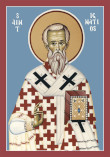 The chief feast of St. Ignatius is on December 20th. Today
we celebrate the translation of his relics from Rome, where he suffered martyrdom, to
Antioch, where he had been archbishop. When St. Ignatius was summoned to Rome to answer for
his faith before the Emperor Trajan (98-117) a number of citizens from Antioch accompanied
him on this long journey, prompted by their great love for their chief pastor. The saint of
God, in no wise willing to deny the Faith of Christ and scorning all the flattery and
promises of the emperor, was condemned to death and thrown into the Great Circus before the
wild beasts. They tore him to pieces and he gave his soul to God. Then his companions
collected his bare bones, took them to Antioch and buried them. When the Persians occupied
Antioch in the sixth century, the relics of St. Ignatius were again taken from Antioch to
Rome. |
2. The Holy Martyrs Romanos, Iakovos, Philotheos, Hyperechios, Abibos, Julian and Paregorios.
They all suffered for Christ in Samosata in the time of the Emperor Maximilian, in the year 297. Philotheos and Hyperechios were aristocrats, and the others were young men of respected families. The pagans killed them in a terrible way: by hammering nails into the head of each of them. They suffered with honor and entered into eternal joy.
3. Our Holy Father Laurence (Lavrenty) of the Kiev Caves.
He voluntarily chose the solitary life like the earlier recluses Isaac and Nikita, guarding himself from the diabolic deception which the other two experienced at the beginning. By great restraint, prayer and meditation, he attained a high level of perfection. He discovered from a frightened demon that, of the 118 monks in the Monastery of the Caves, there were thirty who had received the gift from God of power over evil spirits. He went to God in the year 1194.
FOR CONSIDERATION
The more a man progresses in spiritual understanding and purity of heart, the deeper, it seems to him, is the valley in which he finds himself and the higher the peak to which he is aspiring. One spiritual giant, lying on his death bed, heard that he was being praised for his great asceticism. He burst into tears, saying: ‘My children, I have not begun in the spiritual life.’ When St. Ignatius was lying shackled in prison, he wrote to the Ephesians: ‘I do not command you as though I had some standing. Although I am in chains for the name of Jesus Christ, I am not yet perfected in Him. I am only beginning to be a disciple, and I speak to you as fellow-pupils of my teachers.’
Daily Scripture Readings taken from The Orthodox New Testament, translated and published by Holy Apostles Convent, Buena Vista, Colorado, copyright © 2000, used with permission, all rights reserved.
Daily Prologue Readings taken from The Prologue of Ochrid, by Bishop Nikolai Velimirovic, translated by Mother Maria, published by Lazarica Press, Birmingham, England, copyright © 1985, all rights reserved. Edited by Dormition Skete.