

Daily Devotional
Monday, January 20, 2031 (NS), January 7, 2031 (OS)
No Fasting.
Monday of the Thirty-Second Week
The commemoration of the Afterfeast of Theophany, and the Synaxis of the honorable and glorious prophet, forerunner, and Baptist John.
Scripture Readings
Paschalion — Movable Calendar
Monday of the Thirty-Second Week
Epistle
The Reading is from the General Epistle of Saint Iakovos [§ 53].
2 14Brethren, what is the profit if one declare oneself to have faith but have not works? Is faith able to save him? 15Now if a brother or a sister be naked and wanting of daily food, 16and any of you should say to them, “Go in peace, warm yourselves and feed yourselves,” but ye give them not the necessities of the body, what is the profit? 17Even so faith, if it be not having works, is in itself dead. 18But someone will say, “Thou hast faith, and I have works”; show me thy faith without thy works, and I by my works will show thee my faith. 19Thou believest that God is one. Thou doest well. The demons also believe, and shudder. 20But dost thou wish to know, O vain man, that faith without works is dead? 21Was not Abraham our father justified by works, after he offered Isaac his son upon the altar? 22Thou seest that faith was working with his works, and by works faith was made perfect. 23And the Scripture was fulfilled which saith, “And Abraham believed God, and it was reckoned to him for righteousness [cf. Gen. 15:6]”; and he was called a “friend of God [cf. Ex. 33:11; Is. 41:8].” 24Ye see then that by works a man is justified, and not by faith only. 25But in like manner also was not Rahab the harlot justified by works, after she received the messengers and sent them out by another way? 26For even as the body without the spirit is dead, so also faith without works is dead.
Gospel
The Reading is from the Holy Gospel according to Saint Mark [§ 27]. At that time:
6 54After Jesus came out of the ship, straightway those of the country of Gennesaret recognized Him, 55and ran around that whole country round about, and began to carry about on the beds those who were ill to where they were hearing, “He is there.” 56And wheresoever He entered, into villages or cities or fields, in the marketplaces they kept on laying those who were sick, and beseeching Him that they might touch if just the fringe of His garment; and as many as would touch Him were made well.
7 1And the Pharisees and some of the scribes, who came from Jerusalem, gathered together to Him. 2And after they saw some of His disciples eating loaves with defiled hands, that is, unwashed hands, they found fault. 3For the Pharisees and all the Jews, unless they wash their hands, up to the elbow, eat not, holding the tradition of the elders. 4And on coming from the marketplace, unless they perform ablutions for themselves, they eat not. And there are many other things which they received and hold: dippings of cups and pitchers and copper vessels and couches. 5Then the Pharisees and the scribes questioned Him, “Why do Thy disciples not walk according to the tradition of the elders, but eat bread with unwashed hands?” 6And He answered and said to them, “Well did Esaias prophesy concerning you, the hypocrites, as it hath been written: ‘This people honoreth Me with their lips, but their heart is far away from Me [Is. 29:13]. 7“‘And in vain they revere Me, teaching as precepts the commandments of men [Is. 29:13].’ 8“For having left the commandment of God, ye keep on holding the tradition of men—dippings of pitchers and cups, and many other such like things ye do.”
Menaion — Fixed Calendar
The commemoration of the Afterfeast of Theophany, and the Synaxis of the honorable and glorious prophet, forerunner, and Baptist John.
Epistle
The Reading is from the Acts of the Apostles [§ 42]. In those days:
19 1It came to pass, while Apollos was in Corinth, Paul, having passed through the upper parts, came to Ephesus. And having found certain disciples, 2he said to them, “Did ye, having believed, receive the Holy Spirit?” And they said to him, “Nay, we did not even hear whether there is a Holy Spirit.” 3And he said to them, “Into what then were ye baptized?” And they said, “Into the baptism of John.” 4And Paul said, “John indeed baptized with a baptism of repentance, saying to the people that they should believe in the One coming after him, that is, in the Christ, Jesus.” 5And after they heard this, they were baptized in the name of the Lord Jesus. 6And after Paul laid his hands upon them, the Holy Spirit came upon them, and they were speaking with tongues and prophesying. 7And all the men were about twelve. 8And he entered into the synagogue and kept on speaking boldly for three months, discoursing and trying to persuade them concerning the things of the kingdom of God.
Gospel
The Reading is from the Holy Gospel according to Saint John [§ 3]. At that time:
1 29John seeth Jesus coming to him, and saith, “Behold the Lamb of God Who taketh away the sin of the world. 30“This is He concerning Whom I said, ‘After me cometh a Man Who hath come to be before me, for He was before me.’ 31“And I knew Him not; but that He should be made manifest to Israel, therefore I came baptizing in the water.” 32And John bore witness, saying, “I have beheld the Spirit descending out of heaven as a dove, and He abode upon Him. 33“And I knew Him not, but the One Who sent me to baptize in water, that One said to me, ‘Upon whomsoever thou shalt see the Spirit descending and abiding on Him, this is the One Who baptizeth in the Holy Spirit.’ 34“And I have seen and have borne witness that this is the Son of God.”
Lives of the Saints (Prologue)
January 20th – Civil Calendar
January 7th – Church Calendar
1. St. John the Baptist.
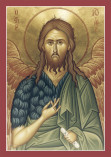 John’s greatest role during his life was enacted on the day of
the Theophany, and because of this the Church has, from the earliest times, dedicated the day
following that feast to his memory. This day is also connected with an event involving the hand
of the Forerunner. The Evangelist Luke desired to take John’s body from Sebaste, where the
great prophet had been beheaded by Herod, to Antioch, his own birthplace. He succeeded, though,
in acquiring and taking only one hand, which was kept in Antioch till the tenth century. It was
then moved to Constantinople, whence it disappeared during the Turkish occupation.
St. John is commemorated several times during the year, but his greatest feast is on this day, January 7th. Among the Gospel-figures surrounding the Savior, the person of John the Baptist holds a very special place, by the manner of his birth in this world and of his earthly life, by his role of baptizer of men to repentance and his Baptism of the Messiah, and lastly, by the tragic manner of his departure from this world. He was of such moral purity that he indeed deserved the name ‘angel’*, as he was named in the Scriptures, rather than being thought of as just a mortal man. St. John differs from all the other prophets in that he had the joy of showing forth to the world the One Whom he had foretold.
About the hand of St. John: it is related that each year, on his feast day, the archbishop would bring it out before the people. Sometimes the hand appeared open, and sometimes clenched. In the first case it indicated that it would be a fertile year, and in the second that it would be a year of famine.
* The word ‘messenger’ is, in Greek, ‘angelos’. See Malachi 3:1; Matt. 11:10. —Tr.
2. The Holy New-Martyr Athanasius.
This martyr of Christ was a poor and simple man, but was rich in faith and in wisdom through the Spirit of God. On one occasion he was inadvertently involved in a quarrel with a Turk. The Turk was educated and adroit with words, but Athanasius strove with all his might to present and uphold the truth of the Christian Faith and its superiority over Islam. They then parted. On the following day, Athanasius was summoned to trial, and found the Turk standing there as his accuser. When the judge called on Athanasius to repudiate his faith and embrace Islam, as he had given the impression of declaring to his companion of the previous day, Athanasius cried out: ‘I would die a thousand deaths before I would deny the Faith of Christ!’ He was therefore condemned to death and beheaded in the year 1700. His body was buried in the Church of St. Paraskeve in Smyrna, the city of his execution.
FOR CONSIDERATION
‘The whole man is not outwardly visible,’ says St Basil the Great. As one house is like another, so it is with the external appearance of a man. But a house receives honor from him who inhabits it, as likewise does a man from the spirit within him. It is easily apparent to bodily sight that the house is not the householder, but only the place where the householder lives; but it is only clear to spiritual sight that the body is not the man but only the dwelling his soul inhabits.
Daily Scripture Readings taken from The Orthodox New Testament, translated and published by Holy Apostles Convent, Buena Vista, Colorado, copyright © 2000, used with permission, all rights reserved.
Daily Prologue Readings taken from The Prologue of Ochrid, by Bishop Nikolai Velimirovic, translated by Mother Maria, published by Lazarica Press, Birmingham, England, copyright © 1985, all rights reserved. Edited by Dormition Skete.