

Daily Devotional
Sunday, June 16, 2030 (NS), June 3, 2030 (OS)
No Fasting.
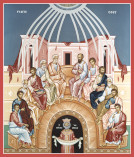
| Eighth Sunday, or the Sunday of Holy Pentecost |
The commemoration of the holy Martyr Lucillian and those with him at Byzantium, the Virgin-martyr Paula, and the four child martyrs, Claudius, Hypatios, Paul, and Dionysios.
Scripture Readings
Paschalion — Movable Calendar
Eighth Sunday, or the Sunday of Holy Pentecost
Epistle
The Reading is from the Acts of the Apostles [§ 3].
2 1While the day of Pentecost was being fulfilled, they were all with one accord in the same place. 2And suddenly there came to be a sound out of the heaven, like as of a violent wind borne along, and it filled the whole house where they were sitting. 3And there appeared to them tongues, as if of fire, being distributed; and it sat upon each one of them. 4And they were all filled with the Holy Spirit, and began to speak in other tongues, even as the Spirit was giving them to utter. 5And there were Jews abiding in Jerusalem, pious men, from every nation of those under the heaven. 6And the report of this having arisen, the multitude came together and was confounded, because they were hearing, each one of them, speaking in his own dialect. 7And they were all amazed and wondering, saying to one another, “Behold, all these who are speaking are Galilæans, are they not? 8“And how do we each hear in our own dialect in which we were born? 9“Parthians and Medes and Elamites and those who dwell in Mesopotamia, also Judæa and Cappadocia, Pontos and Asia, 10“also Phrygia and Pamphylia, Egypt and the parts of Libya which are in the region of Cyrene, and the Romans, both Jews and proselytes, who sojourn here, 11“Cretans and Arabians—we hear them speaking in our own tongues the magnificent works of God.”
Gospel
In the Orthros
The Reading is from the Holy Gospel according to Saint John [§ 65].
20 19When it was evening on that day, the first of the week—and the doors were closed where the disciples were gathered together for fear of the Jews—Jesus came and stood in the midst, and saith to them, “Peace be to you.” 20And after He said this, He showed them His hands and His side. Then were the disciples glad, after they saw the Lord. 21Then Jesus said to them again, “Peace be to you; even as the Father hath sent Me forth, I also send you.” 22And after He said this, He breathed on them, and saith to them, “Receive ye the Holy Spirit: 23“if ye forgive the sins of any, they are forgiven to them; if ye retain the sins of any, they are retained.”
In the Liturgy
The Reading is from the Holy Gospel according to Saint John [§ 27].
7 37In the last day, that great day of the feast, Jesus was standing and cried out, saying, “If anyone thirst, let him come to Me and drink. 38“The one who believeth in Me, even as the Scripture said—rivers of living water shall flow out of his belly.” 39But this He said concerning the Spirit, Whom those who believe in Him were about to receive; for the Holy Spirit was not yet given, because Jesus was not yet glorified. 40Many therefore of the crowd, having heard the utterance, were saying, “This is truly the Prophet.” 41Others were saying, “This is the Christ.” But others were saying, “The Christ is not coming out of Galilee, is He? 42“Hath not the Scripture said that of the seed of David and from the village of Bethlehem, where David was, the Christ is coming?” 43Therefore a division occurred in the crowd on account of Him. 44And some of them were wishing to lay hold of Him, but no one laid hands on Him. 45Then came the officers to the chief priests and Pharisees, and they said to them, “Why did ye not bring Him?” 46The officers answered, “Never did a man so speak as this Man.” 47Then the Pharisees answered them, “Ye have not also been deceived, have ye? 48“Not one of the rulers believe in Him or of the Pharisees, doth he? 49“But this people who knoweth not the law are accursed!” 50Nicodemos (the one who came by night to Him, being one of them) saith to them, 51“Our law doth not judge the man, unless it should first hear him, and know from the man himself what he doeth, doth it?” 52They answered and said to him, “Thou art not also of Galilee, art thou? Search and look, for a prophet hath not been raised out of Galilee.”...
8 12Then Jesus spoke again to them, saying, “I am the light of the world; the one who followeth Me in no wise shall walk in the darkness, but shall have the light of the life.”
Menaion — Fixed Calendar
The commemoration of the holy Martyr Lucillian and those with him at Byzantium, the Virgin-martyr Paula, and the four child martyrs, Claudius, Hypatios, Paul, and Dionysios.
No readings given.
Lives of the Saints (Prologue)
June 16th – Civil Calendar
June 3rd – Church Calendar
1. The Holy Martyr Lucillian and those with him: Claudios, Hypatios, Paul, Dionysius and the Virgin Paula.
Lucillian grew to old age as a pagan priest. Only as a grizzled old man did he learn the truth of Christianity and receive Baptism. His conversion to Christianity caused great excitement among the pagans of Nikomedia, and he was brought to trial for refusing to deny his new faith. He was harshly whipped, and all black and blue, thrown into prison. In the prison were four young men: Claudios, Hypatios, Paul and Dionysius, who had likewise been imprisoned for the Faith. The old man rejoiced in the company of these young men, and they in his, and they spent their time together in spiritual converse, prayer and the singing of psalms. When they were taken from the prison, they were tortured in various ways and then taken to Byzantium, where the young men were beheaded with the sword by the soldiers, and Lucillian crucified by the Jews. The wicked Jews pierced his body all over with nails. A maiden, Paula, openly took the martyrs’ bodies and gave them burial. She was denounced for this, and after torture, was beheaded, receiving a twofold wreath: of virginity and of martyrdom. Their martyrdom took place in the time of the Emperor Aurelian, between 270 and 275.
2. The Hieromartyr Lucian.
A Roman, renowned for his noble birth, wealth and learning, he was for a time a disciple of the Apostle Peter. Later, Pope Clement sent him, together with Dionysius the Areopagite, to Gaul to preach the Gospel, consecrating them bishop before they set out. Lucian sowed the seed of Christ’s teaching with great zeal, first in Gaul and then in Belgium. When the wicked Emperor Domitian began persecuting the Christians, men were sent from Rome to seek out the Christian missionaries and arrest them. They first seized and killed Dionysius, and then set off in pursuit of Lucian. Finding him in Belgium, together with his helpers, the priest Maxianus and the deacon Julian, they killed these two in one place and beheaded Lucian in another. When Lucian had been beheaded, his dead body rose from the ground, and taking its head into its hands (like St. Dionysius and St. John Vladimir), walked thus to the spot at which it wished to be buried. There it fell to the ground, and was there buried. A church was later built over his relics.
3. The Holy Martyr Dimitri, Tsarevitch of Russia.
He received a martyr’s death at the age of eight at the hands of the power-hungry Boris Godunov, in the town of Uglich in 1591. He appeared after his death to a monk and prophesied that a false Dimitri would appear, who would bring about Boris Godunov’s murder. This came to pass. Innumerable miracles were wrought at the grave of the martyred tsarevitch. His relics were dug up fifteen years later, whole and incorrupt, and were transferred solemnly to Moscow and buried in the Church of the Archangel Michael.
FOR CONSIDERATION
Oh, that we could fathom the mystery of God’s providence in the lives of men! We would be filled with fear and trembling in the face of every evil deed and every human sin. ‘I understood Thy works, O Lord, and was amazed.’ In great events, the mystery of God’s providence is clear even to men of little faith—as is shown in the end of the Tsarevitch Dimitri and the bloodthirsty and ambitious Boris Godunov. To attain the first place among the courtiers of Tsar Theodore, Godunov poisoned many of the nobles. When he had become first after the tsar, he decided to poison the tsar’s brother, the eight-year-old Dimitri. Through hired men, he several times administered the strongest poison to the young tsarevitch, who was unaffected by it. It came about by providence that the evil-doer killed his prey, though not in any way secretly: Godunov sent murderers who beheaded the tsarevitch in broad daylight, and thus Dimitri became known as a martyr and Godunov as a murderer throughout Russia. After that, a certain Dimitri arose and proclaimed himself tsarevitch (as though he were the true tsarevitch and some other had been killed), and set out with an army against Godunov. He overcame Godunov and reduced him to such desperate straits that he poisoned himself. He who had poisoned others himself ended by self-administered poison, and he who had murdered the innocent Dimitri was himself defeated by a man named Dimitri. He who has spiritual eyes to see, let him see the mystery of God’s providence!
Daily Scripture Readings taken from The Orthodox New Testament, translated and published by Holy Apostles Convent, Buena Vista, Colorado, copyright © 2000, used with permission, all rights reserved.
Daily Prologue Readings taken from The Prologue of Ochrid, by Bishop Nikolai Velimirovic, translated by Mother Maria, published by Lazarica Press, Birmingham, England, copyright © 1985, all rights reserved. Edited by Dormition Skete.