

Daily Devotional
Monday, October 29, 2029 (NS), October 16, 2029 (OS)
No Fasting.
Monday of the Twenty-Third Week
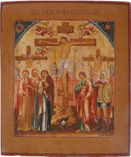
The commemoration of the holy Martyr Longinos, the centurion who stood at the foot of the Cross of the Lord.
Scripture Readings
Paschalion — Movable Calendar
Monday of the Twenty-Third Week
Epistle
The Reading is from the First Epistle of Saint Paul to the Thessalonians [§ 262].
1 1Paul, and Silouanos, and Timothy, to the Church of the Thessalonians in God the Father and the Lord Jesus Christ: Grace to you and peace from God our Father and the Lord Jesus Christ.
2We give thanks to God always concerning you all, making remembrance of you in the time of our prayers, 3remembering unceasingly your work of faith, and labor of love, and patience of hope in our Lord Jesus Christ before our God and Father, 4knowing, brethren, beloved by God, your election. 5For our Gospel did not come to be to you in word only, but also in power, and in the Holy Spirit, and in much fullness of assurance, even as ye know of what sort we were among you for your sake.
Gospel
The Reading is from the Holy Gospel according to Saint Luke [§ 43]. At that time:
9 18It came to pass, as Jesus was praying alone, the disciples were with Him, and He questioned them, saying, “Whom do the crowds say that I am?” 19And they answered and said, “John the Baptist, but others say Elias; and others say that some prophet of the ancients hath risen.” 20And He said to them, “But ye, whom do ye say that I am?” And Peter answered and said, “The Christ of God.” 21And He strictly warned them and commanded them to tell this to no one, 22saying, “It is necessary for the Son of Man to suffer many things, and to be rejected by the elders and chief priests and scribes, and be killed, and be raised the third day.”
Menaion — Fixed Calendar
The commemoration of the holy Martyr Longinos, the centurion who stood at the foot of the Cross of the Lord.
Epistle
The Reading is from the Second Epistle of Saint Paul to Saint Timothy [§ 292]. Child Timothy:
2 1Be thou empowered in the grace that is in Christ Jesus; 2and the things which thou heardest from me in the midst of many witnesses, commit thou these things to faithful men who shall be competent also to teach others. 3Thou therefore suffer hardship as a good soldier of Jesus Christ. 4No one serving as a soldier is entangled with the affairs of life, in order that he might please the one who enlisted him. 5And if anyone also contend as an athlete in the games, he is not crowned unless he contend lawfully. 6The farmer who laboreth must be first to partake of the fruits. 7Be considering what I say; O may the Lord give thee understanding in all things! 8Be remembering Jesus Christ, of the seed of David, Who hath been raised from the dead, according to my Gospel, 9in which I suffer hardship even to bonds as a malefactor, but the word of God hath not been bound. 10On this account I endure all things for the sake of the elect, that they might also attain salvation that is in Christ Jesus with eternal glory.
Gospel
The Reading is from the Holy Gospel according to Saint Matthew [§ 113]. At that time:
27 33After the soldiers came to a place called Golgotha, which is called Place of a Skull, 34they gave Jesus vinegar to drink mingled with gall. And after He tasted it, He would not drink. 35And having crucified Him, they parted His garments among themselves, casting a lot; 36and sitting down, they were watching over Him there. 37And they put over His head His accusation, it having been written: “This is Jesus the King of the Jews.” 38Then two robbers were crucified with Him, one on the right and one on the left. 39And those passing by were blaspheming Him, shaking their heads, 40and saying, “Thou Who destroyest the temple and buildest it in three days! Save Thyself; if Thou art God’s Son, come down from the Cross.” 41And in like manner also the chief priests, mocking with the scribes and elders and Pharisees, were saying, 42“Others He saved, Himself He is not able to save. If He is King of Israel, let Him come down now from the Cross, and let us believe on Him. 43“He hath trusted in God; let Him deliver Him now, if He taketh pleasure in Him; for He said, ‘I am God’s Son.’” 44And also the robbers who were crucified together with Him began to reproach Him with the same thing. 45Now from the sixth hour until the ninth hour there came to be a darkness over all the earth. 46And about the ninth hour Jesus cried out with a loud voice, saying, “Eli, Eli, lima sabachthani?” that is, “My God, My God, why didst Thou forsake Me?” 47And some of those who were standing there, after they heard that, were saying, “This One calleth Elias.” 48And straightway one of them ran, and took a sponge, and filled it with vinegar, and put it on a reed, and was attempting to give Him to drink. 49But the rest were saying, “Let be; let us see if Elias is coming to save Him.” 50And Jesus, having cried again with a loud voice, gave up the spirit. 51And behold, the veil of the temple was torn into two from top to bottom; and the earth was shaken, and the rocks were rent; 52and the sepulchers were opened, and many bodies of the saints who were asleep were raised, 53and came out of the sepulchers after His arising, and entered into the holy city and were manifested to many. 54Now after the centurion and those with him, who were watching over Jesus, saw the earthquake and the things which took place, they were exceedingly afraid, saying, “Truly this was God’s Son.”
Lives of the Saints (Prologue)
October 29th – Civil Calendar
October 16th – Church Calendar
1. The Holy Martyr Longinus.
 The divine Matthew the Evangelist, describing the Passion of the Lord
Jesus Christ, says: ‘Now when the centurion and they that were with him, watching Jesus,
saw the earthquake and the things that were done, they feared greatly, saying: “Truly this
was the Son of God”’ (Matt. 27:54). That centurion was this blessed Longinus, who,
with two other of his soldiers, came to believe in Jesus as the Son of God. He was the officer in
command both at the Lord’s crucifixion on Golgotha and in the watch that guarded the tomb.
When the Jewish elders learned of Christ’s Resurrection, they bribed the soldiers to spread
the falsehood that Christ had not risen, but that His disciples had stolen His body. The Jews
tried to bribe Longinus also, but without success. Then the Jews resorted to their usual
practice: they conspired to kill Longinus. Discovering this, Longinus took off his army belt,
received Baptism from the apostles together with his two friends, and with them secretly left
Jerusalem and went to Cappadocia. There he gave himself to fasting and prayer, and as a living
witness of the Resurrection of Christ, turned many pagans to the true Faith by his testimony. He
then went off to a village where his father had property, but the wicked Jews would not even
there leave him in peace. In response to slander on their part, Pilate sent soldiers to behead
Longinus. Holy Longinus foresaw in his spirit the approach of his executioners, and going out to
meet them, took them to his home without telling them who he was. The soldiers lay down to sleep,
and St. Longinus spent the whole night preparing for death. In the morning, he went and brought
his two friends, dressed himself in white grave-clothes, told the others in the house what was
happening and showed them a place on a hillock to bury him. He then revealed himself to the
soldiers as the Longinus whom they were seeking. The soldiers were embarrassed and ashamed, and
would not think of beheading Longinus, but he laid it on them to carry out their superior’s
command, and he and his two friends were beheaded. Longinus’ head was taken by the soldiers
to Pilate; Pilate gave it to the Jews and they flung it onto a dung-heap outside the city.
The divine Matthew the Evangelist, describing the Passion of the Lord
Jesus Christ, says: ‘Now when the centurion and they that were with him, watching Jesus,
saw the earthquake and the things that were done, they feared greatly, saying: “Truly this
was the Son of God”’ (Matt. 27:54). That centurion was this blessed Longinus, who,
with two other of his soldiers, came to believe in Jesus as the Son of God. He was the officer in
command both at the Lord’s crucifixion on Golgotha and in the watch that guarded the tomb.
When the Jewish elders learned of Christ’s Resurrection, they bribed the soldiers to spread
the falsehood that Christ had not risen, but that His disciples had stolen His body. The Jews
tried to bribe Longinus also, but without success. Then the Jews resorted to their usual
practice: they conspired to kill Longinus. Discovering this, Longinus took off his army belt,
received Baptism from the apostles together with his two friends, and with them secretly left
Jerusalem and went to Cappadocia. There he gave himself to fasting and prayer, and as a living
witness of the Resurrection of Christ, turned many pagans to the true Faith by his testimony. He
then went off to a village where his father had property, but the wicked Jews would not even
there leave him in peace. In response to slander on their part, Pilate sent soldiers to behead
Longinus. Holy Longinus foresaw in his spirit the approach of his executioners, and going out to
meet them, took them to his home without telling them who he was. The soldiers lay down to sleep,
and St. Longinus spent the whole night preparing for death. In the morning, he went and brought
his two friends, dressed himself in white grave-clothes, told the others in the house what was
happening and showed them a place on a hillock to bury him. He then revealed himself to the
soldiers as the Longinus whom they were seeking. The soldiers were embarrassed and ashamed, and
would not think of beheading Longinus, but he laid it on them to carry out their superior’s
command, and he and his two friends were beheaded. Longinus’ head was taken by the soldiers
to Pilate; Pilate gave it to the Jews and they flung it onto a dung-heap outside the city.
2. Our Holy Father Longinus the Lover of Labor.
A monk of the Kiev Caves in the eleventh century, he was doorkeeper in the monastery and had such a pure and grace-filled heart that he knew the disposition of everyone who went into the monastery, and with what disposition others left it. His wonder-working relics are preserved in the cave of St. Theodosius.
FOR CONSIDERATION
The first appearance of the holy martyr Longinus: A long time had elapsed since St. Longinus’ death by martyrdom when it happened that a widow in Cappadocia became blind. Doctors were able to do nothing more for her. Suddenly, the thought came to her to go to Jerusalem and venerate the holy places, hoping that she might be helped there. She had an only son, a lad who served her as a guide. As soon as they arrived in Jerusalem, the boy fell ill and died. The grief of the blind mother was without measure: having lost her eyes, she had now lost her only son, whose eyes had guided her till then. In her pain and grief, St. Longinus appeared to her, and comforted her with the promise that he would both restore her sight to her and show her her son in heavenly glory. Longinus told her all about himself, then told her to go outside the walls of the city to the rubbish heap and dung-hill and dig up his head, and then she would see what would happen next. The woman got up and groped her way out of the city, then called out to someone to take her to the biggest dung hill and leave her there. When she was led to the dung-hill, she bent down and began to dig with her hands, having a strong faith that she would find what the saint had told her to search for. Digging thus, her fingers came upon the head of the holy martyr, and at that moment, her eyes were opened and she saw a man’s skull under her hands. Filled with great joy and thanksgiving to God, she took the head of St. Longinus, washed it, perfumed it and put it in her home as the most precious thing in all the world.
Daily Scripture Readings taken from The Orthodox New Testament, translated and published by Holy Apostles Convent, Buena Vista, Colorado, copyright © 2000, used with permission, all rights reserved.
Daily Prologue Readings taken from The Prologue of Ochrid, by Bishop Nikolai Velimirovic, translated by Mother Maria, published by Lazarica Press, Birmingham, England, copyright © 1985, all rights reserved. Edited by Dormition Skete.