

Daily Devotional
Sunday, October 28, 2029 (NS), October 15, 2029 (OS)
No Fasting.
The Sunday of the Holy Fathers
According to Gk. usage, if the 11th of October should fall on Sunday, we commemorate the service of The Holy Fathers of the Seventh Œcumenical Synod. If not, we commemorate the service on the following Sunday. According Sl. usage, if the 11th of October should fall on Wednesday or earlier, the service is commemorated on the preceding Sunday. If the 11th should fall on Thursday or later, then the service is commemorated on the following Sunday.
Sunday of the Twenty-Second Week
Mode Plagal One — Eleventh Eothinon
The commemoration of Hieromartyr Lucianos, Presbyter of Greater Antioch.
Scripture Readings
Special Commemorations
The Sunday of the Holy Fathers
According to Gk. usage, if the 11th of October should fall on Sunday, we commemorate the service of The Holy Fathers of the Seventh Œcumenical Synod. If not, we commemorate the service on the following Sunday. According Sl. usage, if the 11th of October should fall on Wednesday or earlier, the service is commemorated on the preceding Sunday. If the 11th should fall on Thursday or later, then the service is commemorated on the following Sunday.
Epistle
The Reading is from the Epistle of Saint Paul to Saint Titus [§ mid 302 A]: Child Titus:
3 8Faithful is the word. And concerning these things I desire thee to be affirming, in order that they who have believed God may give heed to set before themselves good works. These things are good and profitable to men. 9But be shunning foolish inquiries, and genealogies, and strifes, and contentions relating to points of the law; for they are unprofitable and vain. 10A heretical man, after a first and second admonition, be rejecting, 11knowing that such a one hath been perverted, and sinneth, being self-condemned.
12Whenever I should send Artemas to thee, or Tychikos, hasten to come to me in Nicopolis, for I have decided to winter there. 13Send forth with haste Zenas the lawyer and Apollos, in order that nothing may be lacking to them. 14And let ours also be learning to set before themselves good works for necessary uses, that they may not be unfruitful.
15All those with me salute thee. Greet those who love us in faith.
Grace be with you all. Amen.
For Sl. usage, see [Heb. 13:7-16].
Gospel
The Reading is from the Holy Gospel according to Saint Matthew [§ 11]. The Lord said to His disciples:
5 14“Ye are the light of the world. A city situated on the top of a mountain cannot be hid. 15“Nor do they light a lamp and put it under the bushel, but upon the lampstand, and it giveth light to all those in the house. 16“Thus, let your light shine before men, that they might see your good works, and might glorify your Father Who is in the heavens.
17“Do not begin to think that I came to abolish the law or the prophets; I came not to abolish, but to fulfill. 18“For verily I say to you, until the heaven and the earth shall have passed away, one iota or one tittle in no wise shall pass away from the law, until all shall have taken place. 19“Whosoever then shall break one of the least of these commandments, and shall teach men so, he shall be called least in the kingdom of the heavens; but whosoever shall do and teach them, this one shall be called great in the kingdom of the heavens.”
for Sl. usage, see [Jn. 17:1-13].
Paschalion — Movable Calendar
Sunday of the Twenty-Second Week
Mode Plagal One — Eleventh Eothinon
Epistle
The Reading is from the Epistle of Saint Paul to the Galatians [§ 215]. Brethren:
6 11See with what size letters I am writing to you with mine own hand. 12As many as wish to make a good show in the flesh, these constrain you to be circumcised, only that they may not be persecuted for the Cross of Christ. 13For not even they themselves who are circumcised keep the law, but they wish you to be circumcised, in order that they might boast in your flesh. 14But may it not be for me to boast, except in the Cross of our Lord Jesus Christ, through Whom the world hath been crucified to me, and I to the world. 15For in Christ Jesus neither circumcision hath any strength, nor uncircumcision, but a new creation. 16And as many as walk by this rule, peace be upon them and mercy, and upon the Israel of God.
17Henceforth, let no one be giving me troubles, for I bear in my body the marks of the Lord Jesus.
18The grace of our Lord Jesus Christ be with your spirit, brethren. Amen.
Gospel
The Reading is from the Holy Gospel according to Saint Luke [§ 35]. The Lord said this parable:
8 5“The one who soweth went out to sow his seed. And as he was sowing, some seed indeed fell by the wayside; and it was trampled down, and the birds of the heaven devoured it. 6“And other seed fell upon the rock; and having sprung up, it was dried up, because it had no moisture. 7“And other seed fell in the midst of the thorns; and the thorns, having sprung up together, choked it. 8“And other seed fell upon the good ground; and having sprung up, it produced fruit a hundredfold.” And after He said these things, He cried, “The one who hath ears to hear, let him hear.” 9And His disciples were asking Him, saying, “What may this parable be?” 10And He said, “To you it hath been given to know the mysteries of the kingdom of God, but to the rest in parables, that ‘seeing they see not, and hearing they understand not [cf. Is. 6:9].’ 11“Now the parable is this: The seed is the word of God. 12“And those by the wayside are the ones who hear; then the devil cometh and taketh away the word from their heart, lest after they believe they should be saved. 13“And those upon the rock are the ones who, whenever they hear, receive the word with joy; and yet these, who for a time believe, have no root, and in time of temptation withdraw. 14“And that which fell into the thorns, these are the ones who heard, and while they are going on their way, they are being choked by cares and wealth and pleasures of life, and do not bring fruit to perfection. 15“But that in the good ground, these are they who, after they hear the word with a noble and good heart, held fast and bore fruit in patience.”
Menaion — Fixed Calendar
The commemoration of Hieromartyr Lucianos, Presbyter of Greater Antioch.
Epistle
The Reading is from the Second Epistle of Saint Paul to Saint Timothy [§ 291]. Child Timothy:
1 8Do thou not become ashamed of the testimony of our Lord, nor me His prisoner, but suffer hardship with the Gospel, according to God’s power, 9Who saved us and called us with a holy calling, not according to our works, but according to His own purpose and grace which was given to us in Christ Jesus before the ages of time, 10but now hath been made manifest by the appearance of our Savior Jesus Christ, Who brought death to nought indeed and brought to light life and incorruption through the Gospel, 11to which I was appointed a herald and apostle and teacher of nations. 12For which cause I also suffer these things, but I am not ashamed; for I know Whom I have believed, and have been persuaded that He is able to guard the deposit entrusted to me until that day. 13Keep on holding fast an outline of sound words which thou heardest from me, in faith and love which are in Christ Jesus. 14Guard thou the good deposit entrusted to thee through the Holy Spirit indwelling in us.
15This thou knowest, that all they who are in Asia were turned away from me, of whom are Phygellos and Hermogenes. 16May the Lord grant mercy to the house of Onesiphoros, for many times he refreshed me, and was not ashamed of my chain; 17but having been in Rome, he sought me out most diligently and found me— 18may the Lord grant him to find mercy from the Lord in that day—and in how many things he ministered in Ephesus thou knowest better than I need say.
Gospel
No reading given.
Lives of the Saints (Prologue)
Special Commemorations
Commemoration of the Seventh Ecumenical Council.
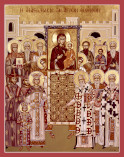 This Council was held in 787 in Nicaea. in the reign of the
devout Empress Irene and her son Constantine, and in the time of Patriarch Tarasius. This Council
finally upheld the veneration of icons, expounding it from Holy Scripture, the witness of the
holy fathers and the examples of miracles in connection with the holy icons. Among other examples
cited, the Cypriot bishop, Constantine, brought forward this one: A herdsman from the city of
Constantia, driving his flock out to pasture one day, saw an icon of the Mother of God adorned
with flowers by the devout. ‘Why give so much honour to a rock?’, said the herdsman,
obviously brought up in iconoclasm, and threw his iron stave at the icon, damaging the right eye
of the Mother of God. As soon as he had left that spot, he stumbled over the same stave and put
out his own right eye. Returning blinded to the city, he cried out tearfully that it was a
punishment from the Mother of God.
This Council was held in 787 in Nicaea. in the reign of the
devout Empress Irene and her son Constantine, and in the time of Patriarch Tarasius. This Council
finally upheld the veneration of icons, expounding it from Holy Scripture, the witness of the
holy fathers and the examples of miracles in connection with the holy icons. Among other examples
cited, the Cypriot bishop, Constantine, brought forward this one: A herdsman from the city of
Constantia, driving his flock out to pasture one day, saw an icon of the Mother of God adorned
with flowers by the devout. ‘Why give so much honour to a rock?’, said the herdsman,
obviously brought up in iconoclasm, and threw his iron stave at the icon, damaging the right eye
of the Mother of God. As soon as he had left that spot, he stumbled over the same stave and put
out his own right eye. Returning blinded to the city, he cried out tearfully that it was a
punishment from the Mother of God.
This Council also decided that the relics of the martyrs be placed in the antimins.* Three hundred and sixty-seven fathers took part in the Council. May the Lord have mercy on us and save us by their prayers.
*Antimins: A cloth containing relics of the saints that is spread on the Holy Table for the celebration of the Divine Liturgy—Tr.
Menaion — Fixed Calendar
October 28th – Civil Calendar
October 15th – Church Calendar
1. Our Holy Father, the Martyr Lucian, Priest of Antioch.
Born of noble parents in Syrian Samosata, he received in his youth a very wide education, both secular and spiritual, and was a man eminent both for his learning and for his strict ascetic life. Giving his goods away to the poor, he supported himself by the writing of works of instruction, feeding himself thus by the work of his hands. He did a very great service to the Church in the work which he undertook of the correcting of the Hebrew text of the Scriptures in many places, texts which heretics had taken the opportunity to twist and corrupt according to their wicked teaching. Because of his learning and his great spirituality, he was ordained priest in Antioch. In the time of Maximian’s persecution, when St. Anthimos of Nikomedia and St. Peter of Alexandria were put to torture, St. Lucian was also on the list of those whom the emperor wanted to have killed. Lucian fled the city and hid, but a jealous heretic priest, Pankratios, revealed his whereabouts. The persecution was terrible at that time, and not even tiny children were safe. Two boys, who would not eat food offered to idols, were thrown into a bath of boiling water, where, under torture, they gave their holy souls into God’s hands. A disciple of Lucian’s, Pelagia (see Oct. 8th), to preserve her virginal purity from the dissolute authorities, gave her soul into God’s hands, and her body fell from the roof of her house. Lucian was taken to Nikomedia to appear before the emperor. On the way, he managed to bring forty soldiers to Christ by his counsel, and they all died a martyr’s death. After interrogation and flogging, St. Lucian was thrown into prison, where he was tortured by hunger. ‘He scorned hunger,’ writes St. John Chrysostom of Lucian. ‘Let us also scorn luxury and destroy the lordship of the stomach; that we may, when the time comes for us to meet such torture, be prepared beforehand, by the help of a lesser ascesis, to show ourselves worthy of glory in the hour of battle.’ He received Communion in prison on the Theophany, and on the following day gave his soul into God’s hands, on January 7th, 312.
2. Our Holy Father Efthymios the New.
Born in Ankyra in 824, of righteous parents Epiphanios and Anna, he served in the army, married and had one daughter, Anastasia. He lived for a long time in asceticism in the monasteries of Olympus and then on the Holy Mountain, and also lived for some time as a stylite near Thessalonica, where he founded monasteries for men and women. He entered into rest on an island near the Holy Mountain at the end of the ninth century. His holy and wonder-working relics are preserved in Thessalonica.
FOR CONSIDERATION
The saints of God set great store on receiving Communion before their death. Even the martyrs, although they sacrificed their lives for Christ the Lord and washed all their sins in their own blood, yearned to receive the Holy Mysteries whenever possible. St. Lucian was in prison with several of his disciples and other Christians. When the Eve of the Theophany came, he longed on that great Christian feast to partake of the body and blood of Christ, for he knew that his death was near. Seeing the heartfelt desire of His suffering servant, God the almighty brought it about that some Christians came to the prison with bread and wine. When the Theophany dawned, Lucian called all the Christians in the prison to stand in a circle round him: ‘Surround me, and be the church.’ He had in the prison neither table nor stool, neither stone nor wood on which to celebrate the holy Liturgy. ‘Holy father, where shall we put the bread and wine?’ they asked Lucian, and he lay down in their midst and told them to put the bread and wine on his chest: ‘Place them on my chest: let it be a living throne for the living God.’ And so the Liturgy was celebrated, meetly and prayerfully, on the martyr’s breast, and all received Communion. On the following day, the emperor sent soldiers to take Lucian out for torture. When the soldiers opened the door of the prison, holy Lucian cried out three times: ‘I am a Christian!’ and gave his soul into God`s hands.
Daily Scripture Readings taken from The Orthodox New Testament, translated and published by Holy Apostles Convent, Buena Vista, Colorado, copyright © 2000, used with permission, all rights reserved.
Daily Prologue Readings taken from The Prologue of Ochrid, by Bishop Nikolai Velimirovic, translated by Mother Maria, published by Lazarica Press, Birmingham, England, copyright © 1985, all rights reserved. Edited by Dormition Skete.