

Daily Devotional
Sunday, October 7, 2029 (NS), September 24, 2029 (OS)
No Fasting.
Sunday of the Nineteenth Week
Mode Two — Eighth Eothinon
The commemoration of the miracle of the most holy Theotokos "of the Myrtle Tree" in Kythera, and holy First-martyr and Equal-to-the-apostles Thekla.
Scripture Readings
Paschalion — Movable Calendar
Sunday of the Nineteenth Week
Mode Two — Eighth Eothinon
Epistle
The Reading is from the Second Epistle of Saint Paul to the Corinthians [§ 194]. Brethren:
11 31The God and Father of our Lord Jesus Christ, Who is blessed to the ages, knoweth that I lie not. 32In Damascus the ethnarch of Aretas the king was guarding the city of the Damascenes, wishing to take me; 33and through a window in a braided rope-basket was I let down through the wall, and escaped his hands.
12 1Indeed it is not expedient for me to boast; for I will come to visions and revelations of the Lord. 2I know a man in Christ who fourteen years ago—whether in the body I know not, or out of the body I know not, God knoweth—such a one was carried off as far as the third heaven. 3And I know such a man—whether in the body or out of the body I know not, God knoweth— 4that he was caught up into Paradise and heard unspeakable words, which it is not allowed for a man to speak. 5On behalf of such a one I will boast, but on behalf of myself I will not boast, except in my weaknesses. 6For if I should wish to boast, I shall not be foolish; for I will speak the truth. But I forbear, lest anyone should reckon to me above what he seeth me to be or what he heareth in any degree of me. 7And lest I should be lifted up by the surpassingness of the revelations, there was given to me a thorn for the flesh, a messenger of Satan, that he may keep on buffeting me, lest I should be lifted up. 8Concerning this I besought the Lord thrice, that it might stand off from me. 9And He hath said to me, “My grace is sufficient for thee; for My power is being made perfect in weakness.” Most gladly therefore will I rather boast in my weaknesses, that the power of the Christ might dwell upon me.
Gospel
The Reading is from the Holy Gospel according to Saint Luke [§ 17]. At that time:
5 1Jesus was standing by the Lake Gennesaret, 2and He saw two ships standing by the lake; but the fishermen disembarked from them and washed the nets. 3And He embarked into one of the ships, which was Simon’s, and asked him to put out to sea a little from the land. And He sat down and was teaching the crowds from the ship. 4And when He left off talking, He said to Simon, “Put out into the deep and let down your nets for a draught.” 5And Simon answered and said to Him, “Master, we toiled through the whole night, and took nothing; but upon Thy word, I will let down the net.” 6And after they did this, they enclosed a great multitude of fish; and their net was being broken through. 7And they nodded to their partners, those in the other ship, so that they should come and help them. And they came and filled both the ships, so that they began to sink. 8And after Simon Peter saw it, he fell down at the knees of Jesus, saying, “Depart from me, for I am a sinful man, O Lord.” 9For astonishment seized him, and all those with him, on account of the draught of the fish which they took together; 10and in like manner also were Iakovos and John, the sons of Zebedee, who were partners with Simon. And Jesus said to Simon, “Cease being afraid; from henceforth thou shalt be taking men alive.” 11And when they brought down their ships upon the land, they left all and followed Him.
*** In the Typikon of those who have placed the 1 stWeek of St. Luke so that it follows the Sunday after the Exaltation of the Cross, sometimes necessitating a jump over Readings from St. Matthew to St. Luke, the “Sunday of the First Week of St. Luke” may not always correspond with the 18 thSunday after Pentecost. Subsequent Sundays of St. Luke also may not concur with the numbered Sunday after Pentecost which we have given in the header of this work. Consult with Liturgical Calendar to determine the actual week number after Pentecost in order to synchronize the Epistle Readings with the Gospel Readings of St. Luke.
Menaion — Fixed Calendar
The commemoration of the miracle of the most holy Theotokos "of the Myrtle Tree" in Kythera, and holy First-martyr and Equal-to-the-apostles Thekla.
Epistle
For the Theotokos:
The Reading is from the Epistle of Saint Paul to the Philippians [§ 240]. Brethren:
2 5Let this mind be in you which was also in Christ Jesus, 6Who, existing in the form of God, deemed it not a prize to be seized to be equal with God; 7but He emptied Himself and took the form of a slave, and came to be in the likeness of men. 8And having been found in fashion as a man, He humbled Himself and became obedient even to death—indeed, the death of a cross. 9Wherefore God also exalted Him exceedingly, and freely gave to Him a name that is above every name, 10that in the name of Jesus every knee should bow, of those in heaven and on earth and under the earth; 11and every tongue should confess for itself that Jesus Christ is Lord, to the glory of God the Father.
For the Proto-martyr:
The Reading is from the Second Epistle of Saint Paul to Saint Timothy [§ 296]. Child Timothy:
3 10Thou hast closely followed my teaching, conduct, purpose, faith, long-suffering, love, patience, 11persecutions, sufferings, such as happened to me in Antioch, in Iconium, in Lystra—what persecutions I endured! And out of them all the Lord delivered me. 12Yes, and all those who wish to live piously in Christ Jesus shall be persecuted. 13But evil men and cheats shall advance to the worse, leading astray and being led astray. 14But thou, keep on abiding in what thou didst learn and wast assured of, knowing from whom thou didst learn, 15and that from a babe thou hast known the sacred writings, which are able to make thee wise in regard to salvation through faith which is in Christ Jesus.
Gospel
The Reading is from the Holy Gospel according to Saint Matthew [§ 104]. The Lord said this parable:
25 1“The kingdom of the heavens shall be likened to ten virgins, who took their lamps and went forth to meet the bridegroom. 2“And five of them were prudent, and five were foolish. 3“Those who were foolish took lamps for themselves and took no oil with them; 4“but the prudent took oil in their vessels with their lamps. 5“But while the bridegroom tarried, they all dozed and went on sleeping. 6“But in the middle of the night, there came to pass a cry, ‘Behold, the bridegroom cometh; go ye out to meet him!’ 7“Then all those virgins were wakened and trimmed their lamps. 8“And the foolish said to the prudent, ‘Give us of your oil, for our lamps are going out.’ 9“But the prudent answered, saying, ‘Peradventure there might not be enough for us and you, but go rather to those who sell, and buy for yourselves.’ 10“But while they went away to buy, the bridegroom came, and they who were ready went in with him to the wedding festivities; and the door was shut. 11“And afterwards the remaining virgins came also, saying, ‘Lord, lord, open to us.’ 12“But he answered and said, ‘Verily I say to you, I know ye not.’ 13“Be watching then, for ye know not the day nor the hour in which the Son of Man cometh.”
Lives of the Saints (Prologue)
October 7th – Civil Calendar
September 24th – Church Calendar
1. The Holy Protomartyr Thekla, Equal to the Apostles.
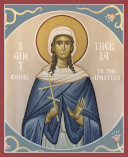 Thekla was born in Iconium of eminent
pagan parents. She was betrothed at the age of eighteen to a young man, at the time that the
Apostle Paul came to Iconium with Barnabas to preach the Gospel. Listening to Paul for three days
and nights, Thekla turned utterly to the Christian Faith and vowed to live in virginity. Her
mother, seeing that she shunned her betrothed and thought no more of marriage, first talked to
her and then beat her and starved her. Finally, she gave her over to the judges and demanded,
wicked mother that she was, that Thekla be burned. The judge threw her into the flames, but God
preserved her unharmed. Thekla then became a follower of the Apostle Paul, and went with him to
Antioch. Attracted by Thekla’s beauty, an elder of the city attempted to take her by force,
but Thekla tore herself out of his grasp. The elder denounced her to the governor as a Christian
who was averse to marriage. The governor condemned her to death and threw her to the wild beasts,
but the animals would not touch the body of this holy virgin. Amazed at this, the governor asked:
‘Who are you, and what is the power that you have in you, that nothing can do you
harm?’ Thekla replied: ‘I am a servant of the living God.’ Then the governor
let her go free, and she began to preach the Gospel and succeeded in bringing many to the true
Faith, among whom was an eminent and honored widow, Tryphena. After this, St. Thekla, with the
blessing of the Apostle Paul, withdrew to a solitary place near Seleukeia. She lived a long time
there in asceticism, healing the sick with miraculous power and in this way bringing many to
Christianity. The doctors in Seleukeia were jealous of her and sent some young men to assault
her, hoping that, in losing her virginity, she would lose also her miraculous power. Thekla fled
from these insolent young men, and when she saw that they would catch her, prayed to God for help
in front of a rock, and the rock opened and hid the holy maiden and bride of Christ. This rock
was her hiding place and her tomb. St. Chrysostom says of this wonderful Christian heroine and
saint: ‘I seem to see this blessed virgin going to Christ with virginity in one hand and
martyrdom in the other.’
Thekla was born in Iconium of eminent
pagan parents. She was betrothed at the age of eighteen to a young man, at the time that the
Apostle Paul came to Iconium with Barnabas to preach the Gospel. Listening to Paul for three days
and nights, Thekla turned utterly to the Christian Faith and vowed to live in virginity. Her
mother, seeing that she shunned her betrothed and thought no more of marriage, first talked to
her and then beat her and starved her. Finally, she gave her over to the judges and demanded,
wicked mother that she was, that Thekla be burned. The judge threw her into the flames, but God
preserved her unharmed. Thekla then became a follower of the Apostle Paul, and went with him to
Antioch. Attracted by Thekla’s beauty, an elder of the city attempted to take her by force,
but Thekla tore herself out of his grasp. The elder denounced her to the governor as a Christian
who was averse to marriage. The governor condemned her to death and threw her to the wild beasts,
but the animals would not touch the body of this holy virgin. Amazed at this, the governor asked:
‘Who are you, and what is the power that you have in you, that nothing can do you
harm?’ Thekla replied: ‘I am a servant of the living God.’ Then the governor
let her go free, and she began to preach the Gospel and succeeded in bringing many to the true
Faith, among whom was an eminent and honored widow, Tryphena. After this, St. Thekla, with the
blessing of the Apostle Paul, withdrew to a solitary place near Seleukeia. She lived a long time
there in asceticism, healing the sick with miraculous power and in this way bringing many to
Christianity. The doctors in Seleukeia were jealous of her and sent some young men to assault
her, hoping that, in losing her virginity, she would lose also her miraculous power. Thekla fled
from these insolent young men, and when she saw that they would catch her, prayed to God for help
in front of a rock, and the rock opened and hid the holy maiden and bride of Christ. This rock
was her hiding place and her tomb. St. Chrysostom says of this wonderful Christian heroine and
saint: ‘I seem to see this blessed virgin going to Christ with virginity in one hand and
martyrdom in the other.’
2. St. Stefan (Stephen), King of Serbia, the First-Crowned (Simon the Monk).
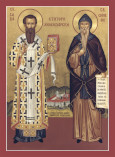 Crowned king at Žiča, his foundation, by his
brother and spiritual father, St. Sava, he was a devout Christian and a wise and
peace-loving ruler. Stefan, together with St. Sava, raised Orthodoxy to great heights among
his people. At his desire, St. Sava made him a monk at the time of his death, giving him
the name Simon. He entered into rest in the Lord on September 24th, 1224, and his relics
are preserved at Studenica. Crowned king at Žiča, his foundation, by his
brother and spiritual father, St. Sava, he was a devout Christian and a wise and
peace-loving ruler. Stefan, together with St. Sava, raised Orthodoxy to great heights among
his people. At his desire, St. Sava made him a monk at the time of his death, giving him
the name Simon. He entered into rest in the Lord on September 24th, 1224, and his relics
are preserved at Studenica.
|
3. St. David (formerly Prince Dimitrije)
Son of Vukan, Stefan’s brother, he built the monastery at Lim, at which he himself became a monk.
4. The Holy Prince Vladislav.
Son of King Stefan, he built the monastery of Mileševa, whither he took St. Sava’s relics from Trnovo. He was distinguished by a rare compassion for the poor. On the coinage of his time, he had inscribed: ‘The servant of God Vladislav’.
FOR CONSIDERATION
Every saint is close to the place where he is invoked for help, or where his holiness is commemorated and glorified. Those who are gifted with insight see them; those who lack this gift believe somehow and will see them in due time. St. Kosmas of Zographou, while still a young monk, was a clairvoyant. Once, on the Annunciation, he went to Vatopedi for the feast with some other monks. Both during the service in church and during the meal in the refectory, Kosmas saw a woman of heavenly beauty and majesty, who was organising, directing and herself serving with authority. He saw her for a long time, not just for a moment, both in the church and in the refectory. Kosmas was deeply perplexed and not a little appalled at this sight, for he felt it scandalous to see a woman in a monastery of the Holy Mountain. When he recounted his vision to his elder at Zographou, saying how unseemly it was for a woman to be on the Holy Mountain, his elder told him that it must have been the Queen of the Holy Mountain, the most holy Mother of God herself. In heartfelt wonder, Kosmas was filled with great joy.
Daily Scripture Readings taken from The Orthodox New Testament, translated and published by Holy Apostles Convent, Buena Vista, Colorado, copyright © 2000, used with permission, all rights reserved.
Daily Prologue Readings taken from The Prologue of Ochrid, by Bishop Nikolai Velimirovic, translated by Mother Maria, published by Lazarica Press, Birmingham, England, copyright © 1985, all rights reserved. Edited by Dormition Skete.