

Daily Devotional
Saturday, October 6, 2029 (NS), September 23, 2029 (OS)
No Fasting.
22. The commemoration of our venerable Fathers whose incorrupt relics rest in the Near Caves of Kiev.
If the 22nd of September should occur on a Saturday, we commemorate our venerable Fathers whose incorrupt relics rest in the Near Caves of Kiev. If the 22nd does not occur on a Saturday, this feast shall be commemorated on the Saturday following the 22nd of September.
Saturday of the Nineteenth Week
The commemoration of the conception of the honorable, glorious, prophet, forerunner, and Baptist John.
Scripture Readings
Special Commemorations
22. The commemoration of our venerable Fathers whose incorrupt relics rest in the Near Caves of Kiev.
If the 22nd of September should occur on a Saturday, we commemorate our venerable Fathers whose incorrupt relics rest in the Near Caves of Kiev. If the 22nd does not occur on a Saturday, this feast shall be commemorated on the Saturday following the 22nd of September.
Epistle
The Reading is from the Second Epistle of Saint Paul to the Corinthians [§§ 176, 177]. Brethren:
4 6It is God Who said, “Let there be light [cf. Gen. 1:3]” to shine out of darkness, Who shined in our hearts, for the illumination of the knowledge of the glory of God in the face of Jesus Christ.
7But we have this treasure in earthen vessels, that the preeminence of the power may be of God, and not from us. 8In every way we are afflicted, but not straitened; we are at a loss, but not utterly at a loss; 9persecuted, but not abandoned; cast down, but not destroyed— 10always bearing about in the body the dying of the Lord Jesus, that the life also of Jesus might be made manifest in our body. 11For we, the living, are always being delivered to death on account of Jesus, that also the life of Jesus might be made manifest in our mortal flesh. 12So that indeed death energizeth itself in us, but life in you. 13But having the same spirit of faith, according to that which hath been written: “I believed, wherefore I spoke [Ps. 115(116):1(10)],” we also believe, and therefore speak, 14knowing that the One Who raised up the Lord Jesus shall raise up us also through Jesus, and shall present us with you. 15For all things are for your sakes, that the grace, which abounded through the majority, might cause the giving of thanks to abound more to the glory of God.
Gospel
The Reading is from the Holy Gospel according to Saint Matthew [§ 43]. The Lord said to His disciples:
11 27“All things were delivered to Me by My Father. And no one doth fully know the Son, except the Father; nor doth anyone fully know the Father, except the Son, and he to whomsoever the Son is willing to reveal Him. 28“Come to Me, all ye who labor and are burdened, and I will give you rest. 29“Take up My yoke upon you and learn from Me, for I am meek and humble in heart; and ye shall find rest to your souls. 30“For My yoke is good and My burden is light.”
Paschalion — Movable Calendar
Saturday of the Nineteenth Week
Epistle
The Reading is from the First Epistle of Saint Paul to the Corinthians [§ 164].
15 58Brethren, keep on becoming firm, immovable, always abounding in the work of the Lord, knowing that your labor is not empty in the Lord.
16 1Now concerning the collection which is for the saints, even as I ordered the churches of Galatia, so also do ye. 2Every first day of the week let each of you by himself be laying in store whatsoever he may be prospered in, that collections may not then take place whenever I should come. 3And whenever I arrive, whomsoever ye shall approve, these will I send with epistles to carry your gift of bounty to Jerusalem.
Gospel
The Reading is from the Holy Gospel according to Saint Luke [§ 15]. At that time:
4 31Jesus went down to Capernaum, a city of Galilee, and was teaching them on the sabbath days. 32And they were astonished at His teaching, for His word was with authority. 33And in the synagogue there was a man who had an unclean demon; and he cried out with a loud voice, 34saying, “Ha! What is it to us and to Thee, Jesus, O Nazarene? Art Thou come to destroy us? I know Thee Who Thou art, the Holy One of God.” 35And Jesus rebuked him, saying, “Be thou muzzled, and come forth out of him.” And after the demon threw him in the midst, he came out from him, and by no means hurt him. 36And amazement came upon all, and they were talking together with one another saying, “What word is this, for with authority and power He commandeth the unclean spirits, and they come out?”
Menaion — Fixed Calendar
The commemoration of the conception of the honorable, glorious, prophet, forerunner, and Baptist John.
Epistle
The Reading is from the Epistle of Saint Paul to the Galatians. Brethren:
For Gk. usage, see Gal. 4:22-27 [§ mid 210]; for Sl. usage, see Gal. 4:22-31 [§§ mid 210, 211].
4 22Abraham had two sons: one by the maidservant, and one by the free woman. 23But on the one hand, the one of the maidservant hath been born according to the flesh; and on the other hand, the one of the free woman through the promise, 24which things are allegorized. For these are the two covenants: one indeed from Mount Sinai which bringeth forth to slavery, which is Agar— 25for the Agar is Mount Sinai in Arabia, and correspondeth to the present Jerusalem, and she doth slave with her children— 26but the Jerusalem above is free, which is Mother of us all. 27For it hath been written: “Rejoice, thou barren, who bearest not; break forth and cry thou who travailest not; for many are the children of the desolate more than of her who hath the husband [Is. 54:1].” 28Now we, brethren, after the manner of Isaac, are children of promise. 29But as then he who was born according to the flesh persecuted him who was born according to the Spirit, even so it is now. 30But what saith the Scripture? “Cast out the maidservant and her son; for in no wise shall the son of the maidservant inherit with the son of the free woman [cf. Gen. 21:10].” 31So then, brethren, we are not children of a maidservant, but of the free woman.
Gospel
The Reading is from the Holy Gospel according to Saint Luke [§ 2]. At that time:
1 5There arose in the days of Herod, the king of Judæa, a certain priest, by name Zacharias, of the course of Abia. And his wife was of the daughters of Aaron, and her name was Elisabeth. 6And they were both righteous before the face of God, walking in all the commandments and ordinances of the Lord blameless. 7And they had no child, inasmuch as Elisabeth was barren, and they both were now advanced in their days. 8And it came to pass, as he was serving as priest in the presence of God in the order of his course, 9according to the custom of the priestly service, he obtained the lot to burn incense after he entered into the temple of the Lord. 10And the whole multitude of the people was praying outside at the hour of incense. 11And an angel of the Lord appeared to him, standing on the right of the altar of the incense. 12And after Zacharias saw him, he was troubled, and fear fell upon him. 13But the angel said to him, “Cease being afraid, Zacharias, because thine entreaty was heard; and thy wife Elisabeth shall bear a son to thee, and thou shalt call his name John. 14“And he shall be joy and exultation to thee, and many shall be glad over his birth. 15“For he shall be great before the face of the Lord, and in no wise shall drink wine and strong drink; and he shall be filled with the Holy Spirit, even from his mother’s womb. 16“And many of the sons of Israel shall he turn around to the Lord their God. 17“And he shall go forth before His face in the spirit and power of Elias, to turn around the hearts of the fathers to the children, and the disobedient to the prudence of the just, to make ready a people having been prepared for the Lord.” 18And Zacharias said to the angel, “According to what shall I know this? For I am an old man, and my wife is advanced in her days.” 19And the angel answered and said to him, “I am Gabriel, the one who standeth before the face of God; and I was sent forth to speak to thee, and to announce to thee these good tidings. 20“And behold, thou shalt be silent and not be able to speak until the day in which these things should come to pass, because thou didst not believe my words which shall be fulfilled in their season.” 21And the people were waiting for Zacharias, and were wondering, as he was taking time in the temple. 22And after he came out, he was not able to speak to them; and they recognized that he had seen a vision in the temple, and he was nodding to them and remained mute. 23And it came to pass when the days of his service were fulfilled, he departed to his house. 24Now after these days his wife Elisabeth conceived, and was concealing herself five months, saying, 25“Thus the Lord hath done to me, in the days in which He looked upon me, to take away my reproach among men.”
Lives of the Saints (Prologue)
Special Commemorations
The commemoration of our venerable Fathers whose incorrupt relics rest in the Near Caves of Kiev.
If the 22nd of September should occur on a Saturday, we commemorate our venerable Fathers whose incorrupt relics rest in the Near Caves of Kiev. If the 22nd does not occur on a Saturday, this feast shall be commemorated on the Saturday following the 22nd of September.
The Synaxis of all the Saints of the Kiev Near Caves.
The blessed work of asceticism begun by Anthony, the lover of labor and man of God, grew throughout the ages as a fruitful olive tree. The numerous saints, who shone like stars in these caves of Anthony’s, are each commemorated on his special day. Today, the whole assembly of them is commemorated and invoked by the faithful for aid.
Menaion — Fixed Calendar
October 6th – Civil Calendar
September 23rd – Church Calendar
1. The Conception of St. John the Baptist.
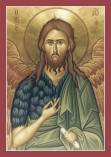 On this day are celebrated God’s mercy, His wondrous act and
His wisdom: His mercy towards the devout and righteous parents of St. John, the aged Zacharias
and Elisabeth, who had all their lives begged a child of God; the wonder of the conception of
John in Elisabeth’s more-than-aged womb; and the wisdom of the dispensation of man’s
salvation. For John, God had a specially great plan: that he should be a prophet and the
forerunner of Christ the Lord, the Savior of the world. Through His angels, God revealed the
birth of Isaac to the childless Sarah, and of Samson to the childless Manoah and his wife, and of
John the Baptist to the childless Zacharias and Elisabeth. Through His angels, God revealed the
birth of those for whom He had a special plan. How could children be born of aged parents? If
someone is curious to find out, let him not ask men, for men do not know, nor does natural law
(it being beyond natural law), but let him turn his gaze to the power of almighty God, Who made
the whole world from nothing and Who, for the creation of Adam, the first man, used no parents,
either young or old. Instead of being curious, let us thank God that He often reveals to us His
power and mercy and wisdom beyond the natural law, by which we would otherwise be fettered, and
without these special wonders of God, would fall into despair and forgetfulness of Him.
On this day are celebrated God’s mercy, His wondrous act and
His wisdom: His mercy towards the devout and righteous parents of St. John, the aged Zacharias
and Elisabeth, who had all their lives begged a child of God; the wonder of the conception of
John in Elisabeth’s more-than-aged womb; and the wisdom of the dispensation of man’s
salvation. For John, God had a specially great plan: that he should be a prophet and the
forerunner of Christ the Lord, the Savior of the world. Through His angels, God revealed the
birth of Isaac to the childless Sarah, and of Samson to the childless Manoah and his wife, and of
John the Baptist to the childless Zacharias and Elisabeth. Through His angels, God revealed the
birth of those for whom He had a special plan. How could children be born of aged parents? If
someone is curious to find out, let him not ask men, for men do not know, nor does natural law
(it being beyond natural law), but let him turn his gaze to the power of almighty God, Who made
the whole world from nothing and Who, for the creation of Adam, the first man, used no parents,
either young or old. Instead of being curious, let us thank God that He often reveals to us His
power and mercy and wisdom beyond the natural law, by which we would otherwise be fettered, and
without these special wonders of God, would fall into despair and forgetfulness of Him.
2. The Holy Martyr Iraida.
She is sometimes called Rais or Raida. A maiden from an Egyptian town called Batan, she was therefore probably an Egyptian. Iraida went out one day to draw water from a well near the sea, and saw a ship laden with bound Christians: priests, deacons, monks, women and maidens. Enquiring, she learned that pagan torturers were taking all this crowd to torture and death for the name of Christ the Lord. In the heart of the young Iraida, the desire flared up to suffer for the Lord. She left her pots by the well, went onto the ship and confessed that she was a Christian. She was immediately bound and taken with the others to the Egyptian town of Antinopolis. After diverse tortures, Iraida was the first to be beheaded, followed by the others. She suffered with honor and was glorified at the beginning of the fourth century.
3. The Holy New-Martyr Nicholas Pantopoles (The Grocer).
He suffered for the Christian Faith as a young man at the hands of the Turks in Constantinople in 1672, his father, a grocer, having moved there from Thessaly. He took the name of his father’s trade (in Greek, pantopoles). After great pressure to become a Turk, and torture because he refused, he was beheaded and entered into the kingdom of God. His relics are preserved in the monastery of Xeropotamou on the Holy Mountain.
4. The Holy New-Martyr John.
Born in a place called Konitsa in Albania, he was a Moslem of Moslem parents. Later, seeing the wonderful power of the Christian Faith in various places and events, he was baptized. He was arrested for this and brought before the Turkish judge. Tortured for the Christian Faith in Aetolia and beheaded in 1814, he cried out at the time of his death: ‘Remember me, O Lord, in Thy kingdom!’
FOR CONSIDERATION
He who gives to the poor gives to Christ. This is the meaning of the Gospel teaching emphasised by the saints from their experience. Peter the Merciful, when he had repented, began to give alms to the poor whenever he had the chance. On one occasion, a shipwrecked man, who had barely saved his naked body from the wreck, met him and begged for clothing. St. Peter took off his costly toga and clothed the naked man in it. Shortly afterwards, Peter saw his toga in the shop of some merchant, displayed for sale. Peter was very distressed that the shipwrecked man had sold his toga instead of making use of it. ‘I am not worthy,’ he said, ‘that the Lord should accept my alms.’ But the Lord appeared to him in a dream in the guise of a handsome Man, brighter than the sun, with a Cross on His head and wearing Peter’s toga. ‘What are you sad about, Peter?’ the Lord asked him. ‘How can I not be sad, Lord, when I see that what I gave to that poor wretch he went and sold in the bazaar?’ Then the Lord asked him: ‘Do you know this garment I’m wearing?’ St. Peter replied: ‘I know it, Lord; it’s the toga I gave to the naked man.’ The Lord then said to him: ‘Don’t be sad, then. You gave it to the poor man, and I received it and praise your action.’
Daily Scripture Readings taken from The Orthodox New Testament, translated and published by Holy Apostles Convent, Buena Vista, Colorado, copyright © 2000, used with permission, all rights reserved.
Daily Prologue Readings taken from The Prologue of Ochrid, by Bishop Nikolai Velimirovic, translated by Mother Maria, published by Lazarica Press, Birmingham, England, copyright © 1985, all rights reserved. Edited by Dormition Skete.