

Daily Devotional
Saturday, September 2, 2028 (NS), August 20, 2028 (OS)
No Fasting.
Saturday of the Thirteenth Week
The commemoration of the Afterfeast of the Dormition, and the holy Prophet Samuel.
Scripture Readings
Paschalion — Movable Calendar
Saturday of the Thirteenth Week
Epistle
The Reading is from the First Epistle of Saint Paul to the Corinthians [§ 126]. Brethren:
2 6We speak wisdom among the perfect, but a wisdom not of this age, nor of the rulers of this age, who are coming to nought. 7But we speak God’s wisdom in a mystery, which hath been hidden and which God foreordained before the ages to our glory, 8which not one of the rulers of this age hath known; for if they had known, they would not have crucified the Lord of the glory. 9But even as it hath been written: “Eye hath not seen, and ear hath not heard, and neither hath it entered into the heart of man the things which God prepared for those who love Him [cf. Is. 64:4].”
Gospel
The Reading is from the Holy Gospel according to Saint Matthew [§ 90]. At that time:
22 15The Pharisees took counsel against Jesus how they might ensnare Him in a word. 16And they sent forth to Him their disciples with the Herodians, saying, “Teacher, we know that Thou art true, and teachest the way of God in truth, and there is a care to Thee for no one; for Thou lookest not on the person of men. 17“Tell us then, what thinkest Thou? Is it lawful to give a poll-tax to Cæsar, or not?” 18But Jesus knew their wickedness, and said, “Why are ye trying to tempt Me, ye hypocrites? 19“Show Me the coin of the tribute.” And they brought a denarius to Him. 20And He saith to them, “Whose is this image and the inscription?” 21They say to Him, “Cæsar’s.” Then He saith to them, “Render therefore the things of Cæsar to Cæsar, and the things of God to God.” 22And after they heard these words, they marvelled, and they left Him and went away.
Menaion — Fixed Calendar
The commemoration of the Afterfeast of the Dormition, and the holy Prophet Samuel.
Epistle
The Reading is from the First Epistle of Saint Paul to the Corinthians [§ 156].
14 20Brethren, cease becoming children in your minds, but be ye infants in malice; and keep on becoming mature in your minds. 21In the law it hath been written: “By other tongues and by other lips will I speak to this people; and not even thus will they hear Me [cf. Is. 28:11, 12],” saith the Lord. 22Therefore tongues are for a sign, not to those who believe, but to the unbelievers; and prophecy is not for the unbelievers, but to those who believe. 23If therefore the whole church should come together in the same place, and all be speaking with tongues, and those who are unlearned or unbelievers should come in, will they not say that ye are mad? 24But if all be prophesying, and some unbeliever or one unlearned should come in, he is reproved by all, he is examined by all. 25And thus are the secrets of his heart become manifest; and so falling upon his face, he will make obeisance to God, reporting that God is verily among you.
Gospel
No reading given.
Lives of the Saints (Prologue)
September 2nd – Civil Calendar
August 20th – Church Calendar
1. The Holy Prophet Samuel.
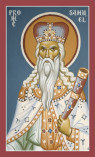 The fifteenth and last of the Judges of Israel, he lived eleven
hundred years before Christ. He was of the tribe of Levi, born of Elkanah and Hannah in a place
called Ramatha or Arimathea, where noble Joseph was later born. The barren Hannah besought Samuel
of the Lord with tears, and dedicated him to God when he was three years old. Living in Shiloh
near the Ark of the Covenant, Samuel, at the age of twelve, had a true revelation from God of the
punishment which would come upon the house of the high priest, Eli, because of the worthlessness
of his sons Hophni and Phineas. This revelation was swiftly fulfilled: the Philistines routed the
Israelites, slew both of Eli’s sons and captured the Ark of the Covenant. When the
messenger brought these bad tidings to Eli, he fell dead on the ground, breathing his last at the
age of ninety-eight, and the same thing happened to his daughter-in-law, the wife of Phineas.
Israel was under the Philistine yoke after this for twenty years. When this time had elapsed, God
sent Samuel to the people to preach repentance to them as the one means of their salvation from
their enemies. The people repented and cast out the foreign idols which they had served,
accepting Samuel as prophet, priest and judge. Then Samuel set out with the army against the
Philistines, and with God’s help, put them to confusion and slew them, freeing the land and
the people. After that, Samuel judged the people in peace to old age. Seeing him growing old, the
people asked him to give them a king in his place. In vain, Samuel urged the people against this,
saying that God was their only king, but the people remained adamant in their desire. Although
this desire was not pleasing to God, He commanded Samuel to anoint Saul the son of Kish, of the
tribe of Benjamin, as king. Saul reigned a short time, and God rejected him for impudence and
disobedience, and then commanded Samuel to anoint David the son of Jesse as king in Saul’s
place. At the time of his death, Samuel gathered all the people together and took leave of them,
and when he died all Israel wept for him and buried him solemnly in his house at Ramah.
The fifteenth and last of the Judges of Israel, he lived eleven
hundred years before Christ. He was of the tribe of Levi, born of Elkanah and Hannah in a place
called Ramatha or Arimathea, where noble Joseph was later born. The barren Hannah besought Samuel
of the Lord with tears, and dedicated him to God when he was three years old. Living in Shiloh
near the Ark of the Covenant, Samuel, at the age of twelve, had a true revelation from God of the
punishment which would come upon the house of the high priest, Eli, because of the worthlessness
of his sons Hophni and Phineas. This revelation was swiftly fulfilled: the Philistines routed the
Israelites, slew both of Eli’s sons and captured the Ark of the Covenant. When the
messenger brought these bad tidings to Eli, he fell dead on the ground, breathing his last at the
age of ninety-eight, and the same thing happened to his daughter-in-law, the wife of Phineas.
Israel was under the Philistine yoke after this for twenty years. When this time had elapsed, God
sent Samuel to the people to preach repentance to them as the one means of their salvation from
their enemies. The people repented and cast out the foreign idols which they had served,
accepting Samuel as prophet, priest and judge. Then Samuel set out with the army against the
Philistines, and with God’s help, put them to confusion and slew them, freeing the land and
the people. After that, Samuel judged the people in peace to old age. Seeing him growing old, the
people asked him to give them a king in his place. In vain, Samuel urged the people against this,
saying that God was their only king, but the people remained adamant in their desire. Although
this desire was not pleasing to God, He commanded Samuel to anoint Saul the son of Kish, of the
tribe of Benjamin, as king. Saul reigned a short time, and God rejected him for impudence and
disobedience, and then commanded Samuel to anoint David the son of Jesse as king in Saul’s
place. At the time of his death, Samuel gathered all the people together and took leave of them,
and when he died all Israel wept for him and buried him solemnly in his house at Ramah.
2. The Hieromartyr Philip, Bishop of Heraklion, with the Priest Severus and the Deacon Hermes.
It is almost certain that they were Slavs. They served God in Thrace, and were there first put to torture for Christ. When the pagans were running to set fire to a Christian church, Philip courageously said to their leaders: ‘Do you think that God is shut within walls? He lives in men’s hearts.’ The church was gutted, all the books burned and the clergy taken to Jedrene, where, after imprisonment and torture, they were thrown half-burned into the River Maritsa. Thirty-eight other Christians died a martyr’s death with them. It is thought that they suffered in the time of Diocletian.
FOR CONSIDERATION
Repent before death closes the door of your life and opens the door of the Judgement. Repent before death, and because you do not know the hour of your death, repent today, this instant, and stop repeating your sin. St. Ephraim the Syrian prayed thus to God:
‘Before the wheel of time comes to a stop in my life, have mercy on
me!
Before the wind of death blows, and sickness, the herald of death, appears in
my body, have mercy on me!
Before the majestic sun in the heavens becomes darkened for me, have mercy on
me; and may Thy light shine for me from the heavens and drive out the fearful darkness of my
mind.
Before the earth returns to earth and becomes corruption, and before the
destruction of all the features of its beauty, have mercy!
Before my sins are revealed at the Judgement to my shame before the Judge, O
most gracious Lord, have mercy on me!
Before the armies come forth, escorting the King’s Son, to gather our
miserable race together before the Judge’s throne, have mercy!
Before the sound of the voice of the trumpet heralds Thy coming, spare Thy
servant and have mercy, O our Lord Jesus!
Before Thou shuttest Thy door to me, and before I become food for the
unquenchable fires of Gehenna, have mercy on me!’
Daily Scripture Readings taken from The Orthodox New Testament, translated and published by Holy Apostles Convent, Buena Vista, Colorado, copyright © 2000, used with permission, all rights reserved.
Daily Prologue Readings taken from The Prologue of Ochrid, by Bishop Nikolai Velimirovic, translated by Mother Maria, published by Lazarica Press, Birmingham, England, copyright © 1985, all rights reserved. Edited by Dormition Skete.