

Daily Devotional
Friday, September 1, 2028 (NS), August 19, 2028 (OS)
Fast Day, but Wine and Olive Oil Allowed.
Friday of the Thirteenth Week
The commemoration of the Afterfeast of the Dormition, and the holy Martyr Andrew the General and the 2,593 martyrs with him.
Scripture Readings
Paschalion — Movable Calendar
Friday of the Thirteenth Week
Epistle
The Reading is from the Second Epistle of Saint Paul to the Corinthians [§ 192]. Brethren:
11 5I reckon to have come behind in nothing of the exceedingly super apostles. 6But even if I am unskilled in speech, yet not in knowledge; but in every way we have been made manifest to you in all things. 7Or did I commit a sin in humbling myself in order that ye might be exalted, because I preached the Gospel of God to you as a free gift? 8I stripped other churches, having received wages from them with a view to your ministration. 9And when I was present with you, and in need, I burdened no one; for that which I lacked the brethren who came from Macedonia supplied. And in all things I kept myself from being burdensome to you, and I will keep myself. 10As the truth of Christ is in me, this boasting in regard to me in the regions of Achaia shall not be fenced in. 11Why? Because I do not love you? God knoweth. 12But what I do, also I will do, that I might cut off the occasion of those wishing an occasion, that in what they boast, they might be found even as we. 13For such are false apostles, guileful workers, transforming themselves into apostles of Christ. 14And a marvellous thing it is not; for Satan himself transformeth himself into an angel of light. 15Therefore it is no great thing if his ministers also transform themselves as ministers of righteousness, of whom the end shall be according to their works. 16Again I say, let no one think me to be foolish; but if otherwise, receive me even if as foolish, in order that I also might boast a little. 17What I speak, I speak it not according to the Lord, but as in foolishness, in this basis of the boasting. 18Since many boast according to the flesh, I also will boast. 19For ye bear with fools gladly, being wise yourselves; 20for ye bear it if anyone enslave you, if anyone devour you, if anyone take from you, if anyone exalt himself, if anyone smite you on the face. 21I speak by way of dishonor, as though we weakened.
Gospel
The Reading is from the Holy Gospel according to Saint Mark [§ 15]. At that time:
4 1Jesus began to teach by the sea. And a great crowd was gathered together to Him, so that He stepped into the ship, and sat in the sea; and the whole crowd was on the land toward the sea. 2And He was teaching them many things in parables, and was saying to them in His teaching, 3“Hearken: Behold, the one who soweth went out to sow. 4“And it came to pass, as he was sowing, some seed indeed fell by the wayside, and the birds came and devoured it. 5“And other seed fell upon the rocky place, where it had not much earth; and straightway it sprang up, because it had no depth of earth. 6“But after the sun rose, it was scorched; and because it had no root, it was dried up. 7“And other seed fell into the thorns; and the thorns shot up and choked it, and it yielded no fruit. 8“But other seed fell into the good ground, and it kept on yielding fruit that was springing up and increasing: and one was bearing thirty, and one sixty, and one a hundred.” 9And He was saying to them, “The one who hath ears to hear, let him hear.”
Menaion — Fixed Calendar
The commemoration of the Afterfeast of the Dormition, and the holy Martyr Andrew the General and the 2,593 martyrs with him.
Epistle
The Reading is from the Epistle of Saint Paul to the Ephesians [§ 233].
6 10Brethren, keep on being empowered in the Lord and in the strength of His might. 11Put on the full armor of God, for you to be able to stand against the wiles of the devil; 12because for us the wrestling is not against blood and flesh, but against the principalities, against the powers, against the cosmic rulers of the darkness of this age, against spiritual hosts of evil on account of the heavenly things. 13For this cause take up the full armor of God, in order that ye might be able to withstand in the evil day, and having counteracted all things, to stand. 14Stand therefore, having girt your loins with truth, and having put on for yourselves the breastplate of righteousness, 15and having shod your feet in readiness of the Gospel of peace; 16on the whole, take up the shield of faith, with which ye shall be able to quench all the fiery darts of the evil one. 17And take the helmet of salvation, and the sword of the Spirit, which is the word of God.
Gospel
The Reading is from the Holy Gospel according to Saint Luke [§ 106]. The Lord said to His disciples, “Be taking heed of men:
21 12“For they shall lay their hands upon you and persecute you, delivering you up to synagogues and prisons, bringing you before kings and governors on account of My name; 13“but it shall prove to be a testimony for you. 14“Therefore settle it for yourselves in your hearts not to premeditate to make a defense; 15“for I will give you a mouth and wisdom, which all those who oppose you shall not be able to contradict nor withstand. 16“And ye shall be delivered up also by parents, and kinfolk, and friends, and brethren; and they shall put some of you to death. 17“And ye shall be hated by all for My name’s sake. 18“But a hair of your head in no wise shall perish. 19“In your patience win your souls.”
Lives of the Saints (Prologue)
September 1st – Civil Calendar
August 19th – Church Calendar
1. The Holy Martyr Andrew Stratelates.
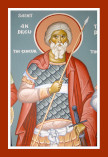 He was an officer, a tribune,
in the Roman army in the time of the Emperor Maximian. A Syrian by birth, he served in his native
land. When the Persians attacked the imperial Roman army, this Andrew was entrusted with the
command in the battle against the enemy whence his title: commander, stratelates. A secret
Christian, although as yet unbaptized, Andrew commended himself to the living God, and taking
only the cream of the army, went to war. Before the battle, he told his soldiers that, if they
all called upon the aid of the one true God, Christ the Lord, their enemies would become as dust
scattered before them. All the soldiers, fired with enthusiasm by Andrew and his faith, invoked
Christ’s aid and attacked. The Persian army was utterly routed. When the victorious Andrew
returned to Antioch, some jealous men denounced him as a Christian and the imperial governor
summoned him for trial. Andrew openly proclaimed his steadfast faith in Christ. After harsh
torture, the governor threw Andrew into prison and wrote to the emperor in Rome. Knowing
Andrew’s popularity among the people and in the army, the emperor ordered the governor to
set Andrew free, but to seek another occasion and another excuse (not his faith) to kill him. By
God’s revelation, Andrew came to know of this imperial command, and taking his faithful
soldiers (2,593 in all) with him, went off to Tarsus in Cilicia, where they were all baptized by
the bishop, Peter. Persecuted here also by imperial might, Andrew and his companions withdrew
deep into the Armenian mountain of Tavros. There in a ravine, while they were at prayer, the
Roman army came upon them and beheaded them all. Not one of them would recant, all being
determined on death by martyrdom for Christ. On the spot where a stream of the martyrs’
blood flowed down, a spring of healing water sprang forth, healing from every disease. The
bishop, Peter, came secretly with his people and buried the martyrs’ bodies in that same
place. They all suffered with honor at the end of the third century and were crowned with wreaths
of eternal glory, entering into the kingdom of Christ our God.
He was an officer, a tribune,
in the Roman army in the time of the Emperor Maximian. A Syrian by birth, he served in his native
land. When the Persians attacked the imperial Roman army, this Andrew was entrusted with the
command in the battle against the enemy whence his title: commander, stratelates. A secret
Christian, although as yet unbaptized, Andrew commended himself to the living God, and taking
only the cream of the army, went to war. Before the battle, he told his soldiers that, if they
all called upon the aid of the one true God, Christ the Lord, their enemies would become as dust
scattered before them. All the soldiers, fired with enthusiasm by Andrew and his faith, invoked
Christ’s aid and attacked. The Persian army was utterly routed. When the victorious Andrew
returned to Antioch, some jealous men denounced him as a Christian and the imperial governor
summoned him for trial. Andrew openly proclaimed his steadfast faith in Christ. After harsh
torture, the governor threw Andrew into prison and wrote to the emperor in Rome. Knowing
Andrew’s popularity among the people and in the army, the emperor ordered the governor to
set Andrew free, but to seek another occasion and another excuse (not his faith) to kill him. By
God’s revelation, Andrew came to know of this imperial command, and taking his faithful
soldiers (2,593 in all) with him, went off to Tarsus in Cilicia, where they were all baptized by
the bishop, Peter. Persecuted here also by imperial might, Andrew and his companions withdrew
deep into the Armenian mountain of Tavros. There in a ravine, while they were at prayer, the
Roman army came upon them and beheaded them all. Not one of them would recant, all being
determined on death by martyrdom for Christ. On the spot where a stream of the martyrs’
blood flowed down, a spring of healing water sprang forth, healing from every disease. The
bishop, Peter, came secretly with his people and buried the martyrs’ bodies in that same
place. They all suffered with honor at the end of the third century and were crowned with wreaths
of eternal glory, entering into the kingdom of Christ our God.
2. Our Holy Father Theophanes.
Born in Ioannina, he left everything as a young man and went to the Holy Mountain, where he became a monk in the monastery of Docheiariou. In fasting, prayer, vigils and the stripping away of all that was unnecessary, he stood out among all the monks, and was consequently chosen in due time as abbot. Later, through some disagreement with the monks, he left the Holy Mountain, and with his nephew, went to Berea in Macedonia, where he founded a monastery dedicated to the most holy Mother of God. When this monastery began to flower with the spiritual life, he left his nephew in charge and went to Naousa, where he founded another monastery, in honor of the Holy Archangels. He died peacefully some time in the fifteenth century. His wonder-working relics rest today in Naousa, and reveal God’s great power.
3. The Holy Martyrs Timothy, Agapius and Thekla.
They suffered for Christ in the time of the wicked Emperor Diocletian. Timothy was burned by fire, and Agapius and Thekla thrown to the wild beasts.
FOR CONSIDERATION
When some unexpected trouble falls upon us guiltless, we should not immediately bemoan the fact, but seek God’s providence in it, which can, through this trouble, bring us something new and helpful. The great Theophanes, abbot of Docheiariou, one day received the shocking news that the Turks had seized his sister’s son, forced him to embrace Islam and then taken him to Constantinople. Theophanes immediately went himself to Constantinople and succeeded, with God’s help, in locating his nephew and taking him secretly to his monastery on the Holy Mountain. There, he brought him back to the Christian Faith and made him a monk. But the brethren grumbled against their abbot and his nephew, from fear of the Turks, for they were afraid that the Turks would hear of it and would come and destroy the monastery. Not knowing what else to do, St. Theophanes took his nephew and withdrew secretly, not only from Docheiariou but from the Holy Mountain, and went to Berea. The later activities of Theophanes in Berea and Naousa prove how useful misfortune can be to the Church. That which Theophanes would never have achieved on the Holy Mountain, he achieved in these other places to which he had fled: he founded two monasteries in which, in due time, many monks found salvation and many people were upheld. Also, added to this, his holy relics among the people became a source of healing, for the strengthening of the Faith in unbelievers and in those of little faith. Thus God, in His wisdom, guides the destinies of men through unexpected ills, which seem to men at the time to be for their loss.
Daily Scripture Readings taken from The Orthodox New Testament, translated and published by Holy Apostles Convent, Buena Vista, Colorado, copyright © 2000, used with permission, all rights reserved.
Daily Prologue Readings taken from The Prologue of Ochrid, by Bishop Nikolai Velimirovic, translated by Mother Maria, published by Lazarica Press, Birmingham, England, copyright © 1985, all rights reserved. Edited by Dormition Skete.