

Daily Devotional
Sunday, June 23, 2024 (NS), June 10, 2024 (OS)
No Fasting.
| Eighth Sunday, or the Sunday of Holy Pentecost |
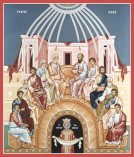
The commemoration of Hieromartyr Timothy, Bishop of Prusa, and the Martyrs Alexander and Antonina at Constantinople.
Scripture Readings
Paschalion — Movable Calendar
Eighth Sunday, or the Sunday of Holy Pentecost
Epistle
The Reading is from the Acts of the Apostles [§ 3].
2 1While the day of Pentecost was being fulfilled, they were all with one accord in the same place. 2And suddenly there came to be a sound out of the heaven, like as of a violent wind borne along, and it filled the whole house where they were sitting. 3And there appeared to them tongues, as if of fire, being distributed; and it sat upon each one of them. 4And they were all filled with the Holy Spirit, and began to speak in other tongues, even as the Spirit was giving them to utter. 5And there were Jews abiding in Jerusalem, pious men, from every nation of those under the heaven. 6And the report of this having arisen, the multitude came together and was confounded, because they were hearing, each one of them, speaking in his own dialect. 7And they were all amazed and wondering, saying to one another, “Behold, all these who are speaking are Galilæans, are they not? 8“And how do we each hear in our own dialect in which we were born? 9“Parthians and Medes and Elamites and those who dwell in Mesopotamia, also Judæa and Cappadocia, Pontos and Asia, 10“also Phrygia and Pamphylia, Egypt and the parts of Libya which are in the region of Cyrene, and the Romans, both Jews and proselytes, who sojourn here, 11“Cretans and Arabians—we hear them speaking in our own tongues the magnificent works of God.”
Gospel
In the Orthros
The Reading is from the Holy Gospel according to Saint John [§ 65].
20 19When it was evening on that day, the first of the week—and the doors were closed where the disciples were gathered together for fear of the Jews—Jesus came and stood in the midst, and saith to them, “Peace be to you.” 20And after He said this, He showed them His hands and His side. Then were the disciples glad, after they saw the Lord. 21Then Jesus said to them again, “Peace be to you; even as the Father hath sent Me forth, I also send you.” 22And after He said this, He breathed on them, and saith to them, “Receive ye the Holy Spirit: 23“if ye forgive the sins of any, they are forgiven to them; if ye retain the sins of any, they are retained.”
In the Liturgy
The Reading is from the Holy Gospel according to Saint John [§ 27].
7 37In the last day, that great day of the feast, Jesus was standing and cried out, saying, “If anyone thirst, let him come to Me and drink. 38“The one who believeth in Me, even as the Scripture said—rivers of living water shall flow out of his belly.” 39But this He said concerning the Spirit, Whom those who believe in Him were about to receive; for the Holy Spirit was not yet given, because Jesus was not yet glorified. 40Many therefore of the crowd, having heard the utterance, were saying, “This is truly the Prophet.” 41Others were saying, “This is the Christ.” But others were saying, “The Christ is not coming out of Galilee, is He? 42“Hath not the Scripture said that of the seed of David and from the village of Bethlehem, where David was, the Christ is coming?” 43Therefore a division occurred in the crowd on account of Him. 44And some of them were wishing to lay hold of Him, but no one laid hands on Him. 45Then came the officers to the chief priests and Pharisees, and they said to them, “Why did ye not bring Him?” 46The officers answered, “Never did a man so speak as this Man.” 47Then the Pharisees answered them, “Ye have not also been deceived, have ye? 48“Not one of the rulers believe in Him or of the Pharisees, doth he? 49“But this people who knoweth not the law are accursed!” 50Nicodemos (the one who came by night to Him, being one of them) saith to them, 51“Our law doth not judge the man, unless it should first hear him, and know from the man himself what he doeth, doth it?” 52They answered and said to him, “Thou art not also of Galilee, art thou? Search and look, for a prophet hath not been raised out of Galilee.”...
8 12Then Jesus spoke again to them, saying, “I am the light of the world; the one who followeth Me in no wise shall walk in the darkness, but shall have the light of the life.”
Menaion — Fixed Calendar
The commemoration of Hieromartyr Timothy, Bishop of Prusa, and the Martyrs Alexander and Antonina at Constantinople.
No readings given.
Lives of the Saints (Prologue)
June 23rd – Civil Calendar
June 10th – Church Calendar
1. The Hieromartyr Timothy, Bishop of Prousa.
For his great spiritual purity, God gave him the gift of wonder-working, and he healed all manner of diseases and pains among the people. During the reign of the evil Emperor Julian, who had renounced Christ, holy Timothy was thrown into prison. The faithful visited him there to listen to the wise teaching of their bishop. When this came to his ears, Julian commanded that the executioner behead him in the prison. This was in 362, and his soul entered into Paradise while his relics remained, full of miraculous power, to help the people and declare the power of the Lord.
2. The Holy Martyrs Alexander and Antonina.
Antonina was a virgin and Alexander an imperial soldier, both from Alexandria and both Christians. Antonina was first taken before the judge and tortured. When they threw her into prison, Alexander went to it at the command of an angel of God (being up to that time a stranger to Antonina), draped her in his military cloak and told her to keep her head lowered and go out through the guardhouse in front of the gates. In this way, she escaped and he remained in the prison. They brought Alexander before the judge, and began to interrogate him for the name of Christ. When Antonina heard of this, she came before the judge herself, and he put them both to various tortures. He cut off their hands and then flayed their naked bodies, scorching their wounds with torches, and finally cast them into a fire set in a hole in the ground, covering them with earth. They suffered with honor for the name of Christ and entered into the courts of the heavenly King on May 3rd, 313. The wicked judge, Festus, became dumb at the time of the martyrs’ deaths, and an evil spirit fell on him, torturing him for seven days before killing him.
3. St. Bassian, Bishop of Lodi.
A pagan born in Syracuse of eminent and wealthy parents, he studied philosophy in Rome. At his own desire, he was baptized by the devout elder Gordianus. This offended his parents, and to escape their wrath, he went to Ravenna on the advice of St. John the Theologian, who appeared to him, and there in Ravenna made himself known to the bishop, Ursus, a kinsman of his. On the bishop’s instructions, Bassian found lodgings near the Church of the Holy Martyr Apollinarius outside the city, and there labored a long time in toil, fasting and prayer. When the Bishop of Lodi in Liguria died, Bassian was elected, not according to his own desire but through a revelation in a dream. He was consecrated by St. Ambrose of Milan and Ursus of Ravenna. He had a great gift of healing, and could even raise the dead. He was present during St. Ambrose’s last hours and heard from those holy lips how St. Ambrose had seen the Lord Jesus Christ. He lived to a great age in toil and asceticism and finished his earthly course at the age of ninety, entering into the kingdom of God in about 409. His holy relics continue to work miracles as a witness to the power of God and the greatness of His saint.
FOR CONSIDERATION
It is not the same thing to eat your meal with a blessing and to eat it without one. Every meal is eaten at God’s table which He Himself has laid for us, and we must thank God, our Host, and ask His blessing. Food which is blessed is both sweeter and more satisfying, but unblessed food is both bitter and unsatisfying—and unhealthy. The Emperor Theodosios the Younger was once walking in the outskirts of Constantinople, and seeing the little house of a monk, called in on him. The elder asked the emperor if he would like something to eat. The emperor accepted, and the elder brought him bread, oil, salt and water. The emperor ate and drank, and then asked the monk: ‘Do you know who I am?’ ‘God knows who you are,’ answered the monk. ‘I am the Emperor Theodosios.’ The monk silently prostrated before him. The emperor then said to him: ‘I am an emperor and the son of an emperor, but believe me, I have never before in my life eaten such sweet-tasting food as here today with you.’ ‘And do you know the reason?’ asked the elder, and went on: ‘It is because we monks always prepare our food with prayer and a blessing, and therefore even bad food will turn into sweet for us. They certainly take a lot of trouble over the preparation of your food, but they do not ask a blessing from God, and so the most delicious food is tasteless.’
Daily Scripture Readings taken from The Orthodox New Testament, translated and published by Holy Apostles Convent, Buena Vista, Colorado, copyright © 2000, used with permission, all rights reserved.
Daily Prologue Readings taken from The Prologue of Ochrid, by Bishop Nikolai Velimirovic, translated by Mother Maria, published by Lazarica Press, Birmingham, England, copyright © 1985, all rights reserved. Edited by Dormition Skete.