

Daily Devotional
Monday, June 3, 2024 (NS), May 21, 2024 (OS)
No Fasting.
Monday of the Fifth Week
The commemoration of the holy God-fearing emperor and empress and Equal-to-the-apostles, Constantine and Helen.
Scripture Readings
Paschalion — Movable Calendar
Monday of the Fifth Week
Epistle
The Reading is from the Acts of the Apostles [§ 30]. In those days:
12 12Peter came to the house of Mary, the mother of John who was surnamed Mark, where a considerable number of them were gathered together and praying. 13And after Peter knocked at the door of the gateway, a maidservant, by name Rhoda, came to hearken. 14And having recognized the voice of Peter, from her joy she did not open the gateway, but she ran in and announced that Peter stood before the gateway. 15And they said to her, “Thou art mad.” But she was strongly affirming that it was so. And they kept on saying, “It is his angel.” 16But Peter continued knocking. And after they opened, they saw him and were amazed. 17And having motioned to them with his hand to be silent, he set out in detail to them how the Lord brought him out of the prison. And he said, “Relate these things to Iakovos and to the brethren.” And going out, he went to another place.
Gospel
The Reading is from the Holy Gospel according to Saint John [§ 32]. The Lord said to those Jews who had come to Him:
8 42“If God were your Father, ye would love Me; for I came forth out of God and am come; for neither have I come of Myself, but that One sent Me forth. 43“Why do ye not understand My speech? Because ye are not able to hear My word. 44“Ye are of your father, the devil, and the desires of your father ye wish to do. That one was a manslayer from the beginning, and hath not stood in the truth, because there is no truth in him. Whenever he may speak the lie, he speaketh out of the things which are his own; for he is a liar and the father of it. 45“And because I speak the truth, ye believe Me not. 46“Which of you reproveth Me concerning sin? But if I speak truth, why do ye not believe Me? 47“The one who is of God heareth the words of God; on this account ye hear not, because ye are not of God.” 48Then the Jews answered and said to Him, “We say well, do we not, that Thou art a Samaritan and hast a demon?” 49Jesus answered, “I have not a demon; but I honor My Father, and ye dishonor Me. 50“And I seek not Mine own glory; there is One Who seeketh and judgeth. 51“Verily, verily, I say to you, if anyone should keep My word, he in no wise shall ever see death.”
Menaion — Fixed Calendar
The commemoration of the holy God-fearing emperor and empress and Equal-to-the-apostles, Constantine and Helen.
Epistle
For Gk. usage, see [Acts 26:1, 12-20] hereunder;
for Sl. usage, see [Acts 26:1-5, 12-20] hereunder.
According to Sl. usage, read from Acts if this feast should fall within the fifty days before holy Pentecost; otherwise, see [Gal. 1:11-19].
The Reading is from the Acts of the Apostles [§ 49]. In those days:
26 1Agrippa said to Paul, “It is permitted thee to speak for thyself.” Then Paul, stretching forth his hand, began to defend himself:
For Gk. usage, skip to Acts 26:12-20; for Sl. usage, read Acts 26:2-5, 12-20.
2“Concerning all the things of which I am being accused by the Jews, king Agrippa, I deem myself happy, because I am about to defend myself before thee today, 3“especially because thou art one acquainted with all of the customs and also the subjects of dispute among the Jews. Wherefore I entreat thee to hear me with forbearance. 4“So then, my way of life from my youth which was from the beginning among mine own nation in Jerusalem, all the Jews know, 5“who knew me before, from the beginning—if they would be willing to testify—that according to the strictest sect of our religion, I lived a Pharisee.... 12“And during these things,...
Gk. and Sl. usages continue the Reading from here, Acts 26:12-20.
12“As I went to Damascus with authority and a commission from the chief priests, 13“at midday, in the way, I saw, O king, a light from heaven, above the brightness of the sun, shining round about me and those traveling with me. 14“And after all of us fell down to the ground, I heard a voice speaking to me and saying in the Hebrew language, ‘Saul, Saul, why persecutest thou Me? It is hard for thee to kick against the goads.’ 15“And I said, ‘Who art Thou, Lord?’ And He said, ‘I am Jesus Whom thou persecutest. 16“‘But rise up and stand on thy feet; for I appeared to thee for this purpose, to appoint thee a servant and a witness both of what thou didst see and of what I shall appear to thee in visions, 17“‘taking thee out for Myself from the people and the nations, to whom now I send thee forth, 18“‘to open their eyes, in order to turn them about from darkness to light and from the power of Satan to God, in order to receive forgiveness of sins and an inheritance among those who have been sanctified by faith that is in Me.’ 19“Whereupon, O king Agrippa, I did not become disobedient to the heavenly vision; 20“but I was bringing tidings to those in Damascus first and in Jerusalem, and in all the land of Judæa, and to the nations, to repent and turn to God, practising works worthy of repentance.”
Gospel
The Reading is from the Holy Gospel according to Saint John [§ mid 35]. The Lord said to those Jews who had come to Him:
10 1“Verily, verily, I say to you, the one who entereth not by the door into the fold of the sheep, but goeth up from another place, that one is a thief and a robber. 2“But the one who entereth by the door is a shepherd of the sheep. 3“To this one the doorkeeper openeth, and the sheep hear his voice; and he calleth his own sheep by name and leadeth them out. 4“And whenever he should put forth his own sheep, he goeth before them; and the sheep follow him, because they know his voice. 5“But a stranger in no wise will they follow, but will flee from him, because they know not the voice of strangers.” 6This parable Jesus spoke to them; but they understood not what it was which He spoke to them. 7Then said Jesus to them again, “Verily, verily, I say to you that I am the door of the sheep. 8“All, as many as came before Me, are thieves and robbers; but the sheep heard them not. 9“I am the door; by Me if anyone should enter, he shall be saved, and shall go in and go out and find pasture.”
Lives of the Saints (Prologue)
June 3rd – Civil Calendar
May 21st – Church Calendar
1. The Holy Emperor Constantine and the Empress Helena.
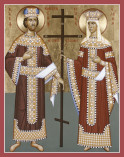 Constantine’s parents were the Emperor Constantius
Chlorus and the Empress Helena. Chlorus had further children by another wife, but by Helena he
had only the one, Constantine. Constantine fought two great battles when he came to the throne:
one against Maxentius, a tyrant in Rome, and the other against Licinius not far from Byzantium.
At the battle against Maxentius, when Constantine was in great anxiety and uncertainty about his
chances of success, a shining cross, surrounded by stars, appeared to him in the sky in full
daylight. On the cross were written the words: ‘In this sign, conquer!’ The wondering
emperor ordered that a great cross be put together, like the one that had appeared, and be
carried before the army. He also ordered all of his soldiers to paint crosses on their shields.
By the power of the Cross, he gained a glorious victory over enemies greatly superior in number.
Maxentius drowned himself in the Tiber. Immediately after this, Constantine issued the famous
Edict of Milan, in 313, to put an end to the persecution of Christians. Conquering Byzantium, he
built a beautiful capital city on the Bosphorus, which from that time was named
Constantinople.
Constantine’s parents were the Emperor Constantius
Chlorus and the Empress Helena. Chlorus had further children by another wife, but by Helena he
had only the one, Constantine. Constantine fought two great battles when he came to the throne:
one against Maxentius, a tyrant in Rome, and the other against Licinius not far from Byzantium.
At the battle against Maxentius, when Constantine was in great anxiety and uncertainty about his
chances of success, a shining cross, surrounded by stars, appeared to him in the sky in full
daylight. On the cross were written the words: ‘In this sign, conquer!’ The wondering
emperor ordered that a great cross be put together, like the one that had appeared, and be
carried before the army. He also ordered all of his soldiers to paint crosses on their shields.
By the power of the Cross, he gained a glorious victory over enemies greatly superior in number.
Maxentius drowned himself in the Tiber. Immediately after this, Constantine issued the famous
Edict of Milan, in 313, to put an end to the persecution of Christians. Conquering Byzantium, he
built a beautiful capital city on the Bosphorus, which from that time was named
Constantinople.
When there was discord in the Church about the troublesome heretic Arius, the emperor summoned the First Ecumenical Council in Nicaea, in 325, where the heresy was condemned and Orthodoxy confirmed. St. Helena, the emperor’s devout mother, was very zealous for the Christian Faith. She visited Jerusalem and found the Precious Cross of the Lord, and built the Church of the Resurrection over Golgotha and many other churches in the Holy Land. This holy woman went to the Lord in 327, at the age of eighty. The Emperor Constantine outlived his mother by ten years and entered into rest at the age of about sixty in 337, in the city of Nikomedia. His body was buried in the Church of the Holy Apostles in Constantinople.
2. Our Holy Father, the New-Martyr Pachomius.
Born in Little Russia, he was taken by the Tartars as a boy and sold to a Turkish tanner as a slave. He spent twenty-seven years in slavery in Usaki in Asia Minor, and was forced to embrace Islam. He went off to the Holy Mountain, became a monk and spent twelve years near the monastery of St. Paul. He resolved to suffer for Christ. His spiritual elder, Joseph, sent him off to Usaki, where he showed himself to his former owner as a Christian, wearing his monastic schema. The Turks gave him over to torture, then threw him into prison and finally beheaded him on May 8th, 1730, on Ascension Day. Many miracles were wrought by his blood and his relics. His body was buried on the island of Patmos in the Church of St. John the Theologian. Thus this villager from Little Russia became a martyr and wears the wreath in the kingdom of Christ.
FOR CONSIDERATION
We see that vice is something shameful and sinful, and that it always hides itself and always takes on the semblance of good works. St. John Chrysostom says most beautifully: ‘Vice has not got its own, personal face, but borrows the face of good deeds.’ The Savior also said: ‘(they) come to you in sheep’s clothing, but inwardly they are ravening wolves’ (Matt. 7:15). Call a liar a liar, and a thief a thief; a murderer a murderer, an immoral man an immoral man and a slanderer a slanderer, and you will anger them. Call any man honest, honorable, selfless, truthful, just, conscientious, and you’ll please and content him. Again I quote St. Chrysostom: ‘Good works are something natural to man, while vice is something unnatural and false.’ If a man is seized by some vice, he quickly justifies it by some good work, clothing it in the garment of good deeds. Truly, vice does not have its own, personal face, and neither has the devil, the father of vice.
Daily Scripture Readings taken from The Orthodox New Testament, translated and published by Holy Apostles Convent, Buena Vista, Colorado, copyright © 2000, used with permission, all rights reserved.
Daily Prologue Readings taken from The Prologue of Ochrid, by Bishop Nikolai Velimirovic, translated by Mother Maria, published by Lazarica Press, Birmingham, England, copyright © 1985, all rights reserved. Edited by Dormition Skete.