

Daily Devotional
Sunday, June 2, 2024 (NS), May 20, 2024 (OS)
No Fasting.
| Fifth Sunday of Pascha, or Sunday of the Samaritan Woman Mode Four — Seventh Eothinon |
The commemoration of the holy Martyr Thallelaios, the unmercenary healer, at Aegae in Cilicia, and his companions, the Martyrs Alexander and Asterios, and the opening of the relics of our father among the saints, Aleksii, Metropolitan of Moscow and Wonder-worker of All Russia.
Scripture Readings
Paschalion — Movable Calendar
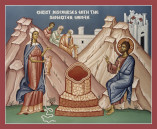
Fifth Sunday of Pascha, or Sunday of the Samaritan Woman
Mode Four — Seventh Eothinon
Epistle
The Reading is from the Acts of the Apostles [§ 28]. In those days:
For Gk usage, see Acts 11:19-30; for Sl. usage. see Acts 11:19-26, 29, 30.
11 19The apostles, who were scattered because of the affliction that arose about Stephen, went abroad as far as Phœnicia and Cyprus and Antioch, speaking the word to no one except to Jews only. 20But some of them were men of Cyprus and Cyrene, who, after they came to Antioch, began speaking to the Hellenists, preaching as good tidings the Lord Jesus. 21And the hand of the Lord was with them, and a great number believed and turned to the Lord. 22Then the report concerning them was heard in the ears of the Church which was in Jerusalem. And they sent forth Barnabas to go through as far as Antioch, 23who, after he came and saw the grace of God, was glad and was exhorting all to keep on remaining near to the Lord with purpose of heart. 24For he was a good man, and full of the Holy Spirit and of faith; and a considerable crowd was added to the Lord. 25And Barnabas went forth to Tarsus to search for Saul. 26And having found him, he brought him to Antioch. And it came to pass that they were gathered together with the Church for a whole year, and taught a considerable crowd. And the disciples were called Christians first in Antioch.
27And in these days prophets came down from Jerusalem to Antioch. 28And one of them, by name Agavos, rose up, and signified by the Spirit that there was about to be a great famine over all the inhabited world, which also came to pass in the time of Claudius Cæsar. 29And according as any one of the disciples was prospered, each of them determined to send relief toward ministering to the brethren who dwelt in Judæa, 30which also they did, sending it off to the presbyters by the hand of Barnabas and Saul.
Gospel
The Reading is from the Holy Gospel according to Saint John [§ 12]. At that time:
4 5Jesus came to a city of Samaria called Sychar, near the place which Jacob gave to his son Joseph. 6And Jacob’s well was there. Jesus then, having grown weary from the journey, was sitting thus on the well. It was about the sixth hour. 7There cometh a woman of Samaria to draw water. Jesus saith to her, “Give Me to drink.” 8For His disciples had gone away into the city in order that they might buy provisions. 9Then the Samaritan woman saith to Him, “How is it that Thou, being a Jew, askest to drink from me, who am a Samaritan woman? For the Jews have no dealings with Samaritans.” 10Jesus answered and said to her, “If thou knewest the gift of God, and Who is the One Who saith to thee, ‘Give Me to drink,’ thou wouldest have asked Him, and He would have given to thee living water.” 11The woman saith to Him, “Lord, Thou hast no bucket for drawing water, and the well is deep. From what place then hast Thou the water, the living one? 12“Thou art not greater than our father Jacob, who gave us the well, and drank from it himself, and his sons, and his animals, art Thou?” 13Jesus answered and said to her, “Everyone who drinketh of this water shall thirst again; 14“but whosoever drinketh of the water which I shall give him in no wise shall ever thirst. But the water which I shall give him shall become in him a fountain of water springing into eternal life.” 15The woman saith to Him, “Lord, give me this water, that I may not be thirsting, nor keep on coming here to draw.” 16Jesus said to her, “Go, call thy husband, and come here.” 17The woman answered and said, “I have no husband.” Jesus said to her, “Well didst thou say, ‘I have no husband,’ 18“for thou hast had five husbands, and now he whom thou hast is not thy husband; this truly thou hast spoken.” 19The woman saith to Him, “Lord, I perceive that Thou art a prophet. 20“Our fathers do reverence in this mountain, and ye say that in Jerusalem is the place where it is needful to do reverence.” 21Jesus saith to her, “Woman, believe Me, that there is coming an hour when neither in this mountain, nor in Jerusalem, shall ye do reverence to the Father. 22“Ye do reverence what ye know not; we do reverence what we know, for salvation is of the Jews. 23“But there is coming an hour, and now is, when the true worshippers shall do reverence to the Father in spirit and truth; for also the Father seeketh such as those who revere Him. 24“God is Spirit, and it is needful for those who revere Him to do reverence in spirit and truth.” 25The woman said to Him, “I know that Messiah is coming, the One Who is called Christ. Whenever that One should come, He will announce to us all things.” 26Jesus saith to her, “I am, the One Who speaketh to thee.” 27And upon this came His disciples, and they wondered that He was speaking with a woman; nevertheless no one said, “What seekest Thou?” or “Why speakest Thou with her?” 28The woman then left her waterpot, and went away into the city, and saith to the people, 29“Come, see a Man Who told me all things whatsoever I did. This One is not the Christ, is He?” 30Then they went forth out of the city and were going toward Him.
31But in the meantime the disciples were entreating Him, saying, “Rabbi, eat.” 32But He said to them, “I have food to eat which ye know not.” 33Therefore the disciples were saying to one another, “No one brought Him anything to eat, did he?” 34Jesus saith to them, “My food is that I be doing the will of Him Who sent Me, and that I should finish His work. 35“Do ye not say, ‘It is yet a space of four months, and the harvest cometh’? Behold, I say to you, lift up your eyes and see the fields, for they are white already to harvest. 36“And the one who reapeth receiveth a reward, and gathereth fruit to life eternal, that both the one who soweth and the one who reapeth may rejoice together. 37“For in this the saying is true, ‘There is one who soweth and another who reapeth.’ 38“I sent you forth to reap on what ye have not labored; others have labored, and ye have entered into their labor.” 39And many of the Samaritans of that city believed in Him, because of the utterance of the woman testifying, “He told me all things whatsoever I did.” 40Therefore, when the Samaritans came to Him, they were asking Him to stay with them; and He stayed there two days. 41And many more believed because of His word. 42And to the woman they were saying, “We no longer believe because of thy talk; for we ourselves have heard, and we know that this One is truly the Savior of the world, the Christ.”
Menaion — Fixed Calendar
The commemoration of the holy Martyr Thallelaios, the unmercenary healer, at Aegae in Cilicia, and his companions, the Martyrs Alexander and Asterios, and the opening of the relics of our father among the saints, Aleksii, Metropolitan of Moscow and Wonder-worker of All Russia.
Epistle
For the Martyrs:
The Reading is from the Epistle of Saint Paul to the Romans [§ 99]. Brethren:
8 28We know that to those who love God all things work together for good, to those who are called according to purpose. 29For whom He foreknew, He also foreordained to be conformable to the image of His Son, in order for Him to be the firstborn among many brethren. 30But whom He foreordained, these also He called; and whom He called, these also He justified; and whom He justified, these also He glorified. 31What then shall we say to these things? If God is for us, who can be against us? 32He Who indeed spared not His own Son, but delivered Him up for us all, how shall He not with Him also graciously give us all things? 33Who shall bring an accusation against the elect of God? God is the One Who justifieth. 34Who is the one who condemneth? Christ is the One Who died, but much more is He the One also Who was raised, Who also is at the right of God, Who also intercedeth for us. 35Who shall separate us from the love of Christ? Shall affliction, or distress, or persecution, or famine, or nakedness, or danger, or sword? 36Even as it hath been written: “For on account of Thee, we are being put to death the whole day; we were counted as sheep of slaughter [Ps. 43(44):23(22)].” 37But in all these things we more than conquer through the One Who loved us. 38For I have been persuaded that neither death, nor life, nor angels, nor principalities, nor powers, nor things present, nor things coming, 39nor height, nor depth, nor any other created thing, shall be able to separate us from the love of God, which is in Christ Jesus our Lord.
For the Hierarch:
The Reading is from the Epistle of Saint Paul to the Hebrews [§ 335]. Brethren:
13 17Be obedient to those who lead you, and keep on submitting, for they are watchful for your souls, as those about to render an account, that they may do this with joy, and not groaning; for this would be unprofitable for you. 18Keep on praying for us; for we trust that we have a good conscience, in all things wishing to conduct ourselves well. 19But I beseech you more abundantly to do this, that I might be restored more quickly to you.
20Now the God of peace Who brought up from the dead our Lord Jesus, the Shepherd of the sheep, the great One, in the blood of an everlasting covenant, 21may He render you perfect in every good work, in order to do His will, doing in you that which is well-pleasing before His face, through Jesus Christ, to Whom be glory to the ages of the ages. Amen.
Gospel
For the Martyrs:
The Reading is from the Holy Gospel according to Saint Luke [§ mid 51]. The Lord said to His disciples:
10 19“Behold, I give you the authority to tread upon serpents and scorpions, and upon all the power of the enemy; and nothing in anywise shall injure you. 20“However cease rejoicing in this, that the spirits are being made subject to you; but be rejoicing that your names were written in the heavens.” 21In the same hour Jesus rejoiced in the Spirit, and said, “I give thanks to Thee, O Father, Lord of the heaven and of the earth, that Thou didst hide these things from the wise and intelligent, and didst reveal them to babes. Yea, Father, for thus it was well-pleasing before Thee.”
For the Hierarch:
The Reading is from the Holy Gospel according to Saint Matthew [§ 11]. The Lord said to His disciples:
5 14“Ye are the light of the world. A city situated on the top of a mountain cannot be hid. 15“Nor do they light a lamp and put it under the bushel, but upon the lampstand, and it giveth light to all those in the house. 16“Thus, let your light shine before men, that they might see your good works, and might glorify your Father Who is in the heavens.
17“Do not begin to think that I came to abolish the law or the prophets; I came not to abolish, but to fulfill. 18“For verily I say to you, until the heaven and the earth shall have passed away, one iota or one tittle in no wise shall pass away from the law, until all shall have taken place. 19“Whosoever then shall break one of the least of these commandments, and shall teach men so, he shall be called least in the kingdom of the heavens; but whosoever shall do and teach them, this one shall be called great in the kingdom of the heavens.”
Lives of the Saints (Prologue)
June 2nd – Civil Calendar
May 20th – Church Calendar
1. The Holy Martyr Thallaleus (Thalelaios).
He was born in Lebanon. His father’s name was Berucius and his mother’s was Romylia. He was an eighteen-year-old youth, handsome and well-grown and with ginger hair. A doctor by profession, he suffered for Christ in the reign of Numerian. When he courageously confessed his faith in Christ the Lord before the judge, the latter commanded the two executioners, Alexander and Asterios, to bore through his knees, pass a rope through the pierced bone and hang him from a tree. But the executioners, as though the unseen power of God had deprived them of sight, bored through a plank and hung it on the tree. When the judge discovered this, he thought that the executioners had done it deliberately, and ordered that they be flogged. Then Alexander and Asterios cried out under the flogging: ‘The Lord is alive to us; from now on, we are become Christians. We believe in Christ, and suffer for Him.’ Hearing this, the judge ordered that they be beheaded. Then the judge took the awl, to bore through Thallaleus’ knees himself, but his hand was paralysed and he had to ask Thallaleus to heal him, which the kindly martyr, with Christ’s aid, did by his prayers. Then he was thrown into water, but showed himself alive to the judge (for Thallaleus was praying within himself that God would not have him die at once, but would let his tortures continue). When he was thrown to the wild beasts, they licked his feet and rubbed tamely round him. He was finally beheaded and entered into eternal life in 284.
2. The Holy Martyr Asklas.
He suffered in Antionus, a town in Egypt, in the time of Diocletian. He was flogged, flayed and burned with torches, but remained to the end steadfast in the Faith. When the torturer, Arrianos, was crossing the Nile by boat, Asklas, by his prayers, stopped the boat and would not let it move again until Arrianos had put in writing that he believed in Christ as the one, almighty God. But, dismissing that wonder as magic, Arrianos the torturer forgot all that he had written and continued to torture the man of God even more harshly. At last, Asklas had a stone tied around his neck and he was thrown into the Nile. But, on the third day, Christians found his body on the bank, with the stone still round his neck (as the martyr had foretold to them before his death), and gave him burial, in 287. The holy martyr Leonidas suffered together with him. Their torturer, Arrianos, repented later, came to believe in Christ with his whole heart and began to proclaim his faith publicly before the heathen. They then killed him also; and thus Arrianos, the sometime torturer of Christians, became worthy of the martyr’s wreath for Christ.
3. Our Holy Father Stefan of Piperi.
This saint was of the tribe of Nikšić, from the village of Župa, of poor and devout parents, Radoje and Yacima. To learn the ascetic life, he lived first in the monastery of Morača, where he became abbot. The Turks drove him out of there, and he settled in Rovaski Turmanj, in the place now called Celište. After that, he moved again and settled in a cell at Piperi, where he remained to his death in toil and godly asceticism. He entered peacefully into rest in the Lord on May 20th, 1697. His relics are preserved there to this day, and glorify Christ our God and Stefan the man of God by their many wonders.
FOR CONSIDERATION
When a man acquires a Christian conscience, he strives with zeal to set his life aright and to be pleasing to God. All else becomes for him of lesser value. We have examples of such men, not only among the great ascetics and spiritual teachers, but also among mighty kings. The Emperor Theodosios the Great offers us one such example. He at one time fell into heresy, but afterwards repented. In his funeral oration over Theodosios’ body, St. Ambrose said: ‘I loved this man, who, stripping himself of all imperial symbols, publicly bewailed his sin in church, and with sighs and tears, begged for forgiveness. That which a poor man might be ashamed to do was not shame to the emperor. After gaining a glorious victory over the enemies of the empire, he vowed not to receive holy Communion until the return of his sons, because his enemies had been killed in battle.’
Daily Scripture Readings taken from The Orthodox New Testament, translated and published by Holy Apostles Convent, Buena Vista, Colorado, copyright © 2000, used with permission, all rights reserved.
Daily Prologue Readings taken from The Prologue of Ochrid, by Bishop Nikolai Velimirovic, translated by Mother Maria, published by Lazarica Press, Birmingham, England, copyright © 1985, all rights reserved. Edited by Dormition Skete.