

Daily Devotional
Tuesday, May 28, 2024 (NS), May 15, 2024 (OS)
No Fasting.
Tuesday of the Fourth Week
The commemoration of our venerable Father Pachomios the Great, founder of cenobitic monasticism, and our holy father among the saints, Achilles, Bishop of Larisa.
Scripture Readings
Paschalion — Movable Calendar
Tuesday of the Fourth Week
Epistle
The Reading is from the Acts of the Apostles [§ 25]. In those days:
10 21Peter went down to the men who were sent forth to him from Cornelius, and said, “Behold, I am he whom ye seek; what is the cause for which ye are come?” 22And they said, “Cornelius, a centurion, a righteous man and one fearing God, and whose character is approved by testimony by the entire nation of the Jews, was divinely warned by a holy angel to send for thee to his house, and to hear words from thee.” 23Then he called them in and lodged them. And on the morrow Peter went forth with them, and some of the brethren from Joppa accompanied him. 24And on the morrow they entered into Cæsarea. And Cornelius was expecting them, and called together to himself his kinfolk and close friends. 25And as Peter was coming in, Cornelius met him and fell at his feet and made obeisance. 26But Peter raised him, saying, “Stand up; I myself also am a man.” 27And as he talked with him, he went in, and found many who were gathered together. 28And he said to them, “Ye know how unlawful it is for a man who is a Jew to join himself or come near to one of another race; but God showed me not to call a person common or unclean. 29“Wherefore, after I was sent for, I also came without gainsaying. I inquire therefore for what reason ye sent for me?” 30And Cornelius said, “Four days ago I was fasting until this hour, and I was keeping the ninth hour of prayer in my house; and behold, a man stood before me in bright clothing, 31“and said, ‘Cornelius, thy prayer was heard and thine alms were remembered before God. 32“‘Send therefore to Joppa and call for Simon, who is surnamed Peter. This man is staying as a guest in the house of Simon, a tanner beside the sea, who, after he cometh, shall speak to thee.’ 33“At once therefore I sent to thee; and thou didst well in coming. Now therefore, we are all present before God, to hear all the things that have been commanded thee by God.”
Gospel
The Reading is from the Holy Gospel according to Saint John [§ 25]. At that time:
7 1Jesus was walking about in Galilee; for He was not willing to walk about in Judæa, because the Jews were seeking to kill Him. 2Now the feast of the Jews, the feast of tabernacles, was near. 3His brethren therefore said to Him, “Pass over from this place, and go into Judæa, in order that Thy disciples might see the works which Thou doest; 4“for no one doeth anything in secret, and he himself seeketh to be known in public. Since Thou doest these things, manifest Thyself to the world.” 5For not even His brethren were believing in Him. 6Then Jesus said to them, “My time is not yet come; but your time is always ready. 7“The world is not able to hate you; but Me it hateth, because I bear witness concerning it that the works of it are evil. 8“Ye go up to the feast; I am not yet going up to this feast, for My time hath not yet been fulfilled.” 9And having said these things to them He stayed in Galilee. 10But when His brethren went up, then He also went up to the feast, not openly, but as in secret. 11Then the Jews were seeking Him at the feast and were saying, “Where is that One?” 12And there was much murmuring among the crowds concerning Him. Some, on the one hand, were saying, “He is good”; but others, on the other hand, were saying, “No, but rather He deceiveth the crowd.” 13No one, nevertheless, was speaking openly about Him for fear of the Jews.
Menaion — Fixed Calendar
The commemoration of our venerable Father Pachomios the Great, founder of cenobitic monasticism, and our holy father among the saints, Achilles, Bishop of Larisa.
Epistle
For the venerable Father:
The Reading is from the Epistle of Saint Paul to the Galatians [§ 213]. Brethren:
5 22The fruit of the Spirit is love, joy, peace, long-suffering, kindness, goodness, faith, 23meekness, self-control; against such things there is no law. 24But they who are of the Christ crucified the flesh with the passions and the lusts. 25If we live by the Spirit, let us also be walking by the Spirit. 26Let us not become vainglorious, provoking one another, envying one another.
6 1Brethren, even if a man should be overtaken in some transgression, ye, the spiritual ones, be restoring such a one in the spirit of meekness, looking out for thyself, lest thou also be tempted. 2Keep on bearing one another’s burdens, and thus fill up the law of the Christ.
for Sl. usage, see [2 Cor. 4:6-15].
Gospel
The Reading is from the Holy Gospel according to Saint Matthew [§ 10]. At that time:
4 23Jesus was going around all Galilee, teaching in their synagogues, and proclaiming the Gospel of the kingdom, and curing every disease and every sickness among the people. 24And the report of Him went out into all Syria. And they brought to Him all those who were ill, constrained by various diseases and torments, and possessed by demons, and lunatics, and paralytics; and He cured them. 25And great crowds followed Him from Galilee, and Decapolis, and Jerusalem, and Judæa, and beyond the Jordan.
5 1And seeing the crowds, He went up into the
mountain; and after He sat down, His disciples came to Him. 2And He opened His mouth
and began to teach them, saying:
3“Blessed are the poor in spirit, for theirs is the
kingdom of the heavens.
4“Blessed are they who mourn, for they shall be
comforted.
5“Blessed are the meek, for they shall inherit the
earth.
6“Blessed are they who hunger and thirst after
righteousness, for they shall be filled.
7“Blessed are the merciful, for they shall find mercy.
8“Blessed are the pure in heart, for they shall see
God.
9“Blessed are the peacemakers, for they shall be called
sons of God.
10“Blessed are they who have been persecuted on account
of righteousness, for theirs is the kingdom of the heavens.
11“Blessed are ye whenever they reproach you and persecute
you, and say every evil word against you falsely on account of Me.
12“Be rejoicing and be exceedingly glad, for your reward
is great in the heavens. For so they persecuted the prophets who were before
you.
13“Ye are the salt of the earth; but if the salt should become insipid, with what shall it be salted? For it is no longer good for anything, except to be cast out and to be trampled underfoot by men.”
for Sl. usage, see [Lk. 14:25-35].
Lives of the Saints (Prologue)
May 28th – Civil Calendar
May 15th – Church Calendar
1. Our Holy Father Pachomios the Great.
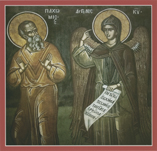 He was an Egyptian by birth and was a pagan in his
youth. As a soldier, he took part in the Emperor Constantine’s war against Maxentius. After
that, learning from Christians about the one God and seeing their devout life, Pachomios was
baptized and went to the Tabennisiot desert, to the famous ascetic Palamon, with whom he lived in
asceticism for ten years. Then an angel appeared to him in the robes of a monk of the Great Habit
at the place called Tabennisi and gave him instructions on the rule of a cenobitic monastery,
commanding him to found such a monastery in that place and prophesying to him that many monks
would come to it seeking the salvation of their souls. Obeying the angel of God, Pachomios began
building many cells, although there was no one in that place but himself and his brother John.
When his brother grumbled at him for doing this unnecessary building, Pachomios simply told him
that he was following God’s command, without explaining who would live there, or when. But
many men soon assembled in that place, moved by the Spirit of God, and began to live in
asceticism under the rule that Pachomios had received from the angel. When the number of monks
had increased greatly, Pachomios, step by step, founded six further monasteries. The number of
his disciples grew to seven thousand. St. Anthony is regarded as the founder of the eremitic
life, and St. Pachomios of the monastic, communal life. The humility, love of toil and abstinence
of this holy father were and remain a rare example for the imitation of monks. St. Pachomios
performed innumerable miracles, and also endured innumerable temptations from demons and men. And
he served men as both father and brother. He roused many to set out on the way of salvation, and
brought many into the way of truth. He was and remains a great light in the Church and a great
witness to the truth and righteousness of Christ. He entered peacefully into rest in 346, at the
age of sixty. The Church recognizes many of his followers as saints: Theodore, Job, Paphnutios,
Pecusius, Athenodorus, Eponichus, Soutus, Psois, Dionysius, Petronius and others.
He was an Egyptian by birth and was a pagan in his
youth. As a soldier, he took part in the Emperor Constantine’s war against Maxentius. After
that, learning from Christians about the one God and seeing their devout life, Pachomios was
baptized and went to the Tabennisiot desert, to the famous ascetic Palamon, with whom he lived in
asceticism for ten years. Then an angel appeared to him in the robes of a monk of the Great Habit
at the place called Tabennisi and gave him instructions on the rule of a cenobitic monastery,
commanding him to found such a monastery in that place and prophesying to him that many monks
would come to it seeking the salvation of their souls. Obeying the angel of God, Pachomios began
building many cells, although there was no one in that place but himself and his brother John.
When his brother grumbled at him for doing this unnecessary building, Pachomios simply told him
that he was following God’s command, without explaining who would live there, or when. But
many men soon assembled in that place, moved by the Spirit of God, and began to live in
asceticism under the rule that Pachomios had received from the angel. When the number of monks
had increased greatly, Pachomios, step by step, founded six further monasteries. The number of
his disciples grew to seven thousand. St. Anthony is regarded as the founder of the eremitic
life, and St. Pachomios of the monastic, communal life. The humility, love of toil and abstinence
of this holy father were and remain a rare example for the imitation of monks. St. Pachomios
performed innumerable miracles, and also endured innumerable temptations from demons and men. And
he served men as both father and brother. He roused many to set out on the way of salvation, and
brought many into the way of truth. He was and remains a great light in the Church and a great
witness to the truth and righteousness of Christ. He entered peacefully into rest in 346, at the
age of sixty. The Church recognizes many of his followers as saints: Theodore, Job, Paphnutios,
Pecusius, Athenodorus, Eponichus, Soutus, Psois, Dionysius, Petronius and others.
2. St. Achillios, Bishop of Larissa.
This great hierarch and wonder-worker was born in Cappadocia. He took part in the First Ecumenical Council, at which he put the heretics to shame, and both by his great learning and his great purity, gave cause for much wonder. Taking up a stone, Achillios called to the Arians: ‘If Christ is a creature of God, as you say, tell oil to flow from this stone.’ The heretics kept silent, amazed at this demand by St. Achillios. Then the saint continued: ‘And if the Son of God is equal to the Father, as we believe, then let oil flow from this stone.’ And oil flowed out, to the amazement of all. St. Achillios entered peacefully into rest in Larissa in the year 330. Samuel, King of Macedonia, when he conquered Thessaly, translated the relics of Achillios to Prespa, to an island in a lake that was named, and is called to this day, Achillios or Ailus.
3. Our Holy Father Silvanos.
He was at first a comedian, mimicking each and all, but then, inflamed by the love of Christ, he became a disciple of St. Pachomios. ‘I would be ready to give my life,’ he said, ‘to receive the forgiveness of my sins.’
FOR CONSIDERATION
When a tyrant exercises tyranny over a righteous man from covetousness, then the tyrant brings both a gain and a loss: a loss for the tyrant and a gain for him who suffers the tyranny. Boris Godunov murdered the eight-year-old Tsarevich Dimitri in order to seize the throne without a rival. The days of his reign were quickly ended, and the tyrant was given over to corruption and damnation; but Dimitri was sanctified. After lying in the grave for fifteen years, Dimitri’s body was found to be incorrupt and wonder-working. There are forty-five miracles of healing recorded over his grave. Whose, then, was the loss and whose the gain from this tyranny? If the tyrant thought that he would, by tyranny, help his opponent to be included in the ranks of the saints and would prepare destruction and damnation for himself, he would change his mind about his planned tyranny. But wrong thinking is the forerunner and companion of tyranny.
Daily Scripture Readings taken from The Orthodox New Testament, translated and published by Holy Apostles Convent, Buena Vista, Colorado, copyright © 2000, used with permission, all rights reserved.
Daily Prologue Readings taken from The Prologue of Ochrid, by Bishop Nikolai Velimirovic, translated by Mother Maria, published by Lazarica Press, Birmingham, England, copyright © 1985, all rights reserved. Edited by Dormition Skete.