

Daily Devotional
Sunday, March 5, 2023 (NS), February 20, 2023 (OS)
Fast Day, but Shellfish, Wine and Olive Oil Allowed.
Holy & Great Fast
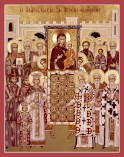
| The Sunday of the First Week of the Great Fast or Sunday of Orthodoxy. Mode Plagal One — Fifth Eothinon |
The commemoration of our venerable father among the saints, Leo, Bishop of Catania in Sicily, and the venerable Hieromartyr Cornelius, Abbot of the Monastery of the Caves of Pskov.
Scripture Readings
Paschalion — Movable Calendar
The Sunday of the First Week of the Great Fast or Sunday of Orthodoxy.
Mode Plagal One — Fifth Eothinon
Epistle
The Reading is from the Epistle of Saint Paul to the Hebrews [§ mid 329]. Brethren:
Gk. usage, Heb. 11:24-26, 32-40; Sl. usage, Heb. 11:24-26, 32-12:2.
11 24By faith Moses, “having become full-grown [Ex. 2:11],” refused to be called the son of pharaoh’s daughter, 25having chosen rather to suffer affliction with the people of God, than to have the temporary enjoyment of sin, 26since he deemed the reproach of Christ greater wealth than the treasures in Egypt; for he kept on looking away from the treasures to the recompense.... 32And what more shall I say? For the time will fail me narrating about Gideon and Barak and also Samson and Jephthae, and about David and Samuel and the prophets, 33who through faith struggled against kingdoms, wrought righteousness, attained to promises, stopped mouths of lions, 34quenched the power of fire, escaped the edges of the sword, were empowered out of weakness, became strong in battle, turned back encampments of aliens. 35Women received their dead by resurrection. And others were tortured, not accepting release, that they might attain a better resurrection. 36And others received trial of mockings and of scourgings, and, moreover, of bonds and of imprisonment. 37They were stoned, they were sawn asunder, were tempted; they died, murdered by the sword. They went about in sheepskins, in goatskins, being in need, afflicted, ill-treated— 38of whom the world was not worthy. They were made to wander in deserts, and in mountains, and in caves, and in the holes of the earth. 39And these all, having been approved by testimony through faith, received not for themselves the promise, 40God having foreseen some better thing concerning us, that they should not be made perfect without us.
12 1Therefore we also, having so great a cloud of witnesses which is set around us, and having laid aside every weight and sin that is easily circumvented, let us by means of patience be running the course which is set before us, 2looking to Jesus, the originator and accomplisher of our faith.
Gospel
The Reading is from the Holy Gospel according to Saint John [§ 5]. At that time:
1 43Jesus intended to go forth into Galilee; and He findeth Philip, and saith to him, “Follow thou Me.” 44Now Philip was from Bethsaida, of the city of Andrew and Peter. 45Philip findeth Nathanael, and saith to him, “We have found the One of Whom Moses in the law, and the prophets, wrote—Jesus the son of Joseph, Who is from Nazareth.” 46And Nathanael said to him, “Out of Nazareth can there be any good thing?” Philip saith to him, “Come and see.” 47Jesus saw Nathanael coming toward Him, and saith concerning him, “Behold, truly an Israelite in whom is no guile.” 48Nathanael saith to Him, “From what place knowest Thou me?” Jesus answered and said to him, “Before Philip called thee, when thou wast under the fig tree, I saw thee.” 49Nathanael answered, and saith to Him, “Rabbi, Thou art the Son of God; Thou art the King of Israel.” 50Jesus answered and said to him, “Because I said to thee, ‘I saw thee underneath the fig tree,’ believest thou? Thou shalt see greater things than these.” 51And He saith to him, “Verily, verily, I say to thee, henceforth ye shall see the heaven having been opened, and the angels of God ascending and descending upon the Son of Man.”
Menaion — Fixed Calendar
The commemoration of our venerable father among the saints, Leo, Bishop of Catania in Sicily, and the venerable Hieromartyr Cornelius, Abbot of the Monastery of the Caves of Pskov.
Epistle
The Reading is from the Epistle of Saint Paul to the Romans [§ 99]. Brethren:
8 28We know that to those who love God all things work together for good, to those who are called according to purpose. 29For whom He foreknew, He also foreordained to be conformable to the image of His Son, in order for Him to be the firstborn among many brethren. 30But whom He foreordained, these also He called; and whom He called, these also He justified; and whom He justified, these also He glorified. 31What then shall we say to these things? If God is for us, who can be against us? 32He Who indeed spared not His own Son, but delivered Him up for us all, how shall He not with Him also graciously give us all things? 33Who shall bring an accusation against the elect of God? God is the One Who justifieth. 34Who is the one who condemneth? Christ is the One Who died, but much more is He the One also Who was raised, Who also is at the right of God, Who also intercedeth for us. 35Who shall separate us from the love of Christ? Shall affliction, or distress, or persecution, or famine, or nakedness, or danger, or sword? 36Even as it hath been written: “For on account of Thee, we are being put to death the whole day; we were counted as sheep of slaughter [Ps. 43(44):23(22)].” 37But in all these things we more than conquer through the One Who loved us. 38For I have been persuaded that neither death, nor life, nor angels, nor principalities, nor powers, nor things present, nor things coming, 39nor height, nor depth, nor any other created thing, shall be able to separate us from the love of God, which is in Christ Jesus our Lord.
Gospel
The Reading is from the Holy Gospel according to Saint Luke [§ 67]. The Lord said:
12 32“Cease being afraid, little flock, for your Father is well pleased to give you the kingdom. 33“Sell your possessions and give alms. Make for yourselves purses which do not become old, an unfailing treasure in the heavens, where no thief draweth near nor moth destroyeth; 34“for where your treasure is, there your heart will be also. 35“Let your loins be girded about and the lamps be kept burning; 36“and be ye like to men waiting for their own lord—whenever he should depart from the wedding festivities—that when he cometh and knocketh, straightway, they might open to him. 37“Happy are those slaves whom the lord, after he cometh, shall find watching. Verily I say to you that he shall gird himself about and shall have them recline at table, and will come forth and minister to them. 38“And if he should come in the second watch, and in the third watch should he come, and find them thus, happy are those slaves. 39“But know ye this, that if the master of the house had known in what hour the thief was coming, he would have watched and not let his house be broken into. 40“Ye therefore also keep on becoming ready, for in the hour ye think not, the Son of Man cometh.”
Synaxarion Readings
The Triumph of Orthodoxy Sunday
I rejoice when I see the veneration due the icons, once so shamefully rejected.
On this first Sunday of Great Lent, the Sunday of Orthodoxy, the Church of Christ celebrates the restoration of the holy and venerable icons by the Emperor Michael, the holy and blessed Empress Theodora, and the holy Methodius, patriarch of Constantinople.
Through God’s indulgence, Leo the Isaurian, a swineherd and keeper of donkeys, inherited the scepter of the kingdom in the 8th century. At that time Saint Germanos was at the helm of the Church. Leo sent for him and said, “Since it seems to me that there is no difference between the holy icons and idols, command that they be removed immediately from among us. Although if they are true likenesses of the saints, let them be hung higher on the walls so that we who are wallowing in sins do not defile them by venerating them.” But the patriarch responded thus to the emperor’s abomination, “O king, we have heard of someone who will come and raise his hand against the holy icons. He is called Conon. Could you be this man?” The emperor said, “I was so called as a child.” And since the patriarch refused to obey the emperor, the latter deposed him and installed Anastasios, who sympathized with him. And so at that time began the struggle against the holy icons.
After this Leo, Constantine Copronymos became heir to the kingdom as well as to the savage attacks against the holy icons. And what can be said about the number and kind of deeds that lawless man committed except that he came to a most shameful end. His son Leo, whose mother was a Khazar, inherited the kingdom after him, and he also came to a bad end. Irene and Constantine then ascended the throne. At the direction of the holy Patriarch Tarasius they assembled the Seventh Council, and the holy icons were once more accepted by Christ’s Church. After they relinquished the kingdom, Nicephoros ascended to the throne. After him there were Stavrakios and then Michael Rangabe, who did not persecute the Orthodox.
The beast-like Leo V the Armenian then seized the throne from Michael, and having been misled by an impious hermit, began the second iconoclasm. And once more the Church was bereft of her beauty. Michael Amorius succeeded him, whose son Theophilus then for the second time directed this madness against the icons. For it was this Theophilus who gave many of the holy fathers over to torments and tortures, not seeking the truth about the holy icons but believing whatever he would. “If there be anyone in the city intent on uprising, then he will be caught not long after,” he said. And after reigning for 12 years, he was stricken with an intestinal disorder so that he desired to relinquish his life. His mouth opened so wide that his internal organs were visible.
The empress was so upset at what had happened, that she could barely sleep. And in a dream she beheld the most pure Theotokos holding the pre-eternal Child, surrounded by most luminous angels. They were striking Theophilus her husband and humiliating him. Now when her dream had passed and Theophilus had come to his senses, he cried, “Woe is me in my wretchedness! I am struck for the sake of the holy icons.” And immediately the empress held an icon of the Theotokos above him and entreated her with tears. And Theophilus, so inclined, saw that one of the clergy surrounding him had an engolpion, which he grabbed and kissed. Now as soon as his lips touched the icon, he returned to normal and was relieved of the adversity and affliction and fell asleep, after confessing that it is good to venerate the holy icons. Then the empress, fetching the holy and precious images from her bedchamber, convinced Theophilus to kiss them and venerate them with all his heart. A short while afterwards Theophilus departed this life. Theodora then commanded that all who were in exile and in prison be freed. John Grammatikos was deposed from the patriarchal throne, since he was more a sorcerer and demon worshiper than a patriarch. Then Methodius, a confessor of Christ, ascended the throne, having suffered much through having been closed up in a tomb alive.
While he was there, Ioannikios the Great, who was practicing asceticism on Mount Olympus, received a divine visitation. The great faster Arsaakios came to him and said, “God has sent me to you, that we might go to the righteous Isaiah the recluse in Nicomedia and learn from him what God desires and what is fitting for His Church.” Now when they came to the venerable Isaiah, he said to them, “Thus saith the Lord: Behold, the end is approaching for the enemies of My image. Go to the empress Theodora and to the Patriarch Methodius and tell them: ‘Cease to do what is not holy, and offer sacrifice to Me with the angels by venerating the countenance of My image and of the Cross.’” Hearing this they immediately left for Constantinople and announced what had been said to Patriarch Methodius and all God’s assembled people. The assembly then went to the empress and found her agreeable in all things, since this was the pious and God-loving tradition of the fathers. The empress straightway brought out an icon of the Theotokos for all to see, and venerating it, she said, “Let all be condemned who do not venerate the holy icons, kissing them in love, not in worship as gods, but as images, for the sake of the love of their archetypes.” And they rejoiced with great joy. And in response she entreated them to pray for her husband Theophilus. Seeing her faith, they obeyed reluctantly. For Patriarch Methodius among the saints assembled all the people, priests and bishops and proceeded to God’s Great Church. Among the assembled were Ioannikios the Great from Olympus, Arsaakios, Pancratios, and the disciples of Theodore the Studite, and the confessors Theophanes and Theodore the Branded, Michael the synkellos of the Holy City and many others. And they prayed to God for Theophilus in tears all night long.
Now this took place throughout the first week of the Great Fast, with the Empress Theodora herself, the women, and all the people taking part. Having completed the prayers, the Empress Theodora retired at dawn on Friday, and dreamed that she was at the foot of the Cross, and there were several people passing by noisily, wearing various instruments of torture. As she recognized the Emperor Theophilus among those being led with his hands bound behind his back, she followed the group and its guards. When they reached the brass gates, she saw a supernatural vision, a man sitting in front of the image of Christ and Theophilus brought before him. Reaching to touch his feet, the empress prayed for the emperor. He opened his mouth and said, “Great is thy faith, O woman. Know that because of thy tears and thy faith, as well as the prayers and petitions of My servants and My priests, I grant forgiveness to thy husband Theophilus.” Then He said to the guards, “Loose him and give him to his wife.” And taking him, she departed rejoicing in gladness. And immediately the dream left her.
Now Patriarch Methodius, while the prayers and petitions were being offered for him, had taken a new parchment scroll and written the names of all the heretical emperors, including Theophilus, placing it under the holy altar table. But on Friday he saw a great and terrible angel entering the temple, coming to him and saying, “Thy petition has been heard, O bishop, and the Emperor Theophilus has received forgiveness. Trouble the Godhead about this no longer.” And desiring to ascertain the truth of his vision the patriarch descended from his place, and taking the parchment and unrolling it, he found—O the judgments of God!—that all reference to the name of Theophilus had been erased by God.
Upon hearing this, the empress rejoiced greatly and requested the patriarch to assemble all the people with the holy icons and crosses in Hagia Sophia so that it might be adorned with the holy icons and God’s new miracle could be known by all. And soon when all had gathered in the church holding candles, the empress arrived with her son. And a Litia was served there with the holy icons and the divine and precious wood of the Cross and with the sacred and divine Gospels. And leaving the church calling out, “Lord, have mercy,” they processed the agreed mile. Then they returned to the church, where Divine Liturgy was celebrated.
When the holy and precious icons were returned to their place, the holy men mentioned earlier and the pious Orthodox rulers were glorified, and those impious people who did not accept the honor of the holy icons were anathematized and condemned. And from that time these holy confessors appointed the annual commemoration of this solemnity, so that we might never again fall into a similar ignominy.
O unchanging Image of the Father, through the prayers of Thy holy confessors, have mercy on us. Amen.
Translated from Triodion, siest ‘Tripesnets: Triod’ Postnaya, Moscow, 1904, by Robert Parent.
Lives of the Saints (Prologue)
March 5th – Civil Calendar: Non-Leap Year
March 4th – Civil Calendar: Leap Year
February 20th – Church Calendar
1. St. Leo, Bishop of Catania.
Beneath the Mount Etna volcano, in the town of Catania, St. Leo was a good shepherd and compassionate teacher of the people. He had great care for the sick and the poor, and both his zeal for the Faith and his compassion for the needy were great. There appeared one day in that town a magician called Heliodorus, who deluded the people with many illusions and greatly seduced the young. He once entered a church during a divine service and began his tricks. St. Leo came up to him, bound him with one end of his pallium and led him out to the marketplace. Since the emperor had ordered the execution of Heliodorus, a great fire was kindled. When it was burning fiercely, Leo stood among the flames, holding Heliodorus to prevent him from working any of his diabolical tricks. Heliodorus was completely burned up, but Leo remained alive and unharmed. All who had been taken in by Heliodorus, and who had regarded him as in some way divine, were put to shame by this. The compassionate and zealous Leo became known throughout the whole kingdom as a wonder-worker, helping people by his miracles. When he had finished his course, sometime in the 8th century, his soul went to the Lord and healing myrrh flowed from his relics.
2. The Hieromartyr Sadok.
Sadok was bishop in Persia after St. Simeon. One night St. Simeon appeared to him in a dream and said: ‘Yesterday, me; today, you!’ Sadok interpreted these words to his congregation as meaning: ‘Last year I suffered; this year you will.’ And indeed, in that year, King Sapor arrested him with many of his clergy and people and brought them to trial. He first ordered them to worship fire and the sun as divine. Sadok replied: ‘We are ready with all our hearts to die for our God, and will not worship fire or the sun.’ They were then tortured and condemned to be beheaded with the sword. Before execution, Sadok raised this prayer to God: ‘Wash us from our sins, O Lord, in our own blood,’—and Sadok gloriously gave his body to death and his soul to God immortal, together with his priests and his people. He suffered in 342 or 344.
FOR CONSIDERATION
Water is finer than earth; fire is finer than water; air is finer than fire; electricity is finer than air. But, in the spiritual world, both air and electricity are coarse elements. Electricity is very fine, but the voice is finer than electricity, thought is finer than the voice and the spirit is finer than thought. Air is fine, and carries the voice over a great distance. Electricity is fine, and carries light over a great distance. So also every act and word and thought of yours is carried to all parts of the spiritual kingdom. Oh, how terrible a thing it is to perform a sinful act, to speak a sinful word and to think a sinful thought! To what an immeasurable distance are waves raised on the spiritual sea! But do not examine distant minutiae that are beyond your ken. It is of the greatest importance to know and weigh how every act, word and thought of yours makes an inescapable impression on four sides: on God and the spiritual world, on nature, on other people and on your own soul. If you train yourself in this knowledge, you will reach a high level of saving vigilance.
Daily Scripture Readings taken from The Orthodox New Testament, translated and published by Holy Apostles Convent, Buena Vista, Colorado, copyright © 2000, used with permission, all rights reserved.
Daily Prologue Readings taken from The Prologue of Ochrid, by Bishop Nikolai Velimirovic, translated by Mother Maria, published by Lazarica Press, Birmingham, England, copyright © 1985, all rights reserved. Edited by Dormition Skete.