

Daily Devotional
Sunday, October 30, 2022 (NS), October 17, 2022 (OS)
No Fasting.
The Sunday of the Holy Fathers
According to Gk. usage, if the 11th of October should fall on Sunday, we commemorate the service of The Holy Fathers of the Seventh Œcumenical Synod. If not, we commemorate the service on the following Sunday. According Sl. usage, if the 11th of October should fall on Wednesday or earlier, the service is commemorated on the preceding Sunday. If the 11th should fall on Thursday or later, then the service is commemorated on the following Sunday.
Sunday of the Twentieth Week
Mode Three — Ninth Eothinon
The commemoration of the holy Prophet Hosea, and the holy righteous Monk-martyr Andrew of Crete.
Scripture Readings
Special Commemorations
The Sunday of the Holy Fathers
According to Gk. usage, if the 11th of October should fall on Sunday, we commemorate the service of The Holy Fathers of the Seventh Œcumenical Synod. If not, we commemorate the service on the following Sunday. According Sl. usage, if the 11th of October should fall on Wednesday or earlier, the service is commemorated on the preceding Sunday. If the 11th should fall on Thursday or later, then the service is commemorated on the following Sunday.
Epistle
The Reading is from the Epistle of Saint Paul to Saint Titus [§ mid 302 A]: Child Titus:
3 8Faithful is the word. And concerning these things I desire thee to be affirming, in order that they who have believed God may give heed to set before themselves good works. These things are good and profitable to men. 9But be shunning foolish inquiries, and genealogies, and strifes, and contentions relating to points of the law; for they are unprofitable and vain. 10A heretical man, after a first and second admonition, be rejecting, 11knowing that such a one hath been perverted, and sinneth, being self-condemned.
12Whenever I should send Artemas to thee, or Tychikos, hasten to come to me in Nicopolis, for I have decided to winter there. 13Send forth with haste Zenas the lawyer and Apollos, in order that nothing may be lacking to them. 14And let ours also be learning to set before themselves good works for necessary uses, that they may not be unfruitful.
15All those with me salute thee. Greet those who love us in faith.
Grace be with you all. Amen.
For Sl. usage, see [Heb. 13:7-16].
Gospel
The Reading is from the Holy Gospel according to Saint Matthew [§ 11]. The Lord said to His disciples:
5 14“Ye are the light of the world. A city situated on the top of a mountain cannot be hid. 15“Nor do they light a lamp and put it under the bushel, but upon the lampstand, and it giveth light to all those in the house. 16“Thus, let your light shine before men, that they might see your good works, and might glorify your Father Who is in the heavens.
17“Do not begin to think that I came to abolish the law or the prophets; I came not to abolish, but to fulfill. 18“For verily I say to you, until the heaven and the earth shall have passed away, one iota or one tittle in no wise shall pass away from the law, until all shall have taken place. 19“Whosoever then shall break one of the least of these commandments, and shall teach men so, he shall be called least in the kingdom of the heavens; but whosoever shall do and teach them, this one shall be called great in the kingdom of the heavens.”
for Sl. usage, see [Jn. 17:1-13].
Paschalion — Movable Calendar
Sunday of the Twentieth Week
Mode Three — Ninth Eothinon
Epistle
The Reading is from the Epistle of Saint Paul to the Galatians [§ 200].
1 11Brethren, I make known to you the Gospel which was preached as good tidings by me, that it is not according to man; 12for I neither received it from man, nor was I taught it, but by a revelation of Jesus Christ. 13For ye heard of my manner of life at one time in Judaism, that according to excess, I used to persecute the Church of God, and was ravaging her. 14And I kept on advancing in Judaism beyond many contemporaries in mine own race, being more exceedingly a zealot of the traditions of my fathers. 15But when it pleased God, Who separated me from my mother’s womb and called me by His grace, 16to reveal His Son in me, that I be preaching Him as good tidings among the nations, immediately I conferred not with flesh and blood, 17neither did I go up to Jerusalem to those who were apostles before me, but I went away into Arabia, and again returned to Damascus. 18Then after three years I went up to Jerusalem to visit Peter, and remained with him fifteen days; 19but of the other apostles I saw none, except Iakovos the brother of the Lord.
Gospel
The Reading is from the Holy Gospel according to Saint Luke [§ 35]. The Lord said this parable:
8 5“The one who soweth went out to sow his seed. And as he was sowing, some seed indeed fell by the wayside; and it was trampled down, and the birds of the heaven devoured it. 6“And other seed fell upon the rock; and having sprung up, it was dried up, because it had no moisture. 7“And other seed fell in the midst of the thorns; and the thorns, having sprung up together, choked it. 8“And other seed fell upon the good ground; and having sprung up, it produced fruit a hundredfold.” And after He said these things, He cried, “The one who hath ears to hear, let him hear.” 9And His disciples were asking Him, saying, “What may this parable be?” 10And He said, “To you it hath been given to know the mysteries of the kingdom of God, but to the rest in parables, that ‘seeing they see not, and hearing they understand not [cf. Is. 6:9].’ 11“Now the parable is this: The seed is the word of God. 12“And those by the wayside are the ones who hear; then the devil cometh and taketh away the word from their heart, lest after they believe they should be saved. 13“And those upon the rock are the ones who, whenever they hear, receive the word with joy; and yet these, who for a time believe, have no root, and in time of temptation withdraw. 14“And that which fell into the thorns, these are the ones who heard, and while they are going on their way, they are being choked by cares and wealth and pleasures of life, and do not bring fruit to perfection. 15“But that in the good ground, these are they who, after they hear the word with a noble and good heart, held fast and bore fruit in patience.”
Menaion — Fixed Calendar
The commemoration of the holy Prophet Hosea, and the holy righteous Monk-martyr Andrew of Crete.
Epistle
The Reading is from the Epistle of Saint Paul to the Hebrews [§§ 330, 331]. Brethren:
11 33All the saints through faith struggled against kingdoms, wrought righteousness, attained to promises, stopped mouths of lions, 34quenched the power of fire, escaped the edges of the sword, were empowered out of weakness, became strong in battle, turned back encampments of aliens. 35Women received their dead by resurrection. And others were tortured, not accepting release, that they might attain a better resurrection. 36And others received trial of mockings and of scourgings, and, moreover, of bonds and of imprisonment. 37They were stoned, they were sawn asunder, were tempted; they died, murdered by the sword. They went about in sheepskins, in goatskins, being in need, afflicted, ill-treated— 38of whom the world was not worthy. They were made to wander in deserts, and in mountains, and in caves, and in the holes of the earth. 39And these all, having been approved by testimony through faith, received not for themselves the promise, 40God having foreseen some better thing concerning us, that they should not be made perfect without us.
12 1Therefore we also, having so great a cloud of witnesses which is set around us, and having laid aside every weight and sin that is easily circumvented, let us by means of patience be running the course which is set before us, 2looking to Jesus, the originator and accomplisher of our faith, Who, in exchange for the joy set before Him, endured a cross, having despised the shame, and hath sat down on the right of the throne of God.
Gospel
No reading given.
Lives of the Saints (Prologue)
Special Commemorations
Commemoration of the Seventh Ecumenical Council.
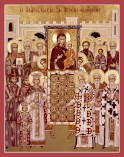 This Council was held in 787 in Nicaea. in the reign of the
devout Empress Irene and her son Constantine, and in the time of Patriarch Tarasius. This Council
finally upheld the veneration of icons, expounding it from Holy Scripture, the witness of the
holy fathers and the examples of miracles in connection with the holy icons. Among other examples
cited, the Cypriot bishop, Constantine, brought forward this one: A herdsman from the city of
Constantia, driving his flock out to pasture one day, saw an icon of the Mother of God adorned
with flowers by the devout. ‘Why give so much honour to a rock?’, said the herdsman,
obviously brought up in iconoclasm, and threw his iron stave at the icon, damaging the right eye
of the Mother of God. As soon as he had left that spot, he stumbled over the same stave and put
out his own right eye. Returning blinded to the city, he cried out tearfully that it was a
punishment from the Mother of God.
This Council also decided that the relics of the martyrs be placed in the antimins.* Three hundred and sixty-seven fathers took part in the Council. May the Lord have mercy on us and save us by their prayers.
*Antimins: A cloth containing relics of the saints that is spread on the Holy Table for the celebration of the Divine Liturgy—Tr.
Menaion — Fixed Calendar
October 30th – Civil Calendar
October 17th – Church Calendar
1. The Holy Prophet Hosea (Osee).
 The son of Beeri of the tribe of Issachar, he lived and
prophesied more than eight hundred years before the birth of Christ. His inspired words are
found in his book, which contains fourteen chapters. He strongly rebuked Israel and Judah
for their idolatry, foretold God’s punishment for their sin, the destruction of
Samaria and Israel for their apostasy but the showing of God’s mercy on the tribe of
Judah. He foresaw the end of the sacrifices of the Old Covenant, and the coming of the Lord
and the rich gifts that He would bring to earth. He lived to great old age, and entered
peacefully into rest. |
2. The Holy Martyrs Kosmas and Damian, the Unmercenaries.
 They were
doctors by trade, and when they embraced the Christian Faith, they healed the sick in the name of
the Lord Jesus Christ, becoming known on all sides for their miraculous healings. The wicked
pagans seized them and took them before the governor, Lysias, in the town of Aegae. These holy
brothers would not deny Christ at any price, so they were first thrown into the sea and then into
fire, but God almighty saved them from drowning and from the flames, an angel of God appearing to
them and saving them. The pagan governor ascribed this to some magical power of theirs, but they
replied: ‘We have no sort of magic, nor use any, but we have the power of Christ to save us
and all who call upon His holy name.’ They were then stoned, but the stones bounced off
them, and they were finally beheaded with the sword. Ss. Leontios, Anthimos and Efprepios also
suffered with them and received wreaths of glory. They suffered in the time of Diocletian and
Maximian, in the early fourth century. Many miracles were wrought by their holy relics, such as
they had themselves also wrought while living on this earth.
3. Our Holy Father, the Martyr Andrew.
He was a Cretan by birth, and a Christian priest. At the time of the iconoclast persecution, he showed himself a great fighter for their veneration and went to Constantinople to denounce the wicked Emperor Kopronymos for his iconoclasm. The emperor was one day in the Church of the Holy Martyr Mamas. Andrew went into the church, stood before the emperor and began to rebuke him openly, before all who were present: ‘You would do better, O king, to look to the work of the army and the governing of the people, than to the persecuting of Christ and His servants.’ For this he was harshly flogged and tortured, and dragged through the streets, where a heretic attacked him with an axe and killed him. Thus Andrew gave his holy soul into God’s hands, in the year 767. His relics had healing power.
4. St. Lazarus the Four-Days-Dead.
 His chief feasts are on March
17th and Lazarus Saturday at the end of the Great Fast. Today we commemorate the
translation of his relics from the island of Cyprus to Constantinople. The Emperor Leo the
Wise built a church to St. Lazarus in Constantinople, and translated his relics there in
890. When, after almost a thousand years, Lazarus’ grave in the town of Kition on
Cyprus was dug up, a marble tablet was found with the inscription still legible:
‘Lazarus the Four-Days-Dead, the friend of Christ’. |
FOR CONSIDERATION
The second appearance of the holy Martyr Longinus: When Saint Longinus appeared to the blind widow whose son had died, he promised to restore her sight and to show her her son in great glory. Finding the relics of the holy martyr and touching them with her hands, the widow immediately saw plainly, and thus one promise was fulfilled. The following night, St. Longinus appeared to the widow, bathed in light and holding her son by the hand, he also being clad in shining robes. Caressing the child like a father, he said to the widow: ‘Behold, woman, the son for whom you’re shedding so many tears! Look at the honor and glory that are his! Behold, and be comforted, for God has raised him up into that heavenly company that live in His kingdom. I have now brought him from the Savior, and he will never be separated from me. Take my head and your son’s body, and bury them in one coffin, and then mourn no longer for your only son, and let not your heart be troubled, for God has given him great glory and endless rejoicing.’ Seeing and hearing all this, the woman was filled with great joy and returned to her home, saying to herself: ‘I asked for bodily sight, and have been given spiritual sight also. I was in grief for the death of my son, and now I have him in heaven, where he stands in glory with the prophets and rejoices unceasingly with them.’
Daily Scripture Readings taken from The Orthodox New Testament, translated and published by Holy Apostles Convent, Buena Vista, Colorado, copyright © 2000, used with permission, all rights reserved.
Daily Prologue Readings taken from The Prologue of Ochrid, by Bishop Nikolai Velimirovic, translated by Mother Maria, published by Lazarica Press, Birmingham, England, copyright © 1985, all rights reserved. Edited by Dormition Skete.