

Daily Devotional
Sunday, June 12, 2022 (NS), May 30, 2022 (OS)
No Fasting.
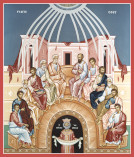
| Eighth Sunday, or the Sunday of Holy Pentecost |
The commemoration of our venerable Father Isaakios, Abbot of the Dalmaton Monastery at Constantinople.
Scripture Readings
Paschalion — Movable Calendar
Eighth Sunday, or the Sunday of Holy Pentecost
Epistle
The Reading is from the Acts of the Apostles [§ 3].
2 1While the day of Pentecost was being fulfilled, they were all with one accord in the same place. 2And suddenly there came to be a sound out of the heaven, like as of a violent wind borne along, and it filled the whole house where they were sitting. 3And there appeared to them tongues, as if of fire, being distributed; and it sat upon each one of them. 4And they were all filled with the Holy Spirit, and began to speak in other tongues, even as the Spirit was giving them to utter. 5And there were Jews abiding in Jerusalem, pious men, from every nation of those under the heaven. 6And the report of this having arisen, the multitude came together and was confounded, because they were hearing, each one of them, speaking in his own dialect. 7And they were all amazed and wondering, saying to one another, “Behold, all these who are speaking are Galilæans, are they not? 8“And how do we each hear in our own dialect in which we were born? 9“Parthians and Medes and Elamites and those who dwell in Mesopotamia, also Judæa and Cappadocia, Pontos and Asia, 10“also Phrygia and Pamphylia, Egypt and the parts of Libya which are in the region of Cyrene, and the Romans, both Jews and proselytes, who sojourn here, 11“Cretans and Arabians—we hear them speaking in our own tongues the magnificent works of God.”
Gospel
In the Orthros
The Reading is from the Holy Gospel according to Saint John [§ 65].
20 19When it was evening on that day, the first of the week—and the doors were closed where the disciples were gathered together for fear of the Jews—Jesus came and stood in the midst, and saith to them, “Peace be to you.” 20And after He said this, He showed them His hands and His side. Then were the disciples glad, after they saw the Lord. 21Then Jesus said to them again, “Peace be to you; even as the Father hath sent Me forth, I also send you.” 22And after He said this, He breathed on them, and saith to them, “Receive ye the Holy Spirit: 23“if ye forgive the sins of any, they are forgiven to them; if ye retain the sins of any, they are retained.”
In the Liturgy
The Reading is from the Holy Gospel according to Saint John [§ 27].
7 37In the last day, that great day of the feast, Jesus was standing and cried out, saying, “If anyone thirst, let him come to Me and drink. 38“The one who believeth in Me, even as the Scripture said—rivers of living water shall flow out of his belly.” 39But this He said concerning the Spirit, Whom those who believe in Him were about to receive; for the Holy Spirit was not yet given, because Jesus was not yet glorified. 40Many therefore of the crowd, having heard the utterance, were saying, “This is truly the Prophet.” 41Others were saying, “This is the Christ.” But others were saying, “The Christ is not coming out of Galilee, is He? 42“Hath not the Scripture said that of the seed of David and from the village of Bethlehem, where David was, the Christ is coming?” 43Therefore a division occurred in the crowd on account of Him. 44And some of them were wishing to lay hold of Him, but no one laid hands on Him. 45Then came the officers to the chief priests and Pharisees, and they said to them, “Why did ye not bring Him?” 46The officers answered, “Never did a man so speak as this Man.” 47Then the Pharisees answered them, “Ye have not also been deceived, have ye? 48“Not one of the rulers believe in Him or of the Pharisees, doth he? 49“But this people who knoweth not the law are accursed!” 50Nicodemos (the one who came by night to Him, being one of them) saith to them, 51“Our law doth not judge the man, unless it should first hear him, and know from the man himself what he doeth, doth it?” 52They answered and said to him, “Thou art not also of Galilee, art thou? Search and look, for a prophet hath not been raised out of Galilee.”...
8 12Then Jesus spoke again to them, saying, “I am the light of the world; the one who followeth Me in no wise shall walk in the darkness, but shall have the light of the life.”
Menaion — Fixed Calendar
The commemoration of our venerable Father Isaakios, Abbot of the Dalmaton Monastery at Constantinople.
No readings given.
Lives of the Saints (Prologue)
June 12th – Civil Calendar
May 30th – Church Calendar
1. Our Holy Father Isaac (Isaakios) the Confessor.
In the time of the Emperor Valens, the Arians persecuted Orthodoxy fiercely with the emperor’s encouragement. Isaac, a hermit somewhere in the East, heard of the persecution, left his desert and went to Constantinople to encourage the faithful and denounce the heretics. Valens arrived in the north at that very time with his army, to meet the Goths who had come down from the Danube into Thrace. Isaac went out and stood before him, saying: ‘Open the churches to those of the true Faith, O emperor, and God will bless thy path,’ but the emperor turned a deaf ear to the elder and went on his way. Isaac spoke out before the emperor on the next day also, repeating his warning, and the emperor almost hearkened to him, but one of his advisors, a follower of the Arian heresy, thwarted him. Isaac spoke before the emperor again on the third day, seizing the emperor’s horse by the reins and pleading with him to grant freedom to the Church of God and to escape divine punishment by acceding to his request. The enraged emperor ordered that the elder be thrown into a briar patch full of thorns and mud, but three angels appeared and pulled him out from his affliction. St. Isaac appeared before the emperor on the fourth day, and foretold a terrible death if he did not give the Orthodox freedom: ‘I tell thee, my emperor, that thou shalt lead thy troops out upon the barbarians, but thou shalt not be able to withstand them. Thou shalt flee before them, but shalt thyself be taken captive and burned alive.’ And so it all came to pass. The barbarians mowed the Greek force down like grass, and the emperor fled with his Arian counselor, and hid in a barn. The barbarians arrived at the spot and realized where the emperor was hiding. They surrounded the barn and set fire to it, burning both the emperor and his counselor. The Emperor Theodosios the Great then came to the throne. He heard of Isaac and of the prophecy that had been fulfilled, and sending for him, prostrated himself before him. And so peace came to reign in the Church and the Arians were banished. Isaac desired to return to his desert, but he was persuaded to remain in Constantinople. A certain influential citizen, Saturninos, built him a monastery where the elder labored in asceticism until his death, performing many wonders. The community overflowed with monks and became a great monastery. Before his death, Isaac appointed a pupil of his, Dalmatos (after whom the monastery was later named), as abbot. The elder Isaac, who had found such favor with God, entered into eternity in the year 383, to rejoice forever in the vision of the face of God.
2. St. Makrina.
The grandmother of St. Basil the Great, she was outstanding for her intellect and piety. She was a disciple of St. Gregory the Wonder-worker of Neocaesarea. In the reign of Diocletian, she abandoned her home and hid in the forests and desert places with her husband, Basil. Although their home was confiscated, they felt no pangs of regret. Stripped of everything except their love for God, they settled in an ancient forest and spent seven years there. By God’s providence, goats would come down from the mountains and provide them with food. They both died peacefully in the fourth century, after great sufferings for the Christian Faith.
FOR CONSIDERATION
The word of God is food for the soul. The word of God is both strength and light for the soul. Whoever reads the word of God provides his soul with food and strength and light. He who can read ought to read the word of the Lord in the holy Scriptures, and he who cannot read ought to listen to what is read. All the saints emphasised the necessity of reading the holy Scriptures. St. Seraphim of Sarov says: ‘The soul must keep itself nourished with the word of God; because the word of God is, as St. Gregory the Theologian says, the bread of angels that feeds the soul that is hungry for God. But, most of all, we must read the New Testament and the Psalms. The understanding is enlightened by these. It is a very good thing to read the word of God in solitude, and to read the entire Bible with understanding. God gives a man His mercy for undertaking this exercise more than for other good deeds, and He fills him with the gift of comprehension. When a man nourishes his soul with the word of God, then he is filled with the understanding of good and evil.’
Daily Scripture Readings taken from The Orthodox New Testament, translated and published by Holy Apostles Convent, Buena Vista, Colorado, copyright © 2000, used with permission, all rights reserved.
Daily Prologue Readings taken from The Prologue of Ochrid, by Bishop Nikolai Velimirovic, translated by Mother Maria, published by Lazarica Press, Birmingham, England, copyright © 1985, all rights reserved. Edited by Dormition Skete.