

Daily Devotional
Thursday, May 28, 2020 (NS), May 15, 2020 (OS)
No Fasting.
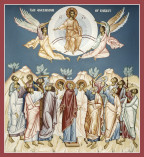
| The Thursday of the Ascension |
The commemoration of our venerable Father Pachomios the Great, founder of cenobitic monasticism, and our holy father among the saints, Achilles, Bishop of Larisa.
Scripture Readings
Paschalion — Movable Calendar
The Thursday of the Ascension
Epistle
The Reading is from the Acts of the Apostles [§ 1].
1 1The first account indeed I made for myself concerning all which, O Theophilos, Jesus began both to do and teach, 2until the day in which He was taken up, after He gave command to the apostles whom He chose for Himself through the Holy Spirit, 3to whom also He presented Himself alive after He had suffered by many proofs, being seen by them during forty days and speaking the things concerning the kingdom of God. 4And being assembled together with them, He ordered them not to depart from Jerusalem, but to wait for the promise of the Father, “which,” He said, “ye heard of Me; 5“for John indeed baptized with water, but ye shall be baptized in the Holy Spirit not many days after these.” 6Indeed therefore, after they came together, they kept on questioning, saying, “Lord, dost Thou at this time restore the kingdom to Israel?” 7And He said to them, “It is not yours to know times or seasons which the Father Himself put in His own authority. 8“But ye shall receive power, after the Holy Spirit is come upon you; and ye shall be witnesses to Me both in Jerusalem, and in all Judæa and Samaria, and unto the ends of the earth.” 9And having said these things, while they looked, He was taken up; and from before their eyes, a cloud took Him up from under. 10And while they were gazing intently into the heaven as He went, then behold, two men stood by them in white raiment, 11who also said, “Men, Galilæans, why do ye stand looking into the heaven? This Jesus, the One Who was taken up from you into the heaven, so shall He come in the manner ye beheld Him going into the heaven.” 12Then they returned to Jerusalem from the mount which is called the Mount of Olives, which is near Jerusalem, being a sabbath’s day journey.
Gospel
In the Orthros
The Reading is from the Holy Gospel According to Saint Mark. [§ 71]. At that time:
16 9After Jesus rose early the first day of the week, He appeared first to Mary Magdalene, from whom He had cast out seven demons. 10She went and brought tidings to those who had been with Him, who were mourning and weeping. 11And they, having heard that He liveth and was seen by her, disbelieved. 12And after these things He was made manifest in a different form to two of them as they were walking and went into the country. 13And they went and brought tidings to the rest; neither did they believe them. 14Afterwards He was made manifest to the eleven themselves as they reclined at table; and He reproached their unbelief and hardness of heart, because they believed not those who saw Him after He was raised. 15And He said to them, “Go into all the world and proclaim the Gospel to the whole creation. 16“The one who believeth and is baptized shall be saved; but the one who believeth not shall be condemned. 17“And these signs shall accompany those who believe: In My name they shall cast out demons; they shall speak in new tongues; 18“they shall take up serpents; and if they should drink anything deadly, in no wise shall it harm them; they shall lay hands on the sick, and they shall be well.”
19Then indeed, after speaking to them, the Lord was taken up into the heaven, and sat on the right of God. 20And they went forth and preached everywhere, the Lord working with them, and confirming the word by the accompanying signs. Amen.
In the Liturgy
The Reading is from the Holy Gospel according to Saint Luke [§ 114]. At that time:
24 36After Jesus rose from the dead, He stood in the midst of His disciples, and saith to them, “Peace be to you.” 37But they were terrified and affrighted, and kept on thinking that they saw a spirit. 38And He said to them, “Why are ye troubled? And why do reasonings come up in your hearts? 39“Behold My hands and My feet, that I am He. Touch Me and see, for a spirit hath not flesh and bones, even as ye see Me having.” 40And having said this, He showed them His hands and His feet. 41And while they yet disbelieved from the joy, and wondered, He said to them, “Have ye anything to eat here?” 42And they gave Him a portion of a broiled fish and of a honeycomb. 43And He took these and ate in their presence. 44And He said to them, “These are the words which I spoke to you while I was yet with you, that it is needful for all the things to be fulfilled, which were written in the law of Moses, and in the prophets, and in the psalms concerning Me.” 45Then He thoroughly opened their mind to understand the Scriptures, 46and said to them, “Thus it hath been written, and thus it was needful for the Christ to have suffered, and to have risen from the dead the third day, 47“and repentance and forgiveness of sins to have been preached in His name to all the nations, beginning from Jerusalem. 48“And ye are witnesses of these things. 49“And behold, I send forth the promise of My Father upon you; but sojourn in the city of Jerusalem, until ye are clothed with power from on high.”
50And He led them out as far as to Bethany. And having lifted up His hands, He blessed them. 51And it came to pass, as He was blessing them, He stood apart from them and was carried up into the heaven. 52And they made obeisance to Him, and returned to Jerusalem with great joy. 53And they were continually in the temple, praising and blessing God. Amen.
Menaion — Fixed Calendar
The commemoration of our venerable Father Pachomios the Great, founder of cenobitic monasticism, and our holy father among the saints, Achilles, Bishop of Larisa.
Epistle
For the venerable Father:
The Reading is from the Epistle of Saint Paul to the Galatians [§ 213]. Brethren:
5 22The fruit of the Spirit is love, joy, peace, long-suffering, kindness, goodness, faith, 23meekness, self-control; against such things there is no law. 24But they who are of the Christ crucified the flesh with the passions and the lusts. 25If we live by the Spirit, let us also be walking by the Spirit. 26Let us not become vainglorious, provoking one another, envying one another.
6 1Brethren, even if a man should be overtaken in some transgression, ye, the spiritual ones, be restoring such a one in the spirit of meekness, looking out for thyself, lest thou also be tempted. 2Keep on bearing one another’s burdens, and thus fill up the law of the Christ.
for Sl. usage, see [2 Cor. 4:6-15].
Gospel
The Reading is from the Holy Gospel according to Saint Matthew [§ 10]. At that time:
4 23Jesus was going around all Galilee, teaching in their synagogues, and proclaiming the Gospel of the kingdom, and curing every disease and every sickness among the people. 24And the report of Him went out into all Syria. And they brought to Him all those who were ill, constrained by various diseases and torments, and possessed by demons, and lunatics, and paralytics; and He cured them. 25And great crowds followed Him from Galilee, and Decapolis, and Jerusalem, and Judæa, and beyond the Jordan.
5 1And seeing the crowds, He went up into the
mountain; and after He sat down, His disciples came to Him. 2And He opened His mouth
and began to teach them, saying:
3“Blessed are the poor in spirit, for theirs is the
kingdom of the heavens.
4“Blessed are they who mourn, for they shall be
comforted.
5“Blessed are the meek, for they shall inherit the
earth.
6“Blessed are they who hunger and thirst after
righteousness, for they shall be filled.
7“Blessed are the merciful, for they shall find mercy.
8“Blessed are the pure in heart, for they shall see
God.
9“Blessed are the peacemakers, for they shall be called
sons of God.
10“Blessed are they who have been persecuted on account
of righteousness, for theirs is the kingdom of the heavens.
11“Blessed are ye whenever they reproach you and persecute
you, and say every evil word against you falsely on account of Me.
12“Be rejoicing and be exceedingly glad, for your reward
is great in the heavens. For so they persecuted the prophets who were before
you.
13“Ye are the salt of the earth; but if the salt should become insipid, with what shall it be salted? For it is no longer good for anything, except to be cast out and to be trampled underfoot by men.”
for Sl. usage, see [Lk. 14:25-35].
Lives of the Saints (Prologue)
May 28th – Civil Calendar
May 15th – Church Calendar
1. Our Holy Father Pachomios the Great.
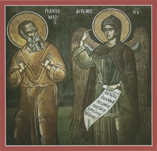 He was an Egyptian by birth and was a pagan in his
youth. As a soldier, he took part in the Emperor Constantine’s war against Maxentius. After
that, learning from Christians about the one God and seeing their devout life, Pachomios was
baptized and went to the Tabennisiot desert, to the famous ascetic Palamon, with whom he lived in
asceticism for ten years. Then an angel appeared to him in the robes of a monk of the Great Habit
at the place called Tabennisi and gave him instructions on the rule of a cenobitic monastery,
commanding him to found such a monastery in that place and prophesying to him that many monks
would come to it seeking the salvation of their souls. Obeying the angel of God, Pachomios began
building many cells, although there was no one in that place but himself and his brother John.
When his brother grumbled at him for doing this unnecessary building, Pachomios simply told him
that he was following God’s command, without explaining who would live there, or when. But
many men soon assembled in that place, moved by the Spirit of God, and began to live in
asceticism under the rule that Pachomios had received from the angel. When the number of monks
had increased greatly, Pachomios, step by step, founded six further monasteries. The number of
his disciples grew to seven thousand. St. Anthony is regarded as the founder of the eremitic
life, and St. Pachomios of the monastic, communal life. The humility, love of toil and abstinence
of this holy father were and remain a rare example for the imitation of monks. St. Pachomios
performed innumerable miracles, and also endured innumerable temptations from demons and men. And
he served men as both father and brother. He roused many to set out on the way of salvation, and
brought many into the way of truth. He was and remains a great light in the Church and a great
witness to the truth and righteousness of Christ. He entered peacefully into rest in 346, at the
age of sixty. The Church recognizes many of his followers as saints: Theodore, Job, Paphnutios,
Pecusius, Athenodorus, Eponichus, Soutus, Psois, Dionysius, Petronius and others.
2. St. Achillios, Bishop of Larissa.
This great hierarch and wonder-worker was born in Cappadocia. He took part in the First Ecumenical Council, at which he put the heretics to shame, and both by his great learning and his great purity, gave cause for much wonder. Taking up a stone, Achillios called to the Arians: ‘If Christ is a creature of God, as you say, tell oil to flow from this stone.’ The heretics kept silent, amazed at this demand by St. Achillios. Then the saint continued: ‘And if the Son of God is equal to the Father, as we believe, then let oil flow from this stone.’ And oil flowed out, to the amazement of all. St. Achillios entered peacefully into rest in Larissa in the year 330. Samuel, King of Macedonia, when he conquered Thessaly, translated the relics of Achillios to Prespa, to an island in a lake that was named, and is called to this day, Achillios or Ailus.
3. Our Holy Father Silvanos.
He was at first a comedian, mimicking each and all, but then, inflamed by the love of Christ, he became a disciple of St. Pachomios. ‘I would be ready to give my life,’ he said, ‘to receive the forgiveness of my sins.’
FOR CONSIDERATION
When a tyrant exercises tyranny over a righteous man from covetousness, then the tyrant brings both a gain and a loss: a loss for the tyrant and a gain for him who suffers the tyranny. Boris Godunov murdered the eight-year-old Tsarevich Dimitri in order to seize the throne without a rival. The days of his reign were quickly ended, and the tyrant was given over to corruption and damnation; but Dimitri was sanctified. After lying in the grave for fifteen years, Dimitri’s body was found to be incorrupt and wonder-working. There are forty-five miracles of healing recorded over his grave. Whose, then, was the loss and whose the gain from this tyranny? If the tyrant thought that he would, by tyranny, help his opponent to be included in the ranks of the saints and would prepare destruction and damnation for himself, he would change his mind about his planned tyranny. But wrong thinking is the forerunner and companion of tyranny.
Daily Scripture Readings taken from The Orthodox New Testament, translated and published by Holy Apostles Convent, Buena Vista, Colorado, copyright © 2000, used with permission, all rights reserved.
Daily Prologue Readings taken from The Prologue of Ochrid, by Bishop Nikolai Velimirovic, translated by Mother Maria, published by Lazarica Press, Birmingham, England, copyright © 1985, all rights reserved. Edited by Dormition Skete.