

Daily Devotional
Wednesday, April 22, 2020 (NS), April 9, 2020 (OS)
No Fasting.
Bright Week - No Fasting All Week
Wednesday of the Renewal Week
The commemoration of the Martyr Efpsychios of Cæsarea in Cappadocia.
Scripture Readings
Paschalion — Movable Calendar
Wednesday of the Renewal Week
Epistle
The Reading is from the Acts of the Apostles [§ 5]. In those days:
Gk. usage, Acts 2:22-38; Sl. usage, Acts 2:22-36.
2 22Peter spoke to the people. “Men, Israelites, hear these words: Jesus the Nazaræan, a Man from God, Who hath been shown forth to you by works of power and wonders and signs, which God did by Him in your midst, even as ye yourselves know— 23“this One, given up by the determinate counsel and foreknowledge of God—ye took and affixed to the Cross by lawless hands and did slay, 24“Whom God raised up, having loosed the throes of death, inasmuch as it was not possible for Him to be held by it. 25“For David saith in regard to Him, ‘I was foreseeing the Lord before my face continually, because He is on my right, that I should not be shaken [Ps. 15(16):8]. 26“‘Therefore my heart was gladdened, and my tongue exulted; moreover my flesh also shall rest upon hope [Ps. 15(16):9], 27“‘for Thou wilt not leave behind my soul in Hades, nor wilt Thou give Thy Holy One to see corruption [Ps. 15(16):10]. 28“‘Thou madest known to me the paths of life; Thou shalt fill me full with good cheer with Thy countenance [Ps. 15(16):11].’ 29“Men, brethren, it is allowed to speak with freedom of speech to you concerning the Patriarch David, that he both died and was buried, and his sepulcher is among us until this day. 30“Therefore being a prophet—and knowing that God swore with an oath to him that from the fruit of his loins, according to his flesh, He would raise up the Christ to sit upon his throne— 31“he foresaw and spoke concerning the resurrection of the Christ, that His soul was not left behind in Hades, nor did His flesh see corruption. 32“This Jesus did God raise up, of Whom we are all witnesses. 33“Therefore having been exalted to the right of God, and having received from the Father the promise of the Holy Spirit, He poured out this which ye now see and hear. 34“For David did not ascend into the heavens, but he saith himself, ‘The Lord said to my Lord, “Sit Thou on My right, 35“‘“until I should place Thine enemies as a footstool of Thy feet [Ps. 109(110):1].”’ 36“Assuredly therefore, let all the house of Israel know that God made Him, this same Jesus Whom ye crucified, both Lord and Christ.”
Gospel
The Reading is from the Holy Gospel according to Saint John [§ 4]. At that time:
1 35John was standing, and two of his disciples. 36And having looked at Jesus walking, he saith, “Behold, the Lamb of God!” 37And the two disciples heard Him speaking, and they followed Jesus. 38And Jesus turned, and beheld them following, and saith to them, “What seek ye?” And they said to Him, “Rabbi” (which is to say, being interpreted, Teacher), “where art Thou staying?” 39He said to them, “Come and see.” Then they went and saw where He was staying. And they stayed with Him that day; and it was about the tenth hour. 40Andrew, the brother of Simon Peter, was one of the two who heard this from John, and followed Him. 41This same one first findeth his own brother Simon, and saith to him, “We have found the Messiah” (which is, being interpreted, the Christ), 42and he led him to Jesus. And having looked at him, Jesus said, “Thou art Simon, the son of Jonas. Thou shalt be called Kephas” (which is interpreted, a stone).
43On the morrow Jesus intended to go forth into Galilee; and He findeth Philip, and saith to him, “Follow thou Me.” 44Now Philip was from Bethsaida, of the city of Andrew and Peter. 45Philip findeth Nathanael, and saith to him, “We have found the One of Whom Moses in the law, and the prophets, wrote—Jesus the son of Joseph, Who is from Nazareth.” 46And Nathanael said to him, “Out of Nazareth can there be any good thing?” Philip saith to him, “Come and see.” 47Jesus saw Nathanael coming toward Him, and saith concerning him, “Behold, truly an Israelite in whom is no guile.” 48Nathanael saith to Him, “From what place knowest Thou me?” Jesus answered and said to him, “Before Philip called thee, when thou wast under the fig tree, I saw thee.” 49Nathanael answered, and saith to Him, “Rabbi, Thou art the Son of God; Thou art the King of Israel.” 50Jesus answered and said to him, “Because I said to thee, ‘I saw thee underneath the fig tree,’ believest thou? Thou shalt see greater things than these.” 51And He saith to him, “Verily, verily, I say to thee, henceforth ye shall see the heaven having been opened, and the angels of God ascending and descending upon the Son of Man.”
Menaion — Fixed Calendar
The commemoration of the Martyr Efpsychios of Cæsarea in Cappadocia.
No readings given.
Lives of the Saints (Prologue)
April 22nd – Civil Calendar
April 9th – Church Calendar
1. The Holy Martyr Efpsychios (Eupsychius).
He was of gentle birth and was reared in faith and devotion. In the time of the Emperor Julian the Apostate, when St. Basil the Great was governing the Church in Caesarea, Efpsychios married a girl of good family. But he was not given even one day to live in wedlock, for, on his wedding day itself, there was a pagan festival with sacrifices to the idol of Fortune. Efpsychios went out with some others and smashed all the idols in the temple, then pulled down the temple itself. Julian was furious, and commanded that the culprits be beheaded, that many Christians be taken into the army, that an enormous levy be imposed on Christians, the proceeds of which were to be used to rebuild the Temple of Fortune, and that the town cease to be called Caesarea (as it had been named by Claudius Caesar), and revert to its former name, Maza. Efpsychios was first bound to a tree and cruelly tortured, and then beheaded, in 362. A little after this time, the wicked Emperor Julian visited that town on his way to Persia, against which he was waging war. St. Basil went to meet him, bearing three barley loaves as a sign of honor and welcome. The emperor ordered that, as a return gift, the saint be given a fistful of hay. Basil said to the Emperor: ‘You ridicule us now, O king; we bring you bread, by which we are fed, and you give us miserable food which you, with all your power, are not able to turn into nourishment for men!’ To this the emperor replied: ‘You can be sure that I will feed you with this hay when I return from Persia!’ But the wicked apostate did not return alive from Persia, but perished there by a fitting and unnatural death.
2. Our Holy Father Vadim the Martyr.
In the time of the Persian King Sapor, Vadim, abbot of a monastery and a man famed for his grace, was thrown into prison with seven of his disciples. With him in prison was a Prince Nirsan, also a Christian. Every day they were taken out and flogged. Prince Nirsan was afraid, and promised to forsake his faith and worship the sun. This was pleasing to Sapor, and he promised Nirsan all the possessions of Vadim’s monastery if he would, with his own hands, behead Vadim. Nirsan agreed to this. With trembling hands, terrified by the dignity of St. Vadim’s face, he let the sword fall several times on the holy man’s neck, barely succeeding in beheading him. But, very quickly after that, he fell into despair and ran himself through with his own sword; thus receiving at his own hands the punishment for slaying a righteous man. St. Vadim suffered in 376.
3. New-martyrs Raphael, Nicholas, and Irene of Mytilene
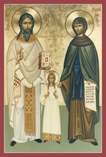 On the island of Mytilene (Lesbos) in the Aegean Sea,
there was an ancient monastery in the fifteenth century. Its archimandrite was Father Raphael,
and there also lived there the Hierodeacon Nicholas and other monks. During their lifetime, the
city of Constantinople fell to the Turks (in 1453), and the Muslims continued their incursions
into the surrounding areas, and soon they also wrested control of Mytilene away from the
Genovese. In 1463, on this island there was an uprising, and Turkish reprisals against the
Christian islanders were brutal. The mayor of the village of Thermi, Basil, together with his
wife and daughter, and also the teacher Theodore, ran up to the monastery to warn the fathers of
the danger, but were instantly arrested there by a company of Turks. It was Great Thursday, and
the Muslims subjected the inhabitants of the monastery to torments for several days. In order to
force the mayor to reveal the whereabouts of the other rebels, the Turks tortured his
twelve-year-old daughter, Irene, before her parents’ eyes; finally she was burned alive in a
large earthenware jar. Then they slaughtered her parents and beheaded the teacher. Finally, on
the evening of Bright Tuesday, they took Saint Raphael and, tying him to a tree by his hair,
severed his head from his body by cutting through his jaws with a saw. Saint Nicholas, who was
tied to a tree and forced to watch, died of a heart attack when he witnessed this horrific
execution of his beloved elder. The Turks threw the bodies of the saints into the spring, set
fire to the monastery, and left. After many centuries, the locals only had a vague memory of what
had happened at that ruined monastery. But God, Who never forgets the exploits of His saints,
deigned to reveal those holy martyrs in modern times, and when some builders happened to dig up
some of the sacred relics in 1959, the martyrs appeared to many different islanders in visions
for the next several years in order to reveal the location of their relics and tell the story of
what had happened to them. These miraculous revelations sent by the Church Triumphant are a great
consolation to the Orthodox faithful of the last times, manifesting a living connection between
the Faith we hold today and the Faith of those who have gone before.
FOR CONSIDERATION
It is said of Pericles that he was a man of almost perfect human form, except that his head was rather too long and narrow-like, so that he invited ironic smiles whenever he appeared bare-headed. To conceal this shortcoming of this great man of his people, Greek sculptors always portrayed him wearing a helmet. If pagans thus strove to conceal the shortcomings of their fellows, how much more should we Christians do so! ‘In honor preferring one another’ (Rom. 12:10), the apostle commands all who follow Christ. How can we say that we follow Him in meekness and purity if we poison the air every day with our talk of others’ sins and weaknesses? To conceal your own virtues and the shortcomings of others—in that lies the greatest spiritual wisdom.
Daily Scripture Readings taken from The Orthodox New Testament, translated and published by Holy Apostles Convent, Buena Vista, Colorado, copyright © 2000, used with permission, all rights reserved.
Daily Prologue Readings taken from The Prologue of Ochrid, by Bishop Nikolai Velimirovic, translated by Mother Maria, published by Lazarica Press, Birmingham, England, copyright © 1985, all rights reserved. Edited by Dormition Skete.