

Daily Devotional
Thursday, August 4, 2016 (NS), July 22, 2016 (OS)
No Fasting.
Thursday of the Seventh Week
The commemoration of the holy Myrrh-bearer and Equal-to-the-apostles Mary Magdalene, and Hieromartyr Phokas of Sinope (commemorated on some Gk. calendars on either the 21st or 23rd of July), and the Virgin-martyr Markella of Chios.
Scripture Readings
Paschalion — Movable Calendar
Thursday of the Seventh Week
Epistle
The Reading is from the First Epistle of Saint Paul to the Corinthians [§ 138].
7 24Brethren, wherein each was called, in this let him abide with God.
25Now concerning the virgins, I have no command of the Lord, but I give an opinion, as one who hath been shown mercy by the Lord to be faithful. 26I think therefore this to be good on account of the present necessity—that for a man to be so is good. 27Hast thou been bound to a wife? Cease seeking to be loosed. Hast thou been loosed from a wife? Cease seeking a wife. 28But even if thou marry, thou hast not sinned. And if the virgin should marry, she did not sin. But such shall have affliction in the flesh, but I am trying to spare you. 29Now this I say, brethren, the time hath been shortened henceforth, that even they who have wives be as though they did not have. 30And they who weep, as though they wept not; and they who rejoice, as though they rejoiced not; and they who buy, as though they possess not; 31and they who make use of this world, as though they did not use it to the full; for the fashion of this world passeth away. 32But I wish you to be without care. The unmarried careth for the things of the Lord, how he shall please the Lord. 33But he who is married careth for the things of the world, how he shall please his wife. 34The wife and the virgin also differ. The unmarried woman careth for the things of the Lord, that she may be holy both in body and spirit, but she who is married careth for the things of the world, how she shall please her husband. 35And this I say for your own profit, not that I might cast a noose upon you, but for that which is seemly, and for constant waiting on the Lord without distraction.
Gospel
The Reading is from the Holy Gospel according to Saint Matthew [§ 61]. At that time:
15 12The disciples of Jesus came to Him and said to Him, “Knowest Thou that the Pharisees were offended after they heard the saying?” 13But He answered and said, “Every plant which My Father, the heavenly One, did not plant shall be rooted out. 14“Let them alone. They are blind guides of the blind. And if the blind guide the blind, both shall fall into a pit.” 15And Peter answered and said to Him, “Explain this parable to us.” 16And Jesus said, “Are ye also still without understanding? 17“Do ye not yet perceive that everything that entereth into the mouth goeth into the belly, and is cast out into the privy? 18“But the things which proceed out of the mouth come forth from the heart, and those defile the man. 19“For out of the heart cometh forth evil thoughts, murders, adulteries, fornications, thefts, false testimonies, blasphemies. 20“These are the things which defile the man; but to eat with unwashed hands defileth not the man.”
21And Jesus went from that place and withdrew into the parts of Tyre and Sidon.
Menaion — Fixed Calendar
The commemoration of the holy Myrrh-bearer and Equal-to-the-apostles Mary Magdalene, and Hieromartyr Phokas of Sinope (commemorated on some Gk. calendars on either the 21st or 23rd of July), and the Virgin-martyr Markella of Chios.
Epistle
For the Equal-to-the-apostles:
The Reading is from the First Epistle of Saint Paul to the Corinthians [§ 141]. Brethren:
9 2Ye are the seal of mine apostleship in the Lord. 3My defense to those who examine me is this: 4We do not have authority to eat and to drink, do we? 5We do not have authority to lead about a wife who is a sister in the Lord, as also the rest of the apostles, and the brethren of the Lord, and Kephas, do we? 6Or do only I and Barnabas have no authority not to be working? 7Who at any time serveth as a soldier at his own pay? Who planteth a vineyard, and eateth not of its fruit? Or who shepherdeth a flock, and eateth not of the milk of the flock? 8I am not saying these things after the manner of man, am I? Or saith not the law these things also? 9For in the law of Moses it hath been written: “Thou shalt not muzzle the ox that treadeth the corn [Deut. 25:4].” It is not the care of the oxen that matters with God, is it? 10Or saith He it altogether for our sakes? For our sakes it was written, that the one who ploweth ought to plow in hope, and the one who thresheth in hope ought to partake of his hope. 11If we did sow to you spiritual things, is it a great thing if we shall reap of your carnal things? 12If others partake of this authority over you, should not rather we? Nevertheless we did not use this authority; but we bear up against all things, lest we should give any hindrance to the Gospel of Christ.
Gospel
For the Equal-to-the-apostles:
The Reading is from the Holy Gospel according to Saint Luke [§ 34]. At that time:
8 1Jesus was traveling through, city by city and village by village, preaching and proclaiming the good tidings of the kingdom of God. And the twelve were with Him, 2and certain women who had been cured of diseases and scourges and evil spirits and infirmities—Mary who is called Magdalene, from whom seven demons had gone out, 3and Joanna the wife of Chuza, a steward of Herod, and Susanna, and many other women who were ministering to Him from their possessions.
for Sl. usage, see [Jn. 20:11-18].
Lives of the Saints (Prologue)
August 4th – Civil Calendar
July 22nd – Church Calendar
1. St. Mary Magdalene.
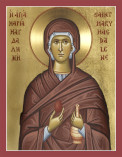 One of the myrrh-bearing women, and equal to the apostles, she was born
in Magdala by the Lake of Gennesaret, of the tribe of Issachar. She was tormented by seven evil
spirits, of which she was freed and healed by the Lord Jesus. Now she was tormented by these
spirits not because she was a sinful woman, but rather, because she was a very virtuous woman,
and the devil thought that she was going to be the one to bear our Savior. Isn’t it ironic
that she came to be close to our Virgin Mary, the Theotokos? She was a faithful follower and
servant of the Lord during His earthly life, and also stood beneath the Cross on Golgotha and
lamented bitterly with the most holy Mother of God. After the Lord’s death, she visited His
tomb three times; and when He rose again, she saw Him twice, once alone and the other time with
the other myrrh-bearing women. She travelled to Rome, went before Tiberias Caesar and presented
him with a red egg, greeting him with the words: ‘Christ is risen!’ At the same time,
she denounced Pilate to Caesar for his unjust condemnation of the Lord Jesus. Caesar listened to
her, and moved Pilate from Jerusalem to Gaul, where this unjust judge died under imperial
displeasure after a terrible illness. After that, she returned from Rome to Ephesus, to St. John
the Theologian, whom she helped in his task of preaching the Gospel. With great love for the
risen Lord and with great zeal, she proclaimed the holy Gospel as a true apostle of Christ. She
died peacefully in Ephesus and was buried, according to tradition, in the same cave in which the
seven young men (see August 4th) had been in a charmed sleep for a hundred years. They came to
life, and then died. St. Magdalene’s relics were then taken to Constantinople. Near the
Garden of Gethsemane, there is a beautiful Russian church dedicated to St. Mary Magdalene.
2. The Hieromartyr Phokas.
Today we commemorate the translation of his relics from Pontus to Constantinople in about 404. The chief commemoration of this saint is on September 22nd, where an account of his life and sufferings is set down. Today, a particular miracle by this saint is also commemorated. A man, Pontinus, was taken by Arabs, who fettered him, tied his hands behind his back and left him to die. Lying on his face on the ground and being incapable of movement, Pontinus cried out: ‘Holy Martyr Phokas, have mercy on me and save me!’ Thus saying, he fell asleep, and saw Phokas in a dream, coming to him, taking him by the hand and saying: ‘The Lord Jesus Christ forgives thee!’ When the man awoke, he found himself free from all his bonds. He got up and went home, and took St. Phokas as his family patron.
3. Our Holy Father Cornelius of Pereyaslavl.
Made a monk at the age of fifteen by an elder called Paul, he later withdrew to the desert in quest of silence. He spent thirty years in silence, never speaking a word to anyone, so that many thought that he was dumb. He was so emaciated from fasting that he looked like a skeleton. He received the Great Habit just before his death, and entered into rest on July 22nd, 1693.
4. The Holy Martyr Markella.
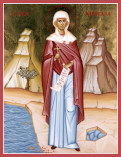 This saint is greatly venerated on the island of Chios. In
her church, miracles are performed throughout the years. Markella was a young girl who was
left motherless very young. Her pagan and bestial father desired to live with his daughter
as though she were his wife. Markella fled from her father, but he, infuriated like a wild
beast, found her and cut her to pieces. Near her church there are several rocks which on
her feast day become saturated with blood. The people take these rocks to the church, pray
to St. Markella and then touch the sick with them, and they are healed. |
FOR CONSIDERATION
‘Blessed are they that weep,’ said the Lord. Blessed are they who weep, seeking the kingdom of God. Blessed are they who weep, suffering for the Christian Faith. Blessed are they who weep, repenting of their sins. There is no true repentance without tears. With what shall we be able to wash away our sin, save by tears or by blood (the blood of martyrdom)? The monks of Nitria begged great Makarios to come to them, so that they would not all have to go to him. Makarios went in obedience. The monks sat round him and asked him for a word of instruction. Makarios burst into tears, and through his tears, said: ‘My brethren, may your eyes flow with tears before you go to that place where our tears would scald our bodies.’ Then all the brethren began to weep.
Daily Scripture Readings taken from The Orthodox New Testament, translated and published by Holy Apostles Convent, Buena Vista, Colorado, copyright © 2000, used with permission, all rights reserved.
Daily Prologue Readings taken from The Prologue of Ochrid, by Bishop Nikolai Velimirovic, translated by Mother Maria, published by Lazarica Press, Birmingham, England, copyright © 1985, all rights reserved. Edited by Dormition Skete.