

Daily Devotional
Wednesday, August 3, 2016 (NS), July 21, 2016 (OS)
Fast Day, but Wine and Olive Oil Allowed.
Wednesday of the Seventh Week
The commemoration of our venerable Fathers Symeon of Emesa, the fool for Christ's sake, and John, his fellow ascetic, and the holy Prophet Ezekiel (commemorated on some Gk. calendars on the 23rd of July).
Scripture Readings
Paschalion — Movable Calendar
Wednesday of the Seventh Week
Epistle
The Reading is from the First Epistle of Saint Paul to the Corinthians [§ 137]. Brethren:
7 12If any brother hath an unbelieving wife, and she consenteth to dwell with him, let him not leave her. 13And a woman who hath an unbelieving husband, and he consenteth to dwell with her, let her not leave him. 14For the unbelieving husband hath been sanctified in the wife, and the unbelieving wife hath been sanctified in the husband; for otherwise then your children are unclean, but now they are holy. 15But if the unbelieving separate himself, let him separate himself. The brother or sister hath not been placed under bondage in such cases. But God hath called us in peace. 16For how knowest thou, O wife, whether thou shalt save thy husband? Or how knowest thou, O husband, whether thou shalt save thy wife? 17Only as God distributed to each, as the Lord hath called each, so let him be walking. And thus I prescribe in all the churches. 18Was anyone called who hath been circumcised? Let him not become uncircumcised. Was anyone called in uncircumcision? Let him not be circumcised. 19Circumcision is nothing, and uncircumcision is nothing, but keeping the commandments of God. 20Each one in the calling in which he was called, in this let him abide. 21Wast thou called being a slave? Let it not be a care to thee; but if thou art able to become free, use it rather. 22For he who is called in the Lord, being a slave, is the Lord’s freedman; and likewise also he who is called, being free, is a slave of Christ. 23Ye were bought with a price; cease making yourselves slaves of men. 24Wherein each was called, brethren, in this let him abide with God.
Gospel
The Reading is from the Holy Gospel according to Saint Matthew [§ 60]. At that time:
14 35After the men of that place recognized Jesus, they sent out into all that country round about, and brought to Him all those who were ill. 36And they besought Him that they might only touch the fringe of His garment; and as many as touched were made to recover.
15 1Then the scribes and Pharisees from Jerusalem came to Jesus, saying, 2“Why do Thy disciples transgress the tradition of the elders? For they do not wash their hands whenever they eat bread.” 3And He answered and said to them, “Why do ye also transgress the commandment of God on account of your tradition? 4“For God commanded, saying, ‘Be honoring thy father and thy mother [Ex. 20:12]’; and, ‘the one who speaketh evil of father or mother, let him come to an end by death [cf. Ex. 21:16].’ 5“But ye say, ‘Whosoever shall say to his father or his mother, “Whatsoever thou mightest be profited by me is a votive gift”—then in no wise shall he be bound to honor his father or his mother’; 6“and thus ye invalidate the commandment of God on account of your tradition. 7“Hypocrites! Well did Esaias prophesy concerning you, saying, 8“‘This people draweth nigh to Me with their mouth, and honoreth Me with their lips, but their heart is far from Me. 9“‘And in vain they reverence Me, teaching as precepts the commandments of men [cf. Is. 29:13].’” 10And He called the crowd and said to them, “Be ye hearing and understanding: 11“Not that which entereth into the mouth defileth the man; but that which goeth forth out of the mouth, this defileth the man.”
Menaion — Fixed Calendar
The commemoration of our venerable Fathers Symeon of Emesa, the fool for Christ's sake, and John, his fellow ascetic, and the holy Prophet Ezekiel (commemorated on some Gk. calendars on the 23rd of July).
Epistle
The Reading is from the First Epistle of Saint Paul to the Corinthians [§ 129]. Brethren:
3 18Let no one be deceiving himself. If anyone among you think himself to be wise in this age, let him become foolish, in order that he might become wise. 19For the wisdom of this world is foolishness with God. For it hath been written: “He taketh the wise in their own craftiness [cf. Job 5:13]”; 20and again, “The Lord knoweth the reasonings of the wise, that they are vain [cf. Ps. 93(94):11].” 21Therefore let no one boast in men. For all things are yours: 22whether Paul, or Apollos, or Kephas, or the world, or life, or death, or things present, or things coming—all are yours. 23And ye are Christ’s, and Christ is God’s.
Gospel
No reading given.
Lives of the Saints (Prologue)
August 3rd – Civil Calendar
July 21st – Church Calendar
1. The Holy Prophet Ezekiel.
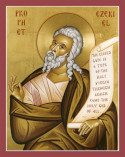 The son of a priest from the city of Sarir, he was taken into
captivity in Babylon with King Jehoiachin and many other Israelites. Living in captivity, Ezekiel
prophesied for twenty-seven years. He was a contemporary of the Prophet Jeremias. As Jeremias
taught and prophesied in Jerusalem, so Ezekiel taught and prophesied in Babylon. Jeremias’
prophecies were known in Babylon, as were Ezekiel’s in Jerusalem. Both these holy men were
in agreement in their prophecy, and they were both ill-treated and tormented by the faithless
Jewish people. Ezekiel had vivid and indescribable visions. By the River Chebar, he saw the
heavens open, and a cloud like fire and lightning, and four living creatures like molten copper.
One of the living creatures had the face of a man, the second that of a lion, the third that of a
calf and the fourth that of an eagle. The human face signified God incarnate as man, the
lion’s face His divinity, the calf’s His sacrifice and the eagle’s His
Resurrection and Ascension. In another image, he was shown the resurrection of the dead. The
prophet saw a valley filled with the dry bones of the dead, and when the Spirit of God came upon
them, they came to life and stood on their feet. He also saw the terrible destruction of
Jerusalem, when the wrath of God cut down all except those who had earlier been marked with the
mark, that of the Greek tav, our letter ‘T,’ which is also the sign of the
Cross. The malice of the Jews did not spare this holy man. Embittered against him for having
denounced them, the Jews bound him to the tails of horses and he was torn asunder. He was buried
in the self-same place in which Shem the son of Noah was buried.
2. Our Holy Fathers Simeon and John.
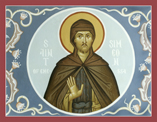 These two young men left their homes and
kinsfolk in Syria: Simeon his old mother and John his wife, and were made monks in the community
of St. Gerasimos, at the hands of Abbot Nikon. They went off into the desert, where they spent
many years in the strictest asceticism. They mortified their bodies with this ascesis until they
were like two pieces of dry wood. One day, Simeon said to John that, at God’s command, he
must leave the desert and return to the company of men, there to serve God as a fool-for-Christ.
John gave him this advice: ‘Keep your heart from all that you see in the world. Whatever
there may be that touches your hand, let it not take hold of your heart. When food passes your
lips, let not your heart be sweetened by it. If your feet have to move, let there be peace within
you. Whatever you do outwardly, let your mind remain tranquil. Pray for me, that God may not part
us from each other in the world to come.’ Holy Simeon accepted his friend’s advice,
embraced him and then left the desert and went among men, to teach them through folly and turn
them to the Christian Faith. He made himself appear mad to men, but his heart was a temple of the
Holy Spirit, a temple of unceasing prayer. He had abundant gifts from God, having discernment
into all men’s secrets, both close at hand and afar off, and healed men of evil spirits and
other infirmities. Dancing through the streets like a madman, he drew near to people and
whispered their sins in their ears, calling them to repentance. He appeared to sinners in dreams,
reprimanding them for their sins and calling them also to repentance. Thus St. Simeon appeared in
a dream to a pagan actor, Bali, who publicly mocked the holy things of the Christians. He rebuked
him and threatened him, and Bali repented and became a good Christian. A dissolute youth went out
of his mind with lust. Seeing him, St. Simeon, feigning madness, struck him a blow on the face,
and said: ‘Do not commit adultery!’ At that moment, the unclean spirit left the young
man and he was healed.
3. St. Victor.
He suffered in Marseilles in the third century. After harsh torture, he was thrown into prison, where he converted the guards to the Christian Faith. He died by crucifixion.
FOR CONSIDERATION, From “My Life in Christ”—St. John of Kronstadt.
When you are struck by other people’s suffering, and the contraction of their souls, so that you are induced to pray for them with a pitying and contrite heart, pray to God to have mercy upon them and to forgive them their sins, as you would pray for the forgiveness of your own sins—that is, implore God with tears to pardon them; likewise pray for the salvation of others as you would pray for your own salvation. If you attain to this and make it a habit, you will receive from God an abundance of spiritual gifts, the gifts of the Holy Spirit, Who loves the soul that cares for the salvation of others, because He Himself, the most Holy Spirit, wishes to save us all in every possible way, if only we do not oppose Him, and do not harden our hearts. “The Spirit Himself intercedeth for us with unutterable groanings (Rom. 8:26).”
Daily Scripture Readings taken from The Orthodox New Testament, translated and published by Holy Apostles Convent, Buena Vista, Colorado, copyright © 2000, used with permission, all rights reserved.
Daily Prologue Readings taken from The Prologue of Ochrid, by Bishop Nikolai Velimirovic, translated by Mother Maria, published by Lazarica Press, Birmingham, England, copyright © 1985, all rights reserved. Edited by Dormition Skete.