

Daily Devotional
Saturday, June 4, 2016 (NS), May 22, 2016 (OS)
No Fasting.
Saturday of the Fifth Week
The commemoration of the holy Martyr Vasiliskos of Comana.
Scripture Readings
Paschalion — Movable Calendar
Saturday of the Fifth Week
Epistle
The Reading is from the Acts of the Apostles [§ 37]. In those days:
15 35Paul and Barnabas were spending time in Antioch, teaching and preaching as good tidings the word of the Lord, with many others also. 36And after some days Paul said to Barnabas, “Let us return now and visit our brethren in every city in which we proclaimed the word of the Lord, and see how they are holding fast.” 37And Barnabas determined to take with them John, who is called Mark. 38But Paul kept on thinking it not meet to take along that one, since he withdrew from them from Pamphylia, and went not with them to the work. 39Then a sharp contention arose, so as to separate them from one another: and Barnabas, having taken Mark, sailed away to Cyprus; 40and Paul, having chosen for himself Silas, went forth, having been commended to the grace of God by the brethren. 41And he passed through Syria and Cilicia, rendering more firm the churches.
Gospel
The Reading is from the Holy Gospel according to Saint John [§ 38]. The Lord said to those Jews who had come to Him:
10 27“The sheep, those that are Mine, hear My voice, and I know them, and they follow Me. 28“And I give them eternal life, and in no wise shall they ever perish, and neither shall anyone snatch them out of My hand. 29“My Father, Who hath given them to Me, is greater than all; and no one is able to snatch them out of My Father’s hand. 30“I and the Father are one.” 31Then the Jews took up stones again that they might stone Him. 32Jesus answered them, “Many good works I showed you from My Father. For what kind of work among these are ye trying to stone Me?” 33The Jews answered Him, saying, “For a good work we are not about to stone Thee, but for blasphemy, and because Thou, being a man, makest Thyself God.” 34Jesus answered them, “Is it not written in your law, ‘I said, “Ye are gods [Ps. 81(82):6]”’? 35“If He called them gods, to whom the word of God came to pass—and the Scripture is not able to be broken— 36“do ye say of Him, Whom the Father sanctified and sent forth into the world, ‘Thou blasphemest,’ because I said, ‘I am God’s Son’? 37“If I do not the works of My Father, cease believing Me. 38“But if I do, even if ye believe Me not, believe the works, that ye might come to know and believe that the Father is in Me, and I in Him.”
Menaion — Fixed Calendar
The commemoration of the holy Martyr Vasiliskos of Comana.
No readings given.
Lives of the Saints (Prologue)
June 4th – Civil Calendar
May 22nd – Church Calendar
1. The Holy Martyr Vasiliskos.
A kinsman of St. Theodore the Tyro, he was martyred together with Eftropios and Kleonikos (March 3rd). When these two were crucified and gave up the spirit, Vasiliskos was taken back to prison. A change of governors occurring at this time, Vasiliskos remained a long time confined in prison. He besought God with tears that He would not deprive him of a martyr’s death for His sake. After he had prayed at length, the Lord Jesus appeared to him and promised to fulfill his desire, sending him to his village to say farewell to his mother and brothers. Thereupon the new governor, Agrippa, arrived and sent to have Vasiliskos brought from the village immediately. On the way to the city of Amaseia, the Lord worked great wonders through His martyr, bringing many of the people to faith in Christ. Agrippa ordered the martyr to offer sacrifice to Apollyon. ‘“Apollyon” means “Destroyer”,’ said Vasiliskos, and with fervent prayer, he knocked the idol to dust and burned the temple with fire from heaven. The terrified Agrippa attributed this all to magic, and ordered that Vasiliskos be beheaded with the sword. Agrippa immediately became insane, and in his madness, went to the place of execution, found a little of the martyr’s blood in the dust and smeared it on himself under his belt, being restored to health by it. Having come to his senses, he was baptized. Later, a certain Marinus, a citizen of Comana (the place of Vasiliskos’ execution) built a church over the martyr’s relics, and many of the sick found healing there.
2. The Holy Martyr John (Jovan) Vladimir, King of Serbia.
He came of a princely family from Zahumlje. His grandfather was named Hvalimir and his father Petrislav. He was a wise ruler—merciful, meek, chaste and courageous. He was fervent in prayer and a devoted builder and benefactor of churches. But he had major battles to fight, both inside and outside his realm; internally with heretics and Bogomils, and externally with invaders, with King Samuel of Bulgaria and the Emperor Basil. Samuel captured him by guile and threw him into prison. While he was in prison, an angel of God appeared to him and foretold that he would soon be released from prison, but that he would die a martyr’s death. Getting to know Vladimir better, Samuel became attached to him and gave him his daughter Kosara in marriage. When Samuel died, his son Radomir became king, but his twin brother Radislav killed him and then summoned Vladimir on some pretext and beheaded him as well, in 1015. The relics of this holy martyr-king are preserved incorrupt in his monastery near Elbasan, and numerous wonders have been worked over them through the ages and to this day. In 1925, a church was built to this royal martyr near the monastery of St. Naum, which famous monastery he founded.
3. The Second Ecumenical Council.
This council was held in Constantinople in 381, in the time of the Emperor Theodosios the Great. Its purpose was to confirm the teaching of the Orthodox Church about the Holy Spirit. Makedonios (Macedonius), Bishop of Constantinople (d. 362), had taught wrongly that the Holy Spirit is God’s creature and not a divine Person, equal to the Persons of the Father and the Son and one in being with Them. Makedonios was condemned by this council and the Nicene Creed was amplified with teaching on the Holy Spirit.
4. Holy and Righteous Melchisedek, King of Salem.
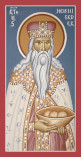 He was a contemporary of our
forefather Abraham. According to the Apostle Paul, he was, as king and priest, a type of
the Lord Jesus (Heb. 7). |
FOR CONSIDERATION
How was Moses able to fast for forty days? How were many Christian ascetics able to live, and live long, with prolonged periods of abstinence from food and drink? A carnal man, unacquainted with the spiritual life, finds this impossible to believe. It is impossible to prove it to him, for it can be understood only from experience. When St. Vasiliskos’ torturers left him for three days without food or water, and then urged him to eat, he refused, saying that he was not hungry. ‘I am,’ he said, ‘filled with immortal nourishment and will not receive mortal food. Earthly bread feeds you, but I am fed by the heavenly word of God; the universe gives you wine, but I receive the grace of the Holy Spirit. You are nourished by meat, but I by fasting; bodily power strengthens you, but me the Cross of Christ; gold enriches you, but me the love of Christ; clothing beautifies you, but me good works. You are made merry by laughter, but I am comforted in my spirit through prayer.’ Behold this man, one of many, in whom the words of Christ are confirmed: ‘Man does not live by bread alone, but by every word that proceedeth out of the mouth of God’ (Matt. 4:4).
Daily Scripture Readings taken from The Orthodox New Testament, translated and published by Holy Apostles Convent, Buena Vista, Colorado, copyright © 2000, used with permission, all rights reserved.
Daily Prologue Readings taken from The Prologue of Ochrid, by Bishop Nikolai Velimirovic, translated by Mother Maria, published by Lazarica Press, Birmingham, England, copyright © 1985, all rights reserved. Edited by Dormition Skete.