

Daily Devotional
Friday, June 3, 2016 (NS), May 21, 2016 (OS)
Fast Day, but Wine and Olive Oil Allowed.
Friday of the Fifth Week
The commemoration of the holy God-fearing emperor and empress and Equal-to-the-apostles, Constantine and Helen.
Scripture Readings
Paschalion — Movable Calendar
Friday of the Fifth Week
Epistle
The Reading is from the Acts of the Apostles [§ 36]. In those days:
15 5There rose up certain of those from the sect of the Pharisees who believed, saying, “It is necessary to circumcise them, and to command them to keep the law of Moses.”
6And the apostles and the presbyters were gathered together to see about this matter. 7And after much discussion took place, Peter rose up and said to them, “Men, brethren, ye know that from former days God Himself chose among us for the nations to hear by my mouth the word of the Gospel, and to believe. 8“And God, the Knower of hearts, bore witness to them, giving them the Holy Spirit, even as also to us; 9“and He made no distinction between both us and them, having purified their hearts by faith. 10“Now then why tempt ye God by putting a yoke upon the neck of the disciples which neither our fathers nor we were able to bear? 11“But through the grace of the Lord Jesus Christ, we believe we are to be saved in like manner as they.” 12And all the multitude became silent, and were listening to Barnabas and Paul relating how many signs and wonders God wrought among the nations through them. 13And after they became silent, Iakovos answered, saying, “Men, brethren, hear me. 14“Symeon related how God first visited to take from the nations a people for His name. 15“And to this agree the words of the prophets, even as it hath been written: 16“‘“After these things I will return, and will build again the tabernacle of David which is fallen, and I will build again the things which have been dug down, and I will set it up [cf. Amos 9:11], 17“‘“so that the residue of men might seek after the Lord, even all the nations upon whom My name hath been called upon them,” saith the Lord Who doeth all these things [cf. Amos 9:12].’ 18“Known to God are all His works from eternity. 19“Wherefore I judge that we are not to trouble those who from the nations are turning to God, 20“but that we write to them to abstain from the pollutions of the idols, and from fornication, and from what is strangled, and from blood. 21“For Moses from generations of old hath in every city those proclaiming him, since he is read every sabbath day.” 22Then it seemed good to the apostles and to the presbyters, with the whole Church, to send chosen men from among them to Antioch with Paul and Barnabas, namely, Judas surnamed Barsavas, and Silas, leading men among the brethren, 23having written by their hand thus: “The apostles and the presbyters and the brethren to those brethren who are of the nations in Antioch and Syria and Cilicia: Greetings. 24“Whereas we have heard that certain from among us who went out troubled you with words, upsetting your souls, saying, ‘Be circumcised and keep the law’—to whom we gave no such command— 25“it seemed good to us, having come to be of one accord, to send chosen men to you with our beloved Barnabas and Paul, 26“men who have handed over their lives for the name of our Lord Jesus Christ. 27“We have sent forth therefore Judas and Silas, who shall themselves also relate verbally the same things. 28“For it seemed good to the Holy Spirit, and to us, to lay upon you no further burden than these necessary things: 29“that ye abstain from sacrifices to idols, and from blood, and from what is strangled, and from fornication; from which, if ye keep yourselves, ye shall do well. Fare-well.”
30So when they were dismissed, they went to Antioch; and after they gathered together the multitude, they delivered the epistle. 31And having read it, they rejoiced for the consolation. 32Both Judas and Silas, being themselves also prophets, by much discourse exhorted the brethren and confirmed them. 33And after they continued for a time, they were sent forth in peace from the brethren to the apostles. 34But it seemed good to Silas to abide there.
Gospel
The Reading is from the Holy Gospel according to Saint John [§ 37]. The Lord said to those Jews who had come to Him:
10 17“On this account My Father loveth Me, because I lay down My soul, that I might take it again. 18“No one taketh it from Me, but I lay it down of Myself. I have authority to lay it down, and I have authority to take it again. This commandment I received from My Father.” 19A division therefore again arose among the Jews on account of these words. 20And many of them were saying, “He hath a demon and is mad; why hear ye Him?” 21Others were saying, “These are not the words of one who is possessed by a demon. A demon is not able to open the eyes of the blind, is he?”
22And it came to be the feast of the dedication in Jerusalem, and it was winter. 23And Jesus was walking about in the temple in Solomon’s porch. 24Then the Jews came round about Him and were saying to Him, “Until when dost Thou lift up our soul? If Thou art the Christ, tell us openly.” 25Jesus answered them, “I told you, and ye believe not. The works which I do in the name of My Father, these bear witness concerning Me. 26“But ye believe not; for ye are not of My sheep, even as I said to you. 27“The sheep, those that are Mine, hear My voice, and I know them, and they follow Me. 28“And I give them eternal life.”
Menaion — Fixed Calendar
The commemoration of the holy God-fearing emperor and empress and Equal-to-the-apostles, Constantine and Helen.
Epistle
For Gk. usage, see [Acts 26:1, 12-20] hereunder;
for Sl. usage, see [Acts 26:1-5, 12-20] hereunder.
According to Sl. usage, read from Acts if this feast should fall within the fifty days before holy Pentecost; otherwise, see [Gal. 1:11-19].
The Reading is from the Acts of the Apostles [§ 49]. In those days:
26 1Agrippa said to Paul, “It is permitted thee to speak for thyself.” Then Paul, stretching forth his hand, began to defend himself:
For Gk. usage, skip to Acts 26:12-20; for Sl. usage, read Acts 26:2-5, 12-20.
2“Concerning all the things of which I am being accused by the Jews, king Agrippa, I deem myself happy, because I am about to defend myself before thee today, 3“especially because thou art one acquainted with all of the customs and also the subjects of dispute among the Jews. Wherefore I entreat thee to hear me with forbearance. 4“So then, my way of life from my youth which was from the beginning among mine own nation in Jerusalem, all the Jews know, 5“who knew me before, from the beginning—if they would be willing to testify—that according to the strictest sect of our religion, I lived a Pharisee.... 12“And during these things,...
Gk. and Sl. usages continue the Reading from here, Acts 26:12-20.
12“As I went to Damascus with authority and a commission from the chief priests, 13“at midday, in the way, I saw, O king, a light from heaven, above the brightness of the sun, shining round about me and those traveling with me. 14“And after all of us fell down to the ground, I heard a voice speaking to me and saying in the Hebrew language, ‘Saul, Saul, why persecutest thou Me? It is hard for thee to kick against the goads.’ 15“And I said, ‘Who art Thou, Lord?’ And He said, ‘I am Jesus Whom thou persecutest. 16“‘But rise up and stand on thy feet; for I appeared to thee for this purpose, to appoint thee a servant and a witness both of what thou didst see and of what I shall appear to thee in visions, 17“‘taking thee out for Myself from the people and the nations, to whom now I send thee forth, 18“‘to open their eyes, in order to turn them about from darkness to light and from the power of Satan to God, in order to receive forgiveness of sins and an inheritance among those who have been sanctified by faith that is in Me.’ 19“Whereupon, O king Agrippa, I did not become disobedient to the heavenly vision; 20“but I was bringing tidings to those in Damascus first and in Jerusalem, and in all the land of Judæa, and to the nations, to repent and turn to God, practising works worthy of repentance.”
Gospel
The Reading is from the Holy Gospel according to Saint John [§ mid 35]. The Lord said to those Jews who had come to Him:
10 1“Verily, verily, I say to you, the one who entereth not by the door into the fold of the sheep, but goeth up from another place, that one is a thief and a robber. 2“But the one who entereth by the door is a shepherd of the sheep. 3“To this one the doorkeeper openeth, and the sheep hear his voice; and he calleth his own sheep by name and leadeth them out. 4“And whenever he should put forth his own sheep, he goeth before them; and the sheep follow him, because they know his voice. 5“But a stranger in no wise will they follow, but will flee from him, because they know not the voice of strangers.” 6This parable Jesus spoke to them; but they understood not what it was which He spoke to them. 7Then said Jesus to them again, “Verily, verily, I say to you that I am the door of the sheep. 8“All, as many as came before Me, are thieves and robbers; but the sheep heard them not. 9“I am the door; by Me if anyone should enter, he shall be saved, and shall go in and go out and find pasture.”
Lives of the Saints (Prologue)
June 3rd – Civil Calendar
May 21st – Church Calendar
1. The Holy Emperor Constantine and the Empress Helena.
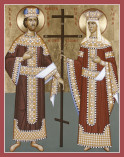 Constantine’s parents were the Emperor Constantius
Chlorus and the Empress Helena. Chlorus had further children by another wife, but by Helena he
had only the one, Constantine. Constantine fought two great battles when he came to the throne:
one against Maxentius, a tyrant in Rome, and the other against Licinius not far from Byzantium.
At the battle against Maxentius, when Constantine was in great anxiety and uncertainty about his
chances of success, a shining cross, surrounded by stars, appeared to him in the sky in full
daylight. On the cross were written the words: ‘In this sign, conquer!’ The wondering
emperor ordered that a great cross be put together, like the one that had appeared, and be
carried before the army. He also ordered all of his soldiers to paint crosses on their shields.
By the power of the Cross, he gained a glorious victory over enemies greatly superior in number.
Maxentius drowned himself in the Tiber. Immediately after this, Constantine issued the famous
Edict of Milan, in 313, to put an end to the persecution of Christians. Conquering Byzantium, he
built a beautiful capital city on the Bosphorus, which from that time was named
Constantinople.
When there was discord in the Church about the troublesome heretic Arius, the emperor summoned the First Ecumenical Council in Nicaea, in 325, where the heresy was condemned and Orthodoxy confirmed. St. Helena, the emperor’s devout mother, was very zealous for the Christian Faith. She visited Jerusalem and found the Precious Cross of the Lord, and built the Church of the Resurrection over Golgotha and many other churches in the Holy Land. This holy woman went to the Lord in 327, at the age of eighty. The Emperor Constantine outlived his mother by ten years and entered into rest at the age of about sixty in 337, in the city of Nikomedia. His body was buried in the Church of the Holy Apostles in Constantinople.
2. Our Holy Father, the New-Martyr Pachomius.
Born in Little Russia, he was taken by the Tartars as a boy and sold to a Turkish tanner as a slave. He spent twenty-seven years in slavery in Usaki in Asia Minor, and was forced to embrace Islam. He went off to the Holy Mountain, became a monk and spent twelve years near the monastery of St. Paul. He resolved to suffer for Christ. His spiritual elder, Joseph, sent him off to Usaki, where he showed himself to his former owner as a Christian, wearing his monastic schema. The Turks gave him over to torture, then threw him into prison and finally beheaded him on May 8th, 1730, on Ascension Day. Many miracles were wrought by his blood and his relics. His body was buried on the island of Patmos in the Church of St. John the Theologian. Thus this villager from Little Russia became a martyr and wears the wreath in the kingdom of Christ.
FOR CONSIDERATION
We see that vice is something shameful and sinful, and that it always hides itself and always takes on the semblance of good works. St. John Chrysostom says most beautifully: ‘Vice has not got its own, personal face, but borrows the face of good deeds.’ The Savior also said: ‘(they) come to you in sheep’s clothing, but inwardly they are ravening wolves’ (Matt. 7:15). Call a liar a liar, and a thief a thief; a murderer a murderer, an immoral man an immoral man and a slanderer a slanderer, and you will anger them. Call any man honest, honorable, selfless, truthful, just, conscientious, and you’ll please and content him. Again I quote St. Chrysostom: ‘Good works are something natural to man, while vice is something unnatural and false.’ If a man is seized by some vice, he quickly justifies it by some good work, clothing it in the garment of good deeds. Truly, vice does not have its own, personal face, and neither has the devil, the father of vice.
Daily Scripture Readings taken from The Orthodox New Testament, translated and published by Holy Apostles Convent, Buena Vista, Colorado, copyright © 2000, used with permission, all rights reserved.
Daily Prologue Readings taken from The Prologue of Ochrid, by Bishop Nikolai Velimirovic, translated by Mother Maria, published by Lazarica Press, Birmingham, England, copyright © 1985, all rights reserved. Edited by Dormition Skete.