

Daily Devotional
Sunday, April 29, 2035 (NS), April 16, 2035 (OS)
No Fasting.
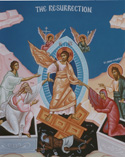
| The Holy and Great Sunday of Pascha |
The commemoration of the Virgin-martyrs Agape, Irene, and Chionia in Illyria.
Scripture Readings
Paschalion — Movable Calendar
The Holy and Great Sunday of Pascha
Epistle
The Reading is from the Acts of the Apostles [§ 1].
1 1The first account indeed I made for myself concerning all which, O Theophilos, Jesus began both to do and teach, 2until the day in which He was taken up, after He gave command to the apostles whom He chose for Himself through the Holy Spirit, 3to whom also He presented Himself alive after He had suffered by many proofs, being seen by them during forty days and speaking the things concerning the kingdom of God. 4And being assembled together with them, He ordered them not to depart from Jerusalem, but to wait for the promise of the Father, “which,” He said, “ye heard of Me; 5“for John indeed baptized with water, but ye shall be baptized in the Holy Spirit not many days after these.” 6Indeed therefore, after they came together, they kept on questioning, saying, “Lord, dost Thou at this time restore the kingdom to Israel?” 7And He said to them, “It is not yours to know times or seasons which the Father Himself put in His own authority. 8“But ye shall receive power, after the Holy Spirit is come upon you; and ye shall be witnesses to Me both in Jerusalem, and in all Judæa and Samaria, and unto the ends of the earth.”
Gospel
In the Liturgy
The Reading is from the Holy Gospel according to Saint John [§ 1].
1 1In the beginning was the Logos, and the Logos was with God, and the Logos was God. 2This One was in the beginning with God. 3All things came into being through Him, and without Him not even one thing came into being that hath come to be. 4In Him was life, and the Life was the light of men. 5And the light shineth in the darkness, and the darkness overcame it not.
6There came to be a man who was sent forth from God, whose name was John. 7This same came for a witness, in order that he might bear witness concerning the Light, that all might believe through Him. 8He was not that One, the Light, but was sent that he might bear witness concerning the Light. 9That was the true Light, which giveth light to every man coming into the world. 10He was in the world, and the world came into being through Him, and the world knew Him not. 11He came to His own, and His own received Him not. 12But as many as received Him, to them He gave power to become children of God, to those who believe in His name: 13who were begotten not of blood, nor of the will of the flesh, nor of the will of man, but of God. 14And the Logos became flesh and tabernacled among us, and we beheld His glory, the glory as of an only-begotten from the Father, full of grace and truth. 15John beareth witness concerning Him, and hath cried out, saying, “This One was He of Whom I said, ‘The One Who cometh after me hath come to be before me, for He was before me.’” 16And of His fullness we all received, and grace for grace; 17for the law was given through Moses, but the grace and the truth came to be by Jesus Christ.
In Vespers
The Reading is from the Holy Gospel according to Saint John [§ 65].
20 19When it was evening on that day, the first of the week—and the doors were closed where the disciples were gathered together for fear of the Jews—Jesus came and stood in the midst, and saith to them, “Peace be to you.” 20And after He said this, He showed them His hands and His side. Then were the disciples glad, after they saw the Lord. 21Then Jesus said to them again, “Peace be to you; even as the Father hath sent Me forth, I also send you.” 22And after He said this, He breathed on them, and saith to them, “Receive ye the Holy Spirit: 23“if ye forgive the sins of any, they are forgiven to them; if ye retain the sins of any, they are retained.” 24But Thomas, one of the twelve, who is called Didymos, was not with them when Jesus came. 25The other disciples therefore were saying to him, “We have seen the Lord.” But he said to them, “Unless I should see in His hands the mark of the nails, and put my finger into the mark of the nails, and put my hand into His side, in no wise will I believe.”
Menaion — Fixed Calendar
The commemoration of the Virgin-martyrs Agape, Irene, and Chionia in Illyria.
No readings given.
Lives of the Saints (Prologue)
April 29th – Civil Calendar
April 16th – Church Calendar
1. The Holy Martyrs Agapia, Chionia and Irene.
They were sisters from the region of Aquileia. When the Emperor Diocletian was staying in Aquileia, he ordered that the famous spiritual guide, Chrysogonus, be executed. An old priest named Zoilus received a vision in which he was shown where the body of Chrysogonus lay unburied. The old man hurried off, found the body of the martyr, placed it in a coffin and carried it to his home. On the thirtieth day after that, St. Chrysogonus appeared to him and told him that the three maidens would be martyred in the next nine days, and that he, Zoilus, would himself enter into rest during that time. Anastasia the Clairvoyant also received the same tidings in a vision sent by Chrysogonus, who had been her teacher. The elder Zoilus did indeed find his rest after nine days, and the three sisters were brought to trial before the emperor. The emperor urged the holy maidens to worship idols, but they all refused, confessing their firm faith in Christ. Irene told the emperor that it was ridiculous to bow down to things made of wood and stone, made to order at an agreed price by the hands of a mortal man. The furious emperor flung them into prison. Now, when the emperor travelled to Macedonia, he took all his slaves and servants with him, including the three sisters. He gave them to Dulcitius, a general, for torture. Inflamed with a dark passion, he desired to defile the maidens, but when he tried to go into the prison, he lost his mind and fell upon the pots and cauldrons in front of the gate, embracing and kissing them, and was completely blackened with soot. When the emperor heard of this happening, he ordered another general to undertake the trial of the sisters. After terrible torture, the judge condemned the first two sisters to death by fire, but kept Irene for a time, hoping to defile her. But, when he sent Irene to the brothel along with some soldiers, an angel of God turned the soldiers back and led her out onto a high hill. The next day the general went out to the hill with his soldiers, and being unable to climb it, ordered that Irene be shot at with arrows. St. Anastasia gathered all three bodies together in one place and gave them burial. They suffered for Christ their King and Lord in about 304.
2. The Holy Martyr Leonides and those with him: Charissa, Nike, Galina, Kallis, Nunechia, Vasilissa and Theodora.
They were thrown into the sea, but it refused to receive them. They walked upon the sea as if it were dry land and sang praises to God: ‘I have won one battle, O Lord, and the soldiers have persecuted me, O Lord, and I have not denied Thee, O Lord; save Thou my soul!’ The pagans were at first astounded to behold this, but they then tied stones around their necks and again threw them into the deep, where they were drowned. They all suffered with honor for Christ our King and Lord in 281.
FOR CONSIDERATION
A story of the elder Barlaam: A man had three friends; two of these he loved sincerely, but avoided the third because he found him boring. It so happened that the emperor summoned the man to pay a debt. He turned to the first friend for aid, but he refused and went away. He asked help of the second, but he would not help him either. Somewhat shamefacedly, he turned to his third friend, who went willingly with him to the emperor. The meaning is this: the first friend is riches, the second is friends and family, and the third is the good deeds of a man in this world. The emperor is God, Who sends out His summons by means of death and demands payment of the debt. A man on the point of death looks for help from his riches, but they simply turn their back on him and pass into the hands of another. Then he turns to his kinsmen, but they go with him for a short distance, but then turn their backs on him, send him off and stay behind themselves tending to their own affairs. Then he begins to think on his good deeds, which he performed so grudgingly—and straightway these come with him on the road to the presence of the King and Judge. He who has ears to hear, let him hear. The soul’s only companions into the other world are his deeds, be they good or bad. All that which was dear and precious to a man abandons him and turns its back on him; only his deeds, down to the very last one, go with him. He who has a mind to understand, let him understand.
Daily Scripture Readings taken from The Orthodox New Testament, translated and published by Holy Apostles Convent, Buena Vista, Colorado, copyright © 2000, used with permission, all rights reserved.
Daily Prologue Readings taken from The Prologue of Ochrid, by Bishop Nikolai Velimirovic, translated by Mother Maria, published by Lazarica Press, Birmingham, England, copyright © 1985, all rights reserved. Edited by Dormition Skete.