

Daily Devotional
Wednesday, April 25, 2035 (NS), April 12, 2035 (OS)
Fast Day. No Meat, Fish, Dairy, Eggs, Alcohol or Olive Oil Allowed.
Holy Week
| Holy and Great Wednesday |
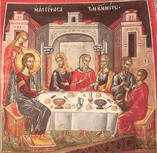
The commemoration of our holy father among the saints, Basil the Confessor, Bishop of Parium.
Scripture Readings
Paschalion — Movable Calendar
Holy and Great Wednesday
Epistle
There is no Epistle Reading this day because of Holy Week.
Gospel
In the Orthros
The Reading is from the Holy Gospel according to Saint John [§ mid 41]. At that time:
12 17The crowd that was with Jesus when He called Lazarus out of the grave and raised him from the dead bore witness. 18On this account the crowd also went to meet Him, because it heard that He had done this sign. 19The Pharisees therefore said among themselves, “Observe ye that ye profit nothing? Behold, the world hath gone away after Him.”
20And there were certain Greeks from among those going up that they might do reverence at the feast. 21Then these came to Philip, who was from Bethsaida of Galilee, and asked him, saying, “Sir, we wish to see Jesus.” 22Philip cometh and telleth Andrew, and again Andrew and Philip tell Jesus. 23But Jesus answered them, saying, “The hour hath come that the Son of Man should be glorified. 24“Verily, verily, I say to you, unless the grain of the wheat that falleth into the earth should die, it abideth alone; but if it should die, it beareth much fruit. 25“The one who loveth his life shall lose it; and the one who hateth his life in this world shall keep it to life eternal. 26“If anyone serve Me, let him keep on following Me; and where I am, there My servant shall be also. And if anyone serve Me, the Father shall honor him. 27“Now My soul hath been troubled; and what shall I say? ‘Father, save Me from this hour’; but on this account I came to this hour. 28“Father, glorify Thy name.” Then a voice came out of the heaven: “I both glorified it and will glorify it again.” 29The crowd then that stood by and heard it was saying that thunder had occurred; others were saying, “An angel hath spoken to Him.” 30Jesus answered and said, “This voice hath not occurred for My sake, but for your sakes. 31“Now is a judgment of this world; now the ruler of this world shall be cast out. 32“And I, if I be lifted up from the earth, will draw all to Myself.” 33But He was saying this, signifying by what manner of death He was about to die. 34The crowd answered Him, “We heard out of the law that the Christ abideth forever; and how sayest Thou, ‘The Son of Man must be lifted up’? Who is this Son of Man?” 35Then Jesus said to them, “Yet a little while is the light with you. Be walking while ye have the light, that darkness might not overtake you; and indeed the one who walketh in the darkness knoweth not where he goeth. 36“While ye have the light, keep on believing in the light, that ye might become sons of light.” Jesus spoke these things, and departed, and was hidden from them.
37But though He had done so many signs before them, yet they kept on not believing in Him, 38that the word of Esaias the prophet might be fulfilled, which he spoke, “Lord, who believed our report? And to whom was the arm of the Lord revealed [Is. 53:1]?” 39On this account they were not able to believe, because Esaias said again, 40“He hath blinded their eyes and hardened their heart, that they should not see with their eyes and understand with their heart and should be converted; and I shall heal them [cf. Is. 6:9, 10].” 41These things said Esaias when he saw His glory and spoke concerning Him. 42Yet, nevertheless, from among the rulers also many believed in Him, but because of the Pharisees they were not confessing Him, lest they should be expelled from the synagogue; 43for they loved the glory of men more than the glory of God. 44But Jesus cried and said, “The one who believeth in Me, believeth not in Me, but in the One Who sent Me; 45“and the one who seeth Me, seeth the One Who sent Me. 46“I have come a light into the world, that everyone who believeth in Me should not abide in the darkness. 47“And if anyone hear My words and believe not, I judge him not; for I came not that I might judge the world, but that I might save the world. 48“The one who rejecteth Me and receiveth not My words, hath that which judgeth him—the word which I spoke, that shall judge him in the last day. 49“For I spoke not of Myself, but the Father Who sent Me, He Himself gave a commandment to Me, what I should say and what I should speak. 50“And I know that His commandment is life everlasting. Therefore, what things I speak, as the Father hath said to Me, so I speak.”
In the Liturgy of the Presanctified Gifts
The Reading is from the Holy Gospel according to Saint Matthew [§ 108]. At that time:
26 6When Jesus was in Bethany, in the house of Simon the leper, 7a woman came to Him having an alabaster flask of very costly perfumed ointment, and she poured it upon His head as He reclined at table. 8But His disciples, having seen it, became indignant, saying, “For what is this loss? 9“For it was possible for this perfumed ointment to have been sold for much and to have been given to the poor.” 10But Jesus, perceiving it, said to them, “Why do ye cause trouble to the woman? For she wrought a good work toward Me. 11“For ye have the poor among yourselves always, but Me ye have not always. 12“For in putting this perfumed ointment upon My body, she did it for My burial. 13“Verily I say to you, wheresoever this Gospel shall be proclaimed in all the world, also what she did shall be spoken of for a memorial of her.” 14Then one of the twelve, who was called Judas Iscariote, went to the chief priests, 15and said, “What are ye willing to give to me, and I will deliver Him up to you?” And they fixed by agreement with him for thirty pieces of silver. 16And from that time he sought an opportunity that he might deliver Him up.
Menaion — Fixed Calendar
The commemoration of our holy father among the saints, Basil the Confessor, Bishop of Parium.
No readings given.
Lives of the Saints (Prologue)
April 25th – Civil Calendar
April 12th – Church Calendar
1. Our Holy Father Isaac II of Syria (St. Isaac the Syrian is commemorated on Jan. 28th).
St. Gregory the Dialogist writes about this Isaac. He went to Italy in the time of the Goths and went into the church in the town of Spoleto to pray. He asked the verger to leave him locked in the church all night, and thus spent the night in prayer without moving from that place. He spent the next day and night in the same way. The verger called him a hypocrite and struck him a blow—and lost his reason at that same moment. Seeing how the verger was so fiercely tormented, Isaac bent over him and the evil spirit fled from him, leaving him whole. People came to hear of this happening, and the whole town thronged around this wonderful elder. They offered him money and goods, but he refused them all and would accept nothing. Instead, he withdrew to a forest, where he built himself a cell, which quickly became transformed into a large monastery. Isaac became famous for his miracles, especially for his discernment. One evening he told the brethren to take all the hoes out to the vineyard and leave them there. The next day, the brethren set out for the vineyard, taking their lunch, as they had no workers. When they got there, they found as many people working as there were hoes to work with. It transpired that these people had come as thieves to steal the hoes, but by the power of God, they were constrained to work all night.
On another occasion, a couple of almost-naked men came seeking clothing from Isaac. He sent a monk to a hollow tree at the end of the road, to bring what he found there. The monk went off, found some clothing and brought it back to the monastery. The abbot took the clothing and gave it to the beggars. They were profoundly ashamed as they recognized their own clothing, which they had concealed in that tree.
A man once sent two beehives to the monastery. A monk hid one of them on the way, and brought the other to the abbot. The saint said to him: ‘Be careful when you go back to that beehive you hid on the way. It’s been taken over by poisonous snakes. Take care they don’t bite you!’
St. Isaac reposed in peace in 550.
2. St. Basil the Confessor.
In a time of iconoclasm, this virtuous man was bishop in the city of Parius in Asia Minor. He refused to sign the imperial order against the veneration of icons, for which he was greatly persecuted and tortured. But he remained firm as diamond in his Orthodoxy. He died in the first half of the 8th century, and went to the Lord.
3. Our Holy Father Akakios.
From the village of Gollitsa in Epirus, he was a great Athonite ascetic, spiritual guide and clairvoyant, and had many heavenly visions. He gave his blessing to several monks to seek martyrdom. He entered into rest at the age of 98, in 1730.
4. Our Holy Mother Athanasia.
Born on the island of Aegina of rich and eminent parents, she gave her goods to the poor and went off to a monastery, where she heaped greater and greater asceticism on herself. She took food only once a day, and that only bread and water, and in the Great Fast only once every two days. Only at Nativity and Pascha did she taste fish and oil. Although she was abbess of the monastery, she was the servant of all the other sisters and was ashamed that any should wait on her. She was made worthy of the great gift of wonder-working, both during her lifetime and after her death. She entered into rest in the Lord in 860.
FOR CONSIDERATION
The wicked Emperor Constantine Kopronymos had a virtuous daughter, the maiden Anthusa, ‘a beauteous branch of an evil stem’. She remained set against all her father’s urgings that she marry, for she was firmly bound in whole-hearted love to Christ the Lord. When her father died, Anthusa gave her goods away to the poor and became a nun in a monastery. It is a cause of wonder that many men of gentle birth have left the vanity of the world and set off on the narrow way after Christ; and it is twice as great a cause of wonder that women scorn youth and wealth and all the transient attraction of the world for the love of Christ. The Lord Himself said that it is hard for a rich man to enter the kingdom of heaven. Hard, yes: but not impossible. To those who scorn their own selves, it is easy to scorn riches and the whole world.
Daily Scripture Readings taken from The Orthodox New Testament, translated and published by Holy Apostles Convent, Buena Vista, Colorado, copyright © 2000, used with permission, all rights reserved.
Daily Prologue Readings taken from The Prologue of Ochrid, by Bishop Nikolai Velimirovic, translated by Mother Maria, published by Lazarica Press, Birmingham, England, copyright © 1985, all rights reserved. Edited by Dormition Skete.