

Daily Devotional
Monday, April 23, 2035 (NS), April 10, 2035 (OS)
Fast Day. No Meat, Fish, Dairy, Eggs, Alcohol or Olive Oil Allowed.
Holy Week
| Holy and Great Monday |
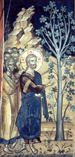
The commemoration of the holy Martyrs Terence, Africanos, Maximos, Pompeios, and 36 others, and also the blessed Zenon, Alexander, and Theodore at Carthage, and our holy father among the saints, Hieromartyr Gregory V, Patriarch of Constantinople.
Scripture Readings
Paschalion — Movable Calendar
Holy and Great Monday
Epistle
There is no Epistle Reading this day because of Holy Week.
Gospel
In the Orthros
The Reading is from the Holy Gospel according to Saint Matthew [§ 84]. At that time:
21 18As Jesus returned into the city, He hungered. 19And having seen a single fig tree in the way, He came to it and found nothing on it, except leaves only, and said to it, “Let there be no more fruit from thee forever.” And forthwith the tree was withered. 20And after the disciples saw it, they wondered, saying, “How was the fig tree withered forthwith?” 21And Jesus answered and said to them, “Verily I say to you, if ye have faith and doubt not, ye shall not only do that which was done to the fig tree, but even if ye should say to this mountain, ‘Be thou taken away, and be thou cast into the sea,’ it shall come to pass. 22“And all things, whatsoever ye ask in prayer, believing, ye shall receive.”
23And after He came into the temple, the chief priests and the elders of the people came to Him as He taught, saying, “By what authority doest Thou these things? And who gave Thee this authority?” 24And Jesus answered and said to them, “I also will question you for one word, which if ye tell Me, I also will tell you by what authority I am doing these things. 25“The baptism of John—from what place was it? From heaven or from men?” And they were reasoning with themselves, saying, “If we should say, ‘From heaven,’ He will say to us, ‘Why then did ye not believe him?’ 26“But if we should say, ‘From men,’ we fear the multitude; for all hold John as a prophet.” 27And they answered and said to Jesus, “We know not.” And He said to them, “Neither do I tell you by what authority I am doing these things. 28“But what think ye? A certain man had two children, and he came to the first and said, ‘Child, go today and work in my vineyard.’ 29“And he answered and said, ‘I will not’; but afterward he felt regret and went forth. 30“And he came to the second and spoke in like manner. And he answered and said, ‘I go, sir’; and he went not forth. 31“Which of the two did the will of the father?” They say to Him, “The first.” Jesus saith to them, “Verily I say to you that the tax collectors and the harlots go into the kingdom of God before you. 32“For John came to you in the way of righteousness, and ye believed him not; but the tax collectors and the harlots believed him; and ye, having seen, felt no regret afterward in order to believe him.
33“Hear another parable: There was a certain man, a master of a house, who planted a vineyard, and put a hedge around it, and dug a wine-vat in it in which to press grapes, and built a tower. And he let it out to vinedressers, and went abroad. 34“And when the season of the fruits drew near, he sent forth his slaves to the vinedressers to receive his fruits. 35“And the vinedressers took his slaves, and indeed beat one, and killed another, and stoned another. 36“Again he sent forth other slaves, more than the first; and they did to them in like manner. 37“But afterwards he sent his son to them, saying, ‘They will respect my son.’ 38“But after the vinedressers saw the son, they said among themselves, ‘This is the heir. Come, let us kill him, and let us gain possession of his inheritance.’ 39“And they took him, and cast him out of the vineyard, and slew him. 40“Whenever the lord, therefore, of the vineyard should come, what shall he do to those vinedressers?” 41They say to Him, “He will evilly destroy those evil men, and will let out the vineyard to other vinedressers who shall render to him the fruits in their seasons.” 42Jesus saith to them, “Did ye never read in the Scriptures, ‘The stone which the builders rejected, this became the head of the corner; this came to be from the Lord, and it is marvellous in our eyes [Ps. 117(118):22, 23; cf. Is. 28:16]’? 43“On this account I say to you that the kingdom of God shall be taken away from you, and it shall be given to a nation producing the fruits of it.”
In the Liturgy of the Presanctified Gifts
The Reading is from the Holy Gospel according to Saint Matthew [§ 98]. At that time:
24 3As Jesus sat upon the Mount of Olives, His disciples came to Him privately, saying, “Tell us, when shall these things be, and what shall be the sign of Thy coming, and of the completion of the age?” 4And Jesus answered and said to them, “Be taking heed, lest anyone lead you astray. 5“For many shall come in My name, saying, ‘I am the Christ’; and they shall lead astray many. 6“But ye are going to hear of wars and rumors of wars; keep on looking out and cease being clamorous; for all these things must come to pass, but the end is not yet. 7“For nation shall be stirred up against nation, and kingdom against kingdom. And there shall be famines, and plagues, and earthquakes, in place after place. 8“But all these are a beginning of birth pangs. 9“Then they shall deliver you up to affliction, and shall kill you; and ye shall be hated by all the nations for My name’s sake. 10“And then many shall be made to stumble, and shall deliver up one another, and shall hate one another. 11“And many false prophets shall be raised up, and shall lead astray many. 12“And because lawlessness shall have been multiplied, the love of the multitude shall grow cold. 13“But the one who endureth to the end, this one shall be saved. 14“And this Gospel of the kingdom shall be proclaimed in all the inhabited world, for a testimony to all the nations; and then shall the end come. 15“Whenever ye therefore see ‘the abomination of the desolation [cf. Dan. 9:27, 12:11],’ which was spoken of by Daniel the prophet, standing in the holy place”—the one who readeth, let him understand— 16“then let those in Judæa flee to the mountains. 17“The one on the housetop, let him not come down to take away anything out of his house. 18“And the one in the field, let him not return back to take up his clothes. 19“And woe to those who are with child and to those who give suck in those days. 20“But be praying that your flight might not take place in winter, neither on a sabbath. 21“For then there shall be great affliction, such as hath not been from the beginning of the world until the present, no, nor ever shall be. 22“And if those days were not shortened, no flesh would be saved; but for the elect’s sake those days shall be shortened. 23“Then if anyone should say to you, ‘Behold, here is the Christ,’ or ‘Here,’ do not begin to believe it. 24“For false christs and false prophets shall be raised up, and they shall produce great signs and wonders, so as to lead astray, if possible, even the elect. 25“Behold, I have told you beforehand. 26“If then they should say to you, ‘Behold, He is in the desert,’ do not begin to go forth; ‘Behold, He is in the secret chambers,’ do not begin to believe it. 27“For even as the lightning cometh forth from the east and appeareth as far as the west, so also shall be the coming of the Son of Man. 28“For wheresoever the corpse may be, there will the eagles be gathered together.
29“And straightway after the affliction of those days shall the sun be darkened, and the moon shall not give her light, and the stars shall fall from the heaven, and the powers of the heavens shall be shaken. 30“And then shall the sign of the Son of Man appear in the heaven, and then the tribes of the earth shall mourn, and they shall see the Son of Man coming on the clouds of the heaven with power and great glory. 31“And He shall send forth His angels with a great sound of a trumpet, and they shall gather together His elect from the four winds, from the uttermost parts of the heavens unto their extremities. 32“Now learn the parable from the fig tree: Whenever its branch at once should become tender and put forth leaves, ye know that the summer is near. 33“Thus also ye, whenever ye see all these things, know ye that it is near, even at the doors. 34“Verily I say to you, in no wise shall this generation pass away until all these things shall have taken place. 35“The heaven and the earth shall pass away, but My words in no wise shall pass away.”
Menaion — Fixed Calendar
The commemoration of the holy Martyrs Terence, Africanos, Maximos, Pompeios, and 36 others, and also the blessed Zenon, Alexander, and Theodore at Carthage, and our holy father among the saints, Hieromartyr Gregory V, Patriarch of Constantinople.
Epistle
For the Hierarch:
The Reading is from the Epistle of Saint Paul to the Hebrews [§ 318]. Brethren:
7 26Such a High Priest was fitting for us: holy, guileless, undefiled, Who hath been separated from the sinners and hath become higher than the heavens, 27Who hath no need daily, even as the high priests, to offer up sacrifices, first for his own sins, then for those of the people; for this He did once for all after He offered up Himself. 28For the law appointeth men high priests who have weakness; but the word of the oath, which is after the law, appointeth the Son, Who hath been perfected forever.
8 1Now in reference to the things being spoken of, the chief point is: We have such a High Priest, Who sat down on the right of the throne of the majesty in the heavens, 2a Liturgist of the holies and of the tabernacle, the true one, which the Lord pitched, and not man.
for Sl. usage, see [Heb. 13:7-16].
Gospel
For the Hieromartyr:
The Reading is from the Holy Gospel according to Saint Luke [§ 67]. The Lord said:
12 32“Cease being afraid, little flock, for your Father is well pleased to give you the kingdom. 33“Sell your possessions and give alms. Make for yourselves purses which do not become old, an unfailing treasure in the heavens, where no thief draweth near nor moth destroyeth; 34“for where your treasure is, there your heart will be also. 35“Let your loins be girded about and the lamps be kept burning; 36“and be ye like to men waiting for their own lord—whenever he should depart from the wedding festivities—that when he cometh and knocketh, straightway, they might open to him. 37“Happy are those slaves whom the lord, after he cometh, shall find watching. Verily I say to you that he shall gird himself about and shall have them recline at table, and will come forth and minister to them. 38“And if he should come in the second watch, and in the third watch should he come, and find them thus, happy are those slaves. 39“But know ye this, that if the master of the house had known in what hour the thief was coming, he would have watched and not let his house be broken into. 40“Ye therefore also keep on becoming ready, for in the hour ye think not, the Son of Man cometh.”
Lives of the Saints (Prologue)
April 23rd – Civil Calendar
April 10th – Church Calendar
1. The Holy Martyrs Terence, Africanus, Maximus, Pompeius and 36 others with them.
They suffered for Christ and were crowned with wreaths of glory in the time of the Emperor Decius. By the emperor’s orders, the governor of Africa notified all the people that they must offer sacrifice to idols. In the case of opposition, the governor was to put the stubborn to harsh torture. Hearing this threat, many lapsed from the Faith and worshipped idols. But these forty martyrs remained steadfast, for which they were put to torture. St. Terence encouraged his companions with these words: ‘Let us, my brethren, keep ourselves from denying Christ our God; that He may not deny us before His heavenly Father and the holy angels.’ The governor divided them into two groups; thirty-six of them, after flogging and having salt rubbed in their open wounds, he beheaded. But the first four he cast into prison with heavy chains round their necks and on their hands and feet. An angel of God appeared to them in the prison and touched their chains, which fell from them. Then the angel brought them a table abundantly heaped with food, and fed them. They were again taken out and tortured, and again shut up in the prison. Also, the governor ordered sorcerers to gather as many poisonous reptiles as possible, such as snakes and scorpions, and to shut them up with the martyrs. But the reptiles would not touch the men of God, but huddled together in one corner, where they remained for three days. When the prison was opened on the third day, the reptiles fell on the sorcerers and bit them. At last the governor passed sentence of death on these four martyrs. When they were taken to the scaffold, they joyfully sang psalms and hymns of thanksgiving to God, Who had accounted them worthy of a martyr’s death. They suffered with honor and attained to the kingdom in the year 250.
2. The 6,000 Holy Martyrs in Georgia.
In the wilderness of David-Garejeli in Georgia, there were twelve monasteries in which monks had lived the ascetic life for centuries. In 1615, Shah Abbas I invaded Georgia, laid it waste and slew innumerable Christians. One day, while out hunting at dawn on the day of Pascha itself, he saw the light of many candles shining in the hills. This was the monks of all twelve monasteries in procession all round the Church of the Resurrection, walking with candles in their hands. When the shah discovered that it was monks, he asked in disbelief: ‘Isn’t the whole of Georgia put to the sword by now?’ and ordered his generals to go and slaughter the monks at once. An angel of God appeared to Abbot Arsenius, and revealed their imminent death to him, and Arsenius informed the brethren. They then all received Communion in the Holy Mysteries and prepared for death. Then the attackers arrived, hacked the abbot to pieces when he came out ahead of the others, and then killed all the rest. They all suffered with honor and were crowned with unfading wreaths in 1615. Thus ended the history of these famous monasteries, which had been like a flame of spiritual enlightenment in Georgia for more than 1,000 years. There remain just two today: St. David and St. John the Baptist. The King of Georgia, Archil, gathered the remains of all the martyrs and buried them. Their relics are to this day full of myrrh for the healing of those in sickness. [These saints are commemorated on Bright Tuesday.]
FOR CONSIDERATION
When a man detaches his mind from the earth and opens it to God with the desire of pleasing Him, then God reveals His will to him in various ways. St. Peter Damascene writes: ‘If a man has a wholehearted desire to please God, to him will God show His will through his thoughts, or through some other person or through holy Scripture.’ Such a man will be careful and will await the promptings of God, both inward and outward. For him there is no such thing as chance, and the world becomes for him as a ten-stringed harp that gives forth no sound but in response to the finger of God.
Daily Scripture Readings taken from The Orthodox New Testament, translated and published by Holy Apostles Convent, Buena Vista, Colorado, copyright © 2000, used with permission, all rights reserved.
Daily Prologue Readings taken from The Prologue of Ochrid, by Bishop Nikolai Velimirovic, translated by Mother Maria, published by Lazarica Press, Birmingham, England, copyright © 1985, all rights reserved. Edited by Dormition Skete.