

Daily Devotional
Saturday, April 14, 2035 (NS), April 1, 2035 (OS)
Fast Day, but Shellfish, Wine and Olive Oil Allowed.
Holy & Great Fast
The Saturday of the Fifth Week of the Great Fast and of the Akathist
The commemoration of our holy Mother Mary of Egypt.
Scripture Readings
Paschalion — Movable Calendar
The Saturday of the Fifth Week of the Great Fast and of the Akathist
Epistle
The Reading is from the Epistle of Saint Paul to the Hebrews [§ 322]. Brethren:
9 24The Christ entered not into the holies made by hand, antitypes of the true things, but into the heaven itself, now to be manifested before the face of God on our behalf; 25not in order that He may offer Himself many times, even as the high priest entereth into the holies year by year with blood belonging to another; 26for otherwise it would be necessary for Him many times to have suffered from the foundation of the world; but now, once for all, at the consummation of the ages, He hath been manifested for the setting at nought of sin by the sacrifice of Himself. 27And inasmuch as it is laid up for men to die once, but after this, judgment, 28thus the Christ Who was offered once for all to bear up the sins of many, shall appear the second time without sin to those who await Him unto salvation.
Another Reading for Saturday of the Fifth Week of the Great Fast for the Theotokos
The Reading is from the Epistle of Saint Paul to the Hebrews [§ 320]. Brethren:
9 1The first tabernacle also used to have both ordinances of worship and the sanctuary of this world. 2For a tabernacle was furnished: the first in which were both the lampstand and the table, and the laying forth of the loaves, which is called Holy; 3and after the second veil, a tabernacle which is called Holy of Holies, 4which hath a golden censer, and the ark of the covenant which hath been covered all around from every side with gold, in which was the golden jar having the manna, and the rod of Aaron that budded, and the tablets of the covenant; 5and above it were the cherubim of glory overshadowing the mercy seat, concerning which now is not the time to speak severally. 6Now after these things were thus furnished, the priests, on the one hand, enter into the first tabernacle, performing worship services; 7on the other hand, into the second, the high priest entereth alone once for all every year, not without blood, which he offereth on behalf of himself and the faults of ignorance of the people.
Gospel
The Reading is from the Holy Gospel according to Saint Mark [§ 35]. At that time:
8 27Jesus went out, and His disciples, into the villages of Cæsarea Philippi; and on the way He was asking His disciples, saying to them, “Whom do men say that I am?” 28And they answered, “John the Baptist, but others say Elias; and others, one of the prophets.” 29And He saith to them, “But ye, whom do ye say that I am?” And Peter answereth and saith to Him, “Thou art the Christ.” 30And He strictly warned them that they should tell no one about Him. 31And He began to teach them that it is necessary for the Son of Man to suffer many things, and to be rejected by the elders and chief priests and scribes, and to be killed, and after three days to rise.
Another Reading for the Theotokos
The Reading is from the Holy Gospel according to Saint Luke [§ 54]. At that time:
10 38Jesus entered into a certain village. And a certain woman, by name Martha, received Him into her house. 39And she had a sister called Mary, who also sat down beside the feet of Jesus, and was listening to His word. 40But Martha was distracted about much serving, and she came up to Him and said, “Lord, is it no concern to Thee that my sister left me to serve alone? Speak to her therefore that she should help me.” 41And Jesus answered and said to her, “Martha, Martha, thou art anxious and troubled about many things. 42“But there is need of one thing, and Mary chose the good part, which shall not be taken away from her.”...
11 27And it came to pass, as He was speaking these things, a certain woman out of the crowd lifted up her voice and said to Him, “Blessed is the womb that bore Thee, and the breasts which Thou didst suck.” 28But He said, “Yea rather, blessed are they who hear the word of God and keep it.”
Menaion — Fixed Calendar
The commemoration of our holy Mother Mary of Egypt.
Epistle
The Reading is from the Epistle of Saint Paul to the Galatians [§§ 208, 209]. Brethren:
3 23Before faith came, we were being guarded under the law, having been closed up to the faith about to be revealed. 24Therefore the law hath become our tutor until Christ, in order that we might be justified by faith. 25But faith having come, we are no longer under a tutor. 26For all are sons of God through faith in Christ Jesus. 27For as many as were baptized into Christ, ye put on Christ. 28There is neither Jew nor Greek, there is neither slave nor free, there is neither male and female; for ye are all one in Christ Jesus. 29And if ye are Christ’s, then are ye Abraham’s seed, and heirs according to promise.
4 1Now I say, as long as the heir is an infant, he differeth nothing from a slave, though he is lord of all; 2but he is under guardians and stewards until the appointed time of the father. 3So we also, when we were infants, were enslaved under the elements of the world. 4But when the fullness of the time came, God sent forth His Son, born of a woman, born under the law, 5in order that He might redeem those under the law, that we might receive what is our due, the adoption as sons.
Gospel
The Reading is from the Holy Gospel according to Saint John [§ 28]. At that time:
8 3The scribes and the Pharisees brought to Jesus a woman who had been caught in adultery. And after they made her stand in the midst, 4they say to Him, “Teacher, this woman was caught committing adultery, in the very act. 5“Now Moses, in the law, commanded us to stone such women. Thou therefore, what sayest Thou?” 6But this they were saying, putting Him to the test, in order that they may have an accusation against Him. But Jesus, having stooped down, was writing with His finger on the ground. 7And as they continued questioning Him, He lifted up Himself and said to them, “The one who is without sin among you, let him first cast the stone at her.” 8And again He stooped down and was writing on the ground. 9But after they heard and were convicted by their own conscience, they were going out one by one, beginning from the eldest. And Jesus was left alone, and the woman being in the midst. 10And after Jesus lifted up Himself, He said to her, “Woman, where are those accusers of thine? Did no one condemn thee?” 11And she said, “No one, Sir.” And Jesus said, “Neither do I condemn thee; go, and henceforth no longer go on sinning.”
Lives of the Saints (Prologue)
April 14th – Civil Calendar
April 1st – Church Calendar
1. St. Mary of Egypt.
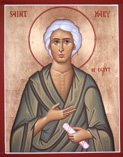 The recorder of the life of this wonderful saint was St. Sophronios,
Patriarch of Jerusalem. A hieromonk, the elder Zosimas, had gone off at one time during the Great
Fast a twenty-days’ walk into the wilderness across the Jordan. He suddenly caught sight of
a human being with a withered and naked body and with hair as white as snow, who fled in its
nakedness from Zosimas’ sight. The elder ran a long way, until this figure stopped at a
stream and called: ‘Father Zosimas, forgive me for the Lord’s sake. I cannot turn
round to you, for I am a naked woman.’ Then Zosimas threw her his outer cloak, and she
wrapped herself in it and turned round to him. The elder was amazed at hearing his name from the
lips of this unknown woman. After considerable pressure on his part, she told him her life-story.
She had been born in Egypt, and from the age of twelve had lived a life enjoying the pleasures of
the flesh whenever she could, spending seventeen years in this way of life in Alexandria. Urged
by the lustful fire of the flesh, she one day got into a ship that was sailing for Jerusalem.
Arriving at the holy city, she made to go into the church to venerate the Precious Cross during
the Elevation of the Holy Cross, but some unseen power prevented her from entering. In great
fear, she turned to an icon of the Mother of God that was in the entrance, and begged her to let
her go in and venerate the Cross, confessing her sin and impurity and promising that she would
then go wherever the Panagia led her. She was then allowed to enter the church. After venerating
the Cross, she went out again to the entrance, and standing in front of the icon, thanked the
Mother of God. Then she heard a voice: ‘If you cross the Jordan, you will find true
peace.’ She immediately bought three loaves of bread and set off for the Jordan, arriving
there the same evening. She received Communion the following morning in the monastery of St.
John, and then crossed the river. She spent forty-eight whole years in the wilderness in the
greatest torments, in terror, in struggles with passionate thoughts like gigantic beasts. She fed
only on herbs and what could be found in the desert. After that, when she was standing in prayer,
Zosimas saw her lifted up in the air. She begged him to bring her Communion the next year on the
bank of the Jordan, and she would come to receive it. The following year, Zosimas came with the
Holy Gifts to the bank of the Jordan in the evening, and stood in amazement as he saw her cross
the river. He saw her coming in the moonlight, and arriving on the further bank, make the sign of
the Cross over the river. She then walked across it as though it were dry land. When she had
received Communion, she begged him to come again the following year to the same place where they
had first met. Zosimas went, and found her dead body there on that spot. Above her head in the
sand was written: ‘Abba Zosimas, bury in this place the body of the humble Mary. Give dust
to dust. I passed away on April 1st, on the very night of Christ’s Passion, after having
partaken of the divine Mysteries.’ Zosimas learned her name for the first time, and also
the awe inspiring marvel that she had arrived at that stream the previous year on the night of
the same day on which she had received Communion—a place that he had taken twenty days to reach.
And thus Zosimas buried the body of the wonderful saint, Mary of Egypt. When he returned to the
monastery, he recounted the whole story of her life and the wonders to which he had been an
eyewitness. Thus the Lord glorifies repentant sinners. St. Mary is also commemorated in the Fifth
Week of the Great Fast. The Church holds her up before the faithful in these days of the Fast as
a model of repentance. She entered into rest in 522.
2. Our Holy Father Procopius the Czech.
Born in Hotish, Czechoslovakia, of eminent parents, he became a priest and went off into the mountains to live after the example of the Eastern hermits. Herzog Ulrich came across him by chance and helped him to found the monastery of St. John the Forerunner by the River Sazava. This holy man entered into rest in 1053.
FOR CONSIDERATION
Why is so much said and written about the sufferings of holy men and women? Because these saints are counted as victors—and how can there be victory without struggle, pain and suffering? In ordinary, earthly warfare no man is reckoned as victorious and heroic who has never been in battle, who has not endured and suffered to a very considerable extent. All the more is this so in spiritual warfare, where the truth is clear and where self-assertion is not only of no use but is a real hindrance. He who knows no struggle for the sake of Christ, either with the world or with the devil or with his own self—how can he be counted among Christ’s soldiers? How, indeed, among Christ’s fellow-victors? St. Mary spoke of this gigantic struggle to the elder Zosimas: ‘For the first seventeen years in this wilderness, I struggled with my mindless passions as with fierce beasts. I wanted to eat meat and fish, which I had eaten abundantly in Egypt. I wanted to drink wine, and did not even have water here. I wanted to hear lustful songs. And I wept and smote my breast. I prayed to the most pure Mother of God to remove these thoughts from me. When I had wept and smote my breast for a long time, I then saw a light that flooded over me from all sides, and was filled with a wonderful peace.’
Daily Scripture Readings taken from The Orthodox New Testament, translated and published by Holy Apostles Convent, Buena Vista, Colorado, copyright © 2000, used with permission, all rights reserved.
Daily Prologue Readings taken from The Prologue of Ochrid, by Bishop Nikolai Velimirovic, translated by Mother Maria, published by Lazarica Press, Birmingham, England, copyright © 1985, all rights reserved. Edited by Dormition Skete.