

Daily Devotional
Sunday, April 8, 2035 (NS), March 26, 2035 (OS)
Fast Day, but Shellfish, Wine and Olive Oil Allowed.
Holy & Great Fast
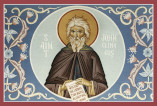
| The Fourth Sunday of the Great Fast, in which we Commemorate St. John Climacus (Of the Ladder). Mode Four — First Eothinon |
The commemoration of the Leave-taking of the Annunciation, and the Synaxis of the Archangel Gabriel.
Scripture Readings
Paschalion — Movable Calendar
The Fourth Sunday of the Great Fast, in which we Commemorate St. John Climacus (Of the Ladder).
Mode Four — First Eothinon
Epistle
The Reading is from the Epistle of Saint Paul to the Hebrews [§ 314]. Brethren:
6 13God, having made a promise to Abraham, since He had no one greater to swear by, swore by Himself, 14saying, “Surely blessing I will bless thee, and multiplying I will multiply thee [cf. Gen. 22:17].” 15And thus, after he patiently endured, he attained the promise. 16For men indeed swear by the greater, and the oath for confirmation is to them an end of all contradiction. 17Wherein God, willing more abundantly to show to the heirs of the promise the immutability of His counsel, mediated by an oath, 18that by two immutable things, in which it was impossible for God to lie, we may have a strong consolation, who have fled for refuge to lay hold of the hope set before us, 19which we have as an anchor of the soul, both sure and firm, and which entereth into “the inner space behind the veil [Lev. 16:2, 12, 15],” 20where Jesus entered as a forerunner on our behalf, having become a high priest forever according to the order of Melchisedek.
COMMEMORATION OF SAINT JOHN OF THE LADDER
The Reading is from the Epistle of Saint Paul to the Ephesians [§ 229]. Brethren:
5 8Be walking as children of light— 9for the fruit of the Spirit is in all goodness and righteousness and truth— 10proving what is well-pleasing to the Lord. 11And cease having fellowship with the unfruitful works of darkness, but rather even reprove them. 12For it is shameful even to speak of the things which are done by them in secret. 13But all things which are reproved are made manifest by the light; for all which is made manifest is light. 14Wherefore, He saith, “Rouse thyself, thou who sleepest, and arise from the dead, and the Christ shall shine on thee [cf. Is. 9:2, 26:19, 52:1, 60:1, 2].”
15Be taking heed then how exactly ye walk, not as unwise ones, but as wise ones, 16redeeming the time, because the days are evil. 17On this account cease becoming foolish, but become as ones understanding what the will of the Lord is. 18And cease being drunk with wine, in which is prodigality, but keep on being filled with the Spirit, 19speaking to one another in psalms and hymns and spiritual songs, singing and chanting in your heart to the Lord.
Gospel
The Reading is from the Holy Gospel according to Saint Mark [§ 40]. At that time:
9 17A certain man came to Jesus, falling on his knees before Him and saying, “Teacher, I brought to Thee my son who hath a dumb spirit. 18“And wheresoever it overtaketh him, it rendeth him; and he foameth and gnasheth his teeth, and is withering away. And I spoke to Thy disciples that they should cast it out, and they did not have the strength.” 19And He answereth and saith, “O unbelieving generation, until when shall I be with you? Until when shall I bear with you? Bring him to Me.” 20And they brought him to Him. And having seen Him, straightway the spirit convulsed him, and he fell on the ground and was rolling about foaming. 21And He asked his father, “How long a time is it since this hath happened to him?” And he said, “From childhood. 22“And ofttimes it casteth him both into fire and into water, in order that it might destroy him. But if Thou art able to do anything, have compassion upon us and help us.” 23And Jesus said to him, “As to the ‘if Thou art able,’ if thou art able to believe, all things can be to the one who believeth.” 24And straightway the father of the little child cried out with tears and was saying, “I believe, O Lord; help Thou mine unbelief.” 25And after Jesus saw that a crowd was running together, He rebuked the spirit, the unclean one, saying to it, “Thou dumb and deaf spirit, I command thee, come out of him, and enter no more into him.” 26And the spirit cried out and convulsed him much, and came out. And he became as if he were one dead, insomuch that many said, “He died.” 27But Jesus took hold of his hand and raised him up, and he arose. 28And after He entered into a house, His disciples were questioning Him privately, “Why were we not able to cast it out?” 29And He said to them, “This kind can come forth by nothing, except by prayer and fasting.”
30And having gone forth from that place, they were passing by through Galilee, and He was not willing that anyone should know it. 31For He was teaching His disciples and was saying to them, “The Son of Man is being delivered into the hands of men, and they shall kill Him; and having been killed, He shall raise Himself the third day.”
Commemoration of Saint John of the Ladder
The Reading is from the Holy Gospel according to Saint Matthew [§ 10]. At that time:
For Gk. usage, see Mt. 4:23-5:13; for Sl. usage, see Mt.4:25-5:13.
4 23Jesus was going around all Galilee, teaching in their synagogues, and proclaiming the Gospel of the kingdom, and curing every disease and every sickness among the people. 24And the report of Him went out into all Syria. And they brought to Him all those who were ill, constrained by various diseases and torments, and possessed by demons, and lunatics, and paralytics; and He cured them. 25And great crowds followed Him from Galilee, and Decapolis, and Jerusalem, and Judæa, and beyond the Jordan.
5 1And seeing the crowds, He went up into the
mountain; and after He sat down, His disciples came to Him. 2And He opened His mouth
and began to teach them, saying:
3“Blessed are the poor in spirit, for theirs is the
kingdom of the heavens.
4“Blessed are they who mourn, for they shall be
comforted.
5“Blessed are the meek, for they shall inherit the
earth.
6“Blessed are they who hunger and thirst after
righteousness, for they shall be filled.
7“Blessed are the merciful, for they shall find mercy.
8“Blessed are the pure in heart, for they shall see
God.
9“Blessed are the peacemakers, for they shall be
called sons of God.
10“Blessed are they who have been persecuted on
account of righteousness, for theirs is the kingdom of the heavens.
11“Blessed are ye whenever they reproach you and persecute
you, and say every evil word against you falsely on account of Me.
12“Be rejoicing and be exceedingly glad, for your reward
is great in the heavens. For so they persecuted the prophets who were before
you.
13“Ye are the salt of the earth; but if the salt should become insipid, with what shall it be salted? For it is no longer good for anything, except to be cast out and to be trampled underfoot by men.”
Menaion — Fixed Calendar
The commemoration of the Leave-taking of the Annunciation, and the Synaxis of the Archangel Gabriel.
Epistle
The Reading is from the Epistle of Saint Paul to the Hebrews [§ 305]. Brethren:
2 2If the word spoken by angels was confirmed, and every transgression and disobedience received a just recompense, 3how shall we escape, if we neglect so great a salvation, which received a beginning to be spoken of by the Lord, and was confirmed to us by those who heard, 4God also bearing them witness with both signs and wonders, and various works of power, and by distributions of the Holy Spirit, according to His will?
5For not to angels did He subject the coming inhabited world about which we speak; 6but one bore witness somewhere, saying, “What is man that Thou art mindful of him or the Son of Man that Thou visitest Him [Ps. 8:4]? 7“Thou didst make Him for a short time less than the angels; Thou didst crown Him with glory and honor [Ps. 8:5], 8“Thou didst subject all things under His feet [Ps. 8:6].” For in subjecting all things to Him, He left nothing not subject to Him. But now we see not yet all things subjected to Him. 9But we see Jesus, Who for a short time was made less than the angels on account of the suffering of death, crowned with glory and honor, so that He, by the grace of God, should taste death for everyone. 10For it was becoming to Him, because of Whom are all things and by means of Whom are all things, bringing many sons to glory, to have perfected the originator of their salvation through sufferings.
Gospel
The Reading is from the Holy Gospel according to Saint Luke [§ 51]. The Lord said to His disciples:
10 16“The one who heareth you heareth Me, and the one who rejecteth you rejecteth Me, and the one who rejecteth Me rejecteth the One Who sent Me forth.”
17And the seventy returned with joy, saying, “Lord, even the demons are being made subject to us in Thy name.” 18And He said to them, “I was beholding Satan as lightning having fallen out of the heaven. 19“Behold, I give you the authority to tread upon serpents and scorpions, and upon all the power of the enemy; and nothing in anywise shall injure you. 20“However cease rejoicing in this, that the spirits are being made subject to you; but be rejoicing that your names were written in the heavens.” 21In the same hour Jesus rejoiced in the Spirit, and said, “I give thanks to Thee, O Father, Lord of the heaven and of the earth, that Thou didst hide these things from the wise and intelligent, and didst reveal them to babes. Yea, Father, for thus it was well-pleasing before Thee.”
Synaxarion Readings
The Fourth Sunday of Great Lent: St. John Climacus
On this day, the fourth Sunday of Great Lent, we commemorate our venerable father among the saints, St. John of Sinai, the author of The Ladder of Divine Ascent.
No one knows the birthplace or parentage of our venerable Father John of Sinai. In his youth, at the age of sixteen, he came to the wilderness of Sinai and dwelt under the guidance of Abba Martyrius. When Abba Martyrius tonsured our venerable Father John at the age of twenty, he took him and went to that pillar of the wilderness, Abba John the Sabbaite in the wilderness of Gouda where he had with him his disciple Stephen the Cappadocian. When the Sabbaite elder saw them, he arose and took water, poured it into a small basin, washed the feet of the disciple (the young John) and kissed his hand; but did not wash the feet of Abba Martyrius his superior. Abba Stephen was scandalized by the situation. After the departure of Abba Martyrius and his disciple, the Elder John noticed that his own disciple was greatly perplexed and said to him, “Why are you so troubled? Believe me, I do not know who the boy is, but today I received the abbot of Sinai and washed his feet.” And after forty years, he did indeed become the abbot according to the prophecy of the elder.
After the passing of his spiritual father, St. John continued alone in the wilderness in a cave in the Wadi Thola. He traveled from time to time, going at least once as far as Alexandria. He records in The Ladder his visit to a large monastic community there and marvels of repentance, obedience, and humility which he observed. In his humility, he counted our venerable father George the Wonderworker of Arselaou as his master. In all, he spent some forty years in solitude and stillness. He guided the monks who dwelt in that desert since he was a most excellent and nurturing spiritual father—for in those days there were innumerable ascetics living in cells all through the mountains and valleys of Sinai. From time to time, he received visitors from farther away. At one point, some other monks, prompted to jealously by the adversary who hates all good, complained of St. John’s fame and loquacious words of teaching. In response, he humbly kept strict silence for over a year, until the same fathers who had complained came, asking him to speak once again for the benefit of all.
After he had spent forty years in the wilderness, the monks of Sinai asked him to become abbot of the great monastery built by the emperor Justinian beside the Burning Bush of Moses, the holy Monastery of St. Catherine. In obedience to the fathers, he left his blessed solitude to take up the responsibilities of abbot. It is told that on the very day on which he assumed the office of abbot, there came a group of about six hundred pilgrims. When they were seated, our venerable Father John saw someone in the crowd with short hair and wearing a Jewish tunic. This person was going about like someone with authority, directing the cooks, the stewards, the storekeepers, and other workers. After the people left, when the servers all sat down to eat, they sought everywhere for the one who had been going about supervising but did not find him. Then the servant of God, our venerable Father John, said, “Do not marvel. The lord Moses did nothing strange in this same place where he served before and which belongs to him.” Behold the wonder! It had been the holy Prophet and Lawgiver Moses who had served the guests.
At the request of Abba John, abbot of Raitho near the shore of the Red Sea, our venerable father wrote his wonderful book, The Ladder of Divine Ascent, in which he sets out the whole of Christian life as a divine ascent of thirty rungs to Christ. This book has been a treasure, a pearl beyond price, to this day. It is useful not only to monastics but to all devout Christians.... St. John was true physician of souls and had great spiritual insight into men’s behavior. He made detailed observations of the symptoms of men’s sin-sick souls, diagnosed their spiritual diseases, and prescribed the appropriate medicine for their recovery and salvation. He showed how one can ascend the “ladder of the virtues” step by step and reach the Promised Land, fleeing the Egypt of the passions. Yet, his success was due only to his own life of constant watchfulness, fasting, vigil, and prayers.
The monastic community he shepherded continues to this day beside the Burning Bush, and his teachings guide and direct monastics throughout the world. During Great Lent, The Ladder is read aloud in monasteries during meals so the monastics may receive his edifying spiritual counsels for their soul’s sustenance, as they simultaneously receive physical nourishment for their bodies.
Today the cave in which he dwelt in the wilderness of Sinai can still be seen, but his resting place is unknown except to the angels. He fell asleep in the Lord in the seventh century. St. John is also commemorated on March 30, the day of his repose.
[From the “Synaxarion of the Lenten Triodion and Pentecostarion.”, HDM Press.]
Lives of the Saints (Prologue)
April 8th – Civil Calendar
March 26th – Church Calendar
1. The Holy Archangel Gabriel.
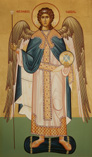 The herald of the incarnation of the Son of God, he is one of the seven
great archangels who stand before the throne of God. The names of these seven are: Michael,
Gabriel, Raphael, Uriel, Salathiel, Jegudiel and Barachiel (and to these is sometimes added an
eighth, Jeremiel). Each has his own particular service, but all are equal in honor. Archangel
Gabriel revealed to Zacharias the birth of the Forerunner, and said of himself: ‘I am
Gabriel that stand in the presence of God’ (Lk. 1:19). His name, Gabriel, signifies
‘man of God’. Speaking about the Annunciation, the holy fathers comment that an angel
with such a name was sent to signify Who He was, and of what nature He was, Who would be born of
the most pure Virgin. He would be the Man of God, the God-Man, the strong and mighty God. Others
have found that it was this same Gabriel who announced the conception of the Virgin Mary to
Joachim and Anna, and that it was he who taught Moses in the wilderness to write the Book of
Genesis. Why did God not send Michael? For the reason that Michael’s service is the
suppression of the enemies of God’s truth, while Gabriel’s is the annunciation of the
salvation of the human race.
2. The Hieromartyr Irenaeus, Bishop of Sirmium (Srem).
It is thought that he was a Slav, and was married and had children before becoming a bishop. He suffered for Christ in the time of Maximian, under Probus, the governor. His kinsmen stood around him during his frightful sufferings, beseeching him with tears to spare himself and them; in other words, to renounce Christ. But this glorious hieromartyr preferred the wounds he received for Christ to all the good things of this world. A certain gardener in Sirmium, Seren, also suffered at this time under Probus, and also one Afrius in Regia. Since Irenaeus would not renounce his faith, Probus commanded that he be thrown from a bridge into the River Sava, where this pastor of Christ’s flock died and took his place among the citizens of heaven. He suffered with honor in 304.
3. Our Holy Father Malchus, the disobedient monk.
Malchus was an agricultural worker in the neighborhood of Antioch, and from his youth his whole spirit was directed towards God. He became a monk, but it happened one time that he disobeyed his spiritual father by deciding to return to his homeland in order to convert his family. While traveling in a caravan, they were attacked by marauders, and the Arabs took him for a slave. While he was in slavery they forced him to take a negress to wife. However, he brought her to the Christian Faith and lived with her as a brother with his sister. They conspired together and escaped from slavery, but the Arabs nearly recaptured them. They hid in a cave in which they saw a lioness with her cubs, and were very greatly afraid. But God preserved them; the lioness did not harm them but killed an Arab who tried to enter the cave and seize the runaways. Reaching his home country, Malchus gave his wife to a women’s monastery and went himself to a men’s monastery. He lived for many years, exercising himself in asceticism, and took his place among the inhabitants of heaven in the fourth century.
FOR CONSIDERATION
When a miracle occurs, may it cause you joy rather than embarrassment. God has put His finger there, sometimes to reward, sometimes to punish, sometimes to encourage His faithful people and sometimes to lead sinners into the way of salvation.
When you see a locomotive, or some other similar steam engine, you know that there is a driver hidden somewhere inside. And there is nothing strange, is there, in the driver’s making his presence known by putting his head out of the cab or waving his arm, fluttering his handkerchief, throwing something out or making some other sign? You know that none of these things interfere with the functioning of the locomotive or damage the smallest screw in it. Why, then, do the faithless say that God interferes with the functioning of earthly machines by His wonders? Because they are dull-witted. But the faithful rejoice at God’s signs like children who stand transfixed at the sight of a locomotive, who are delighted when the driver—a man like themselves—sticks out of the cab. Oh, what a delight it is to us when, out of this inarticulate universe that roars around us, someone like us pops up, and that someone a Being Who knows us and loves us. When a miracle occurs, know that One like us greets us and says: ‘Don’t be afraid; I am behind all this.’ St. Basil the New performed many miracles. He healed sicknesses by his prayers and read men’s destinies like an open book. Through the man pleasing to Him, as always, God demonstrated His love and power towards men, that the faithful might be the more strongly confirmed in their faith, and the faithless put to shame and brought to faith.
Daily Scripture Readings taken from The Orthodox New Testament, translated and published by Holy Apostles Convent, Buena Vista, Colorado, copyright © 2000, used with permission, all rights reserved.
Daily Prologue Readings taken from The Prologue of Ochrid, by Bishop Nikolai Velimirovic, translated by Mother Maria, published by Lazarica Press, Birmingham, England, copyright © 1985, all rights reserved. Edited by Dormition Skete.