

Daily Devotional
Saturday, March 31, 2035 (NS), March 18, 2035 (OS)
Fast Day, but Shellfish, Wine and Olive Oil Allowed.
Holy & Great Fast
The Saturday of the Third Week of the Great Fast
The commemoration of our holy father among the saints, Kyril, Archbishop of Jerusalem.
Scripture Readings
Paschalion — Movable Calendar
The Saturday of the Third Week of the Great Fast
Epistle
The Reading is from the Epistle of Saint Paul to the Hebrews [§ 325]. Brethren:
10 32Remind yourselves of the former days in which, after ye were illuminated, ye endured a great contest of sufferings: 33partly, being made a show of both by reproaches and affliction; and partly, having become partners of those who conducted themselves thus. 34For ye also sympathized with those in bonds and ye yourselves accepted the seizure of your possessions with joy, knowing in yourselves that ye have in the heavens a better and abiding possession. 35Do not begin therefore to cast away your boldness which hath great recompense. 36For ye have need of patience, that, after ye do the will of God, ye might receive for yourselves the promise. 37“For yet a very little while, the One Who cometh will come, and will not delay [cf. Hab. 2:3]. 38“Now the just shall live by faith; and if one should draw himself back, My soul hath no pleasure in him [cf. Hab. 2:4].”
Another Reading for Saturday of the Third Week of the Great Fast in Commemoration of the Departed
The Reading is from the First Epistle of Saint Paul to the Thessalonians [§ 270].
4 13Brethren, we do not wish you to be ignorant concerning those who have fallen asleep, that ye may not be grieving, even as the rest who have no hope. 14For if we believe that Jesus died and is risen, so also those who fell asleep through Jesus will God bring with Him. 15For we say this to you by the word of the Lord, that we the living, the ones remaining over until the coming of the Lord, in no wise shall precede those who fell asleep. 16For the Lord Himself shall descend from heaven with a shout of command, with a voice of an archangel, and with a trumpet of God; and the dead in Christ shall rise first. 17Then we the living, the ones remaining over, shall be carried off together with them in clouds to a meeting of the Lord in the air, and so shall we always be with the Lord.
Gospel
The Reading is from the Holy Gospel according to Saint Mark [§ 8]. At that time:
2 14As Jesus passed by, He saw Levi, the son of Alphæos, sitting at the custom-house, and saith to him, “Follow thou Me.” And he rose up and followed Him. 15And it came to pass, as He was reclining at table in his house, many tax collectors and sinners also were reclining together at table with Jesus and His disciples; for there were many, and they followed Him. 16And after the scribes and the Pharisees saw Him eating with the tax collectors and sinners, they were saying to His disciples, “Why is it that He eateth and drinketh with the tax collectors and sinners?” 17And Jesus, having heard it, saith to them, “They who are strong have no need of a physician, but they who are ill; I came not to call the righteous, but sinners to repentance.”
Commemoration of the Departed
The Reading is from the Holy Gospel according to Saint John [§ 16]. The Lord said to the Jews who had come to Him:
5 24“Verily, verily, I say to you, that the one who heareth My word and believeth the One Who sent Me hath everlasting life, and cometh not into judgment, but hath passed over out of death into life. 25“Verily, verily, I say to you, that an hour cometh, and now is, when the dead shall hear the voice of the Son of God, and they who hear shall live. 26“For even as the Father hath life in Himself, so He also gave to the Son to have life in Himself, 27“and He also gave to Him authority to execute judgment. That He is Son of Man, 28“cease marvelling at this; for an hour is coming in which all those in the graves shall hear His voice, 29“and shall go forth—they who did good things to a resurrection of life, but they who practised bad things to a resurrection of condemnation. 30“I am not able to do anything of Myself. Even as I hear, I judge; and My judgment is just, because I seek not Mine own will, but the will of the One Who sent Me, the Father.”
Menaion — Fixed Calendar
The commemoration of our holy father among the saints, Kyril, Archbishop of Jerusalem.
Epistle
The Reading is from the Epistle of Saint Paul to the Hebrews [§ 334]. Brethren:
13 7Be remembering those who lead you, who spoke to you the word of God, whose faith keep on imitating, observing attentively the end of their conduct: 8Jesus Christ, the same yesterday and today and to the ages. 9Cease being carried about by various and strange teachings. For it is good for the heart to be confirmed by grace, not by foods, in which those walking therein were not profited. 10We have an altar from which those serving the tabernacle have no authority to eat; 11for the bodies of those animals, “whose blood is being brought into the holies for sins” by the high priest, “are being burned outside of the encampment [cf. Lev. 16:27].” 12Wherefore Jesus also, that He might sanctify the people by His own blood, suffered outside of the gate. 13Let us be going forth therefore to Him outside of the encampment, bearing His reproach; 14for we have no abiding city here, but we seek the coming one. 15Through Him, then, let us be offering up a “sacrifice of praise [Lev. 7:2(12)]” continually to God, that is, “the fruit of the lips [cf. Hos. 14:3(2); Is. 57:19],” giving thanks to His name. 16But cease being forgetful of doing good and of contributing; for God is well pleased with such sacrifices.
Gospel
The Reading is from the Holy Gospel according to Saint Matthew [§ 11]. The Lord said to His disciples:
5 14“Ye are the light of the world. A city situated on the top of a mountain cannot be hid. 15“Nor do they light a lamp and put it under the bushel, but upon the lampstand, and it giveth light to all those in the house. 16“Thus, let your light shine before men, that they might see your good works, and might glorify your Father Who is in the heavens.
17“Do not begin to think that I came to abolish the law or the prophets; I came not to abolish, but to fulfill. 18“For verily I say to you, until the heaven and the earth shall have passed away, one iota or one tittle in no wise shall pass away from the law, until all shall have taken place. 19“Whosoever then shall break one of the least of these commandments, and shall teach men so, he shall be called least in the kingdom of the heavens; but whosoever shall do and teach them, this one shall be called great in the kingdom of the heavens.”
Lives of the Saints (Prologue)
March 31st – Civil Calendar
March 18th – Church Calendar
1. St. Kyril, Archbishop of Jerusalem.
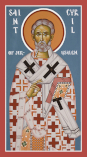 Born in Jerusalem in the time of Constantine the
Great, he died in 386, in the time of Theodosios the Great. He was ordained priest in 346, and in
350 succeeded the blessed Patriarch Maximus on the patriarchal throne of Jerusalem. He was three
times deposed from his throne and sent into exile; until in the end, in the time of Theodosios,
he did not return but lived a further eight years in peace and gave his soul to the Lord. He had
two great struggles: one against the Arians, who became strong under Constantius,
Constantine’s son, and the other in the time of Julian the Apostate, with this renegade and
with the Jews. In a time of Arian domination, at Pentecost, the sign of the Cross, brighter than
the sun, appeared stretching over Jerusalem and the Mount of Olives and remained for several
days. A letter was sent to the Emperor Constans about this happening, which was seen by all
living in Jerusalem, and this served for the strengthening of Orthodoxy against the heretics. In
the time of the Apostate, another sign took place. In order to humiliate the Christians, Julian
arranged with the Jews for them to rebuild the Temple of Solomon. Kyril prayed to God that this
should not happen. And there was a terrible earthquake which destroyed all that had been
newly-built. The Jews began again, but again there was an earthquake, which destroyed not only
the new building but also the old stones that were still in place beneath the earth. And so the
words of the Lord came true: ‘Not one stone shall remain on another.’ Of this
saint’s many writings there has been kept his ‘Catecheses,’ a first-class work,
which sets out the Faith and practice of Orthodoxy to the present day. A rare arch-pastor and a
great ascetic, he was meek, humble, worn out by fasting and pale of face. After a life of great
labor and knightly battle for the Orthodox Faith, he entered peacefully into rest and went to the
eternal courts of the Lord.
2. St. Aninus the Wonder-worker.
Born in Chalcedon, he was little of stature, like Zaccheus, but great in spirit and faith. He denied himself to the world at the age of fifteen and settled near the River Euphrates in a little hut, where he repented for his sins and prayed to God, at first with his teacher Mayum and then, after Mayum’s death, alone. By the power of his prayers he filled an empty well with water, healed the sick of various pains and tamed wild beasts. There was a tamed lion with him as his servant. He had insight into distant happenings. When robbers attacked a stylite, Pionius, at some distance from him, and beat him up to such an extent that he decided to come down from his pillar and go to complain to the judges, St. Aninus saw his intention in his soul and sent him a letter by means of his lion, telling him to set aside his intention, to forgive his assaulters and to continue in his asceticism. He was inexpressibly generous. The bishop of Neocaesarea made a gift to him of a donkey, to ease his carrying of water from the river, but he gave this donkey to some poor man who had complained to him of his poverty. The bishop gave him a second donkey, but he gave that away, too. Then the bishop gave him a third donkey, not for his own but only to serve as a water-carrier, to be kept and returned. At the time of his death, he saw Moses, Aaron and Or coming to him and calling: ‘Aninus, the Lord is calling you. Get up and come with us.’ This he revealed to his disciples, and gave his spirit to the Lord Whom he had served so faithfully. He was 110 years old when he finished his earthly course.
FOR CONSIDERATION
There are malicious people who think that time has brought Christ glorification, and that in the first ages of Christianity the Lord was not thought of so highly as in later ages. There is nothing easier than to shatter this untruth. Here is how St. Kyril of Jerusalem writes of the Lord Christ: ‘This is He Who is and He Who was, coessential with the Father, only-begotten, only-enthroned, equal in power, almighty, without beginning, uncreated, unchangeable, indescribable, invisible, inexpressible, incomprehensible, immense, unthinkable, uncircumscribed. He is “the brightness of the glory of the Father” (Heb. 1:3). He is the Creator of the substance of all created things. He—the Light of light—shines from the bosom of the Father. He is the God of gods (Ps. 49:1), and God of God, Who gives us the knowledge of Himself. He is the Well of life (Ps. 35:10), flowing forth from the Father’s well of life. He is the River of God (Ps. 45:5; 64:10), which comes forth from the infinity of God but is not separated from Him. He is the treasury of the Father’s good gifts and endless blessings. He is the living Water (Jn. 4:14) that gives life to the world. He is the uncreated Ray that is begotten but not cut off from the primal Sun. He is God the Logos (Jn. 1:1), Who with one word brought all things from non-being into being.... This is He Who created us in the image of God, and has now made Himself man in our image; man, but at the same time God.’ And today, sixteen centuries after this confession of faith was written, the Orthodox Church holds the same faith, word for word and letter for letter.
Daily Scripture Readings taken from The Orthodox New Testament, translated and published by Holy Apostles Convent, Buena Vista, Colorado, copyright © 2000, used with permission, all rights reserved.
Daily Prologue Readings taken from The Prologue of Ochrid, by Bishop Nikolai Velimirovic, translated by Mother Maria, published by Lazarica Press, Birmingham, England, copyright © 1985, all rights reserved. Edited by Dormition Skete.