

Daily Devotional
Saturday, March 17, 2035 (NS), March 4, 2035 (OS)
Fast Day, but Shellfish, Wine and Olive Oil Allowed.
Holy & Great Fast
The Saturday of the First Week of the Great Fast
The commemoration of our venerable Father Gerasimos of the Jordan, and our venerable father, the right-believing great Prince Daniel Alexandrovich of Moscow.
Scripture Readings
Paschalion — Movable Calendar
The Saturday of the First Week of the Great Fast
Epistle
The Reading is from the Epistle of Saint Paul to the Hebrews [§ 303]. Brethren:
1 1God, Who of old, in many parts and in many ways, spoke to the fathers through the prophets, 2did in these last of days speak to us through the Son, Whom He appointed heir of all things, by Whom also He made the ages, 3Who being the effulgence of the glory and impress of His hypostasis, and bearing all things by the word of His power, having made for Himself our purification through Himself, sat down on the right of the Majesty in high places, 4having become so much better than the angels, as He hath inherited a more excellent name than they. 5For to which of the angels said He at any time, “Thou art My Son, today I have begotten Thee [Ps. 2:7]”? And again, “I will be to Him for a Father, and He shall be to Me for a Son [2 Kgs.(2 Sam.) 7:14]”? 6And whenever He again should bring in the firstborn into the inhabited world, He saith, “And let all the angels of God do homage to Him [Deut. 32:43 LXX; cf. Ps. 96(97):8(7)].” 7And indeed with reference to the angels He saith, “The One Who maketh His angels spirits, and His ministers a flame of fire [Ps. 103(104):5(4)]”; 8but with reference to the Son, “Thy throne, O God, is forever and ever; a scepter of uprightness is the scepter of Thy kingdom [Ps. 44(45):5(6)]. 9“Thou didst love righteousness and didst hate lawlessness; on this account, God, Thy God, anointed Thee with the oil of gladness beyond Thy fellows [Ps. 44(45):6(7)].” 10And, “Thou, O Lord, in the beginning founded the earth, and the heavens are the works of Thy hands [Ps. 101(102):25]. 11“They shall perish, but Thou remainest; and they shall all become old as an outer garment [Ps. 101(102):26], 12“and as a covering Thou shalt roll them up, and they shall be changed. But Thou art the same, and Thy years shall not fail [Ps. 101(102):26, 27].”
Another Reading for Saturday of the First Week of the Great Fast in Commemoration of Saint Theodore
The Reading is from the Second Epistle of Saint Paul to Saint Timothy [§ 292]. Child Timothy:
2 1Be thou empowered in the grace that is in Christ Jesus; 2and the things which thou heardest from me in the midst of many witnesses, commit thou these things to faithful men who shall be competent also to teach others. 3Thou therefore suffer hardship as a good soldier of Jesus Christ. 4No one serving as a soldier is entangled with the affairs of life, in order that he might please the one who enlisted him. 5And if anyone also contend as an athlete in the games, he is not crowned unless he contend lawfully. 6The farmer who laboreth must be first to partake of the fruits. 7Be considering what I say; O may the Lord give thee understanding in all things! 8Be remembering Jesus Christ, of the seed of David, Who hath been raised from the dead, according to my Gospel, 9in which I suffer hardship even to bonds as a malefactor, but the word of God hath not been bound. 10On this account I endure all things for the sake of the elect, that they might also attain salvation that is in Christ Jesus with eternal glory.
Gospel
The Reading is from the Holy Gospel according to Saint Mark [§ 10]. At that time:
2 23During the sabbath days Jesus was going along through the sown fields; and His disciples began to make their way plucking the ears of grain. 24And the Pharisees were saying to Him, “Behold, why do they that which is not lawful on the sabbath days?” 25And He was saying to them, “Did ye not ever read what David did when he had need and hungered, he and those with him: 26“how he entered into the house of God in the time of Abiathar the high priest, and ate the loaves set forth before the presence of God, which it is not lawful to eat, except for the priests, and gave also to those who were with him?” 27And He was saying to them, “The sabbath was made for man, not man for the sabbath. 28“Therefore the Son of Man is Lord also of the sabbath.”
3 1And He entered again into the synagogue; and a man was there whose hand had been withered. 2And they were watching Him closely, whether He would cure him on the sabbath, in order that they might accuse Him. 3And He saith to the man who had the withered hand, “Arise and stand in the midst.” 4And He saith to them, “Is it lawful on the sabbath days to do good or to do evil, to save life or to kill?” But they were silent. 5And having looked round about on them with wrath, being grieved for the hardness of their heart, He saith to the man, “Stretch forth thy hand.” And he stretched it forth, and his hand was restored sound as the other.
Commemoration of Saint Theodore
The Reading is from the Holy Gospel according to Saint John [§ 52]. The Lord said to His disciples:
15 17“These things I command you, that ye be loving one another.
18“If the world hate you, ye know that it hath hated Me before it hath hated you. 19“If ye were of the world, the world would love its own; but because ye are not of the world—but I chose you for Myself out of the world—therefore the world hateth you. 20“Keep on remembering the word which I said to you, ‘A slave is not greater than his lord.’ If they persecuted Me, they will also persecute you; if they kept My word, they will keep yours also. 21“But all these things they will do to you for My name’s sake, because they know not the One Who sent Me. 22“If I had not come and spoken to them, they would not have sin, but now they have no pretext for their sin. 23“The one who hateth Me hateth My Father also. 24“If I did not do the works among them which no other one hath done, they would not have sin; but now they have both seen and hated both Me and My Father. 25“But this cometh to pass that the word might be fulfilled which hath been written in their law: ‘They hated Me without a cause [cf. Ps. 34(35):22, 68(69):5(4)].’ 26“But whenever the Paraclete should come, Whom I shall send to you from the Father, the Spirit of the truth Who proceedeth from the Father, that One shall bear witness concerning Me. 27“And ye also are bearing witness, because ye have been with Me from the beginning.
16 1“These things I have spoken to you, in order that ye should not be made to stumble. 2“They shall put you out of the synagogues; yea moreover, there cometh an hour that everyone who killeth you should think that he offereth God a service.”
Menaion — Fixed Calendar
The commemoration of our venerable Father Gerasimos of the Jordan, and our venerable father, the right-believing great Prince Daniel Alexandrovich of Moscow.
Epistle
For the blessed Prince:
The Reading is from the Epistle of Saint Paul to the Galatians [§ 213]. Brethren:
5 22The fruit of the Spirit is love, joy, peace, long-suffering, kindness, goodness, faith, 23meekness, self-control; against such things there is no law. 24But they who are of the Christ crucified the flesh with the passions and the lusts. 25If we live by the Spirit, let us also be walking by the Spirit. 26Let us not become vainglorious, provoking one another, envying one another.
6 1Brethren, even if a man should be overtaken in some transgression, ye, the spiritual ones, be restoring such a one in the spirit of meekness, looking out for thyself, lest thou also be tempted. 2Keep on bearing one another’s burdens, and thus fill up the law of the Christ.
Gospel
For the blessed Prince:
The Reading is from the Holy Gospel according to Saint Matthew [§ 47]. The Lord said:
12 30“The one who is not with Me is against Me; and the one who gathereth not with Me scattereth. 31“On this account I say to you every sin and blasphemy shall be forgiven to men, but the blasphemy against the Spirit shall not be forgiven to men. 32“And whosoever shall speak a word against the Son of Man, it shall be forgiven him; but whosoever shall speak against the Holy Spirit, it shall not be forgiven him, neither in this age nor in the coming one. 33“Either make the tree good and the fruit of it good, or make the tree rotten and the fruit of it rotten; for the tree is known from the fruit. 34“O offspring of vipers, how are ye, being evil, able to speak good things? For out of the abundance of the heart the mouth speaketh. 35“The good man out of the good treasure of the heart bringeth forth good things; and the evil man out of the evil treasure bringeth forth evil things. 36“But I say to you, that every idle word, whatsoever men shall speak, they shall render an account concerning it in the day of judgment. 37“For by thy words thou shalt be justified, and by thy words thou shalt be condemned.”
Lives of the Saints (Prologue)
March 17th – Civil Calendar
March 4th – Church Calendar
1. Our Holy Father Gerasimos (Gerasim).
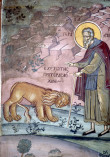 This well-known saint first
learned asceticism in the Egyptian Thebaid, but then went to the Jordan and there founded a
community of about seventy monks which remains to this day. He formulated a particular rule for
his monastery: the monks spent five days a week in their cells weaving baskets and mats; they
were allowed no heat in their cells; five days they ate only a little dry bread and a few dates;
the monks had to leave their cells open, even when they went out, so that anyone could, if he
wanted something, take it from another’s cell. On Saturdays and Sundays they gathered in
the monastery church, ate together boiled vegetables, and took a little wine in God’s
praise. Then each monk brought and placed before the feet of the abbot the work he had done in
the preceding five days. Each monk had only one garment. St. Gerasimos was an example to all. In
the Great Fast he ate nothing but what he received in holy Communion. He once saw a lion which
was roaring with pain, having a thorn in its paw. Gerasimos came near to it, crossed himself and
pulled the thorn out. The lion was so tame that it followed the elder to the monastery and
remained there until the latter’s death. When the elder died, the lion also succumbed to
illness after him and died. St. Gerasimos was present at the Fourth Council in Chalcedon in 451,
in the time of Marcian and Pulcheria, and though he at first inclined a little towards the
Monophysite heresy of Eftyches and Dioscoros, he was at that council a great champion of
Orthodoxy, having been turned from heresy by St. Efthymios. Of Gerasimos’ disciples, the
best-known is St. Kyriakos the Solitary. St. Gerasimos entered into rest and into the eternal joy
of his Lord in 475.
2. The Holy Martyrs Paul and Juliana.
Brother and sister from Ptolemais in Phoenicia, they were cruelly tortured for Christ under the Emperor Aurelian and were finally beheaded. Many miracles attended their martyrdom and many of the pagans, seeing them, were brought to the Faith. Several of them were beheaded in 273 and received martyrs’ wreaths.
3. St. Iakovos the Faster.
He lived in the sixth century. He was so perfected in godliness that he was able to heal the gravest illnesses by his prayers. But the enemy of the human race brought a heavy temptation on him. There was once sent to him a woman who had been corrupted by some mockers. She pretended to weep before him, but enticed him to sin. Seeing that he would fall into sin, Iakovos put his left hand into the fire and held it there until it was completely burned. Seeing this, the woman was filled with fear and horror, repented and reformed her life. But on a second occasion he did not resist and fell with a young girl whom her parents had brought to him to be healed of her madness. He indeed healed her, but then sinned with her, and in order to conceal the sin, killed her and threw her into a river. As always, the path from lust to murder was not very long. Iakovos spent ten years after that as a penitent, living in a grave. He learned after that that God had forgiven him, because, when he at one time prayed for rain in a time of great drought from which both men and cattle were suffering, it fell. Here is an example, similar to that of David, of how wicked the evil demon is; how, by the permission of God, the greatest spiritual giants can topple, and how again, by sincere repentance, God in His compassion will forgive the greatest sins and does not punish those who punish themselves.
FOR CONSIDERATION
If human philosophy can content a man, why did the philosophers Justin and Origen become Christians? Why did Basil and Chrysostom and Gregory, who had in Athens studied Hellenic philosophy in its fullness, receive Baptism? And St. Clement of Rome, who was very rich and very learned? And St. Catherine, who was of the royal house and learned in all the secular knowledge of Egypt? And Ioasaph, the heir of India, who was versed in the whole of Indian philosophy? And so many, many others who first sought an explanation for the enigmas of the world and light for their souls in philosophy, and then drew near to the Church and came to worship Christ the Lord.
Daily Scripture Readings taken from The Orthodox New Testament, translated and published by Holy Apostles Convent, Buena Vista, Colorado, copyright © 2000, used with permission, all rights reserved.
Daily Prologue Readings taken from The Prologue of Ochrid, by Bishop Nikolai Velimirovic, translated by Mother Maria, published by Lazarica Press, Birmingham, England, copyright © 1985, all rights reserved. Edited by Dormition Skete.