

Daily Devotional
Sunday, February 25, 2035 (NS), February 12, 2035 (OS)
No Fasting.
| Fifth Period Mode Plagal Two — Sixth Eothinon |
The commemoration of our fathers among the saints, Meletios, Patriarch of Antioch the Great, and Alexis, Metropolitan and Wonder-worker of All Russia.
Scripture Readings
Paschalion — Movable Calendar
Fifth Period
Sunday of the Thirty-Fourth Week or Sunday of the Prodigal Son
Mode Plagal Two — Sixth Eothinon
Epistle
The Reading is from the First Epistle of Saint Paul to the Corinthians [§ 135]. Brethren:
6 12All things are lawful to me, but all things are not expedient; all things are lawful to me, but I will not be brought under the power of any. 13Foods for the belly, and the belly for foods; but God shall bring to nought both this and these. Now the body is not for fornication, but for the Lord; and the Lord for the body. 14And God both raised up the Lord, and will raise up us by His own power. 15Ye know that your bodies are members of Christ, do ye not? Having taken up then the members of Christ, shall I make them members of a harlot? May it not be! 16Or know ye not that he that is joined to the harlot is one body? For, “The two,” saith He, “shall be into one flesh [Gen. 2:24].” 17But he who is joined to the Lord is one spirit. 18Keep on fleeing fornication. Every sin whatsoever a man might do is outside the body, but he who committeth fornication sinneth against his own body. 19Or know ye not that your body is a temple of the Holy Spirit Who is in you, Whom ye have from God, and ye are not your own? 20For ye were bought with a price; glorify then God in your body and in your spirit, which are God’s.
Gospel
The Reading is from the Holy Gospel according to Saint Luke [§ 79]. The Lord said this parable:
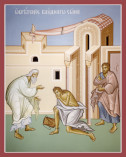
15 11“A certain man had two sons. 12“And the younger of them said to the father, ‘Father, give to me the portion of the property which falleth to me.’ And he divided to them his means of living. 13“And not many days after, the younger son, having gathered all together, went abroad into a distant land, and there scattered his property, living profligately. 14“But after he spent all, there arose a severe famine throughout that land, and he began to be in want. 15“And he went and joined himself to one of the citizens of that land; and he sent him into his fields to feed swine. 16“And he was longing to fill his belly from the husks, which the swine were eating; and no one was giving to him. 17“But having come to himself, he said, ‘How many hired servants of my father abound in loaves, and I am perishing with hunger! 18“‘I will arise and go to my father, and will say to him, “Father, I sinned against heaven and before thee, 19“‘“and am no longer worthy to be called thy son; make me as one of thy hired servants.”’ 20“And he rose up and went to his father. But when he was yet far away, his father saw him and was moved with compassion, and ran, and fell upon his neck, and ardently kissed him. 21“And the son said to him, ‘Father, I sinned against heaven and before thee, and am no longer worthy to be called thy son.’ 22“But the father said to his slaves, ‘Bring forth the robe, the chief one, and clothe him, and provide a ring for his hand and sandals for the feet. 23“‘And bring the calf, the fattened one, and slay it; and let us eat and be merry; 24“‘for this my son was dead and is alive again; and he was lost and is found.’ And they began to be merry. 25“Now his son, the elder one, was in a field; and as he came and drew near to the house, he heard music and dancing. 26“And he summoned one of his servants, and began inquiring what these things may be. 27“And he said to him, ‘Thy brother is come, and thy father slew the calf, the fattened one, because he received him back safe and sound.’ 28“But he was angry and not willing to go in. Then his father went out and besought him. 29“And he answered and said to his father, ‘Behold, so many years I am serving thee, and never did I transgress thy commandment, and never didst thou give a kid to me, in order that I might make merry with my friends; 30“‘but when this thy son came, the one who devoured thy means of living with harlots, thou didst slay for him the calf, the fattened one.’ 31“And he said to him, ‘Child, thou art always with me, and all that is mine is thine. 32“‘But to make merry and to rejoice was fitting, because this thy brother was dead and is alive again, and was lost and is found.’”
Menaion — Fixed Calendar
The commemoration of our fathers among the saints, Meletios, Patriarch of Antioch the Great, and Alexis, Metropolitan and Wonder-worker of All Russia.
Epistle
The Reading is from the Epistle of Saint Paul to the Hebrews [§ 335]. Brethren:
13 17Be obedient to those who lead you, and keep on submitting, for they are watchful for your souls, as those about to render an account, that they may do this with joy, and not groaning; for this would be unprofitable for you. 18Keep on praying for us; for we trust that we have a good conscience, in all things wishing to conduct ourselves well. 19But I beseech you more abundantly to do this, that I might be restored more quickly to you.
20Now the God of peace Who brought up from the dead our Lord Jesus, the Shepherd of the sheep, the great One, in the blood of an everlasting covenant, 21may He render you perfect in every good work, in order to do His will, doing in you that which is well-pleasing before His face, through Jesus Christ, to Whom be glory to the ages of the ages. Amen.
Gospel
The Reading is from the Holy Gospel according to Saint Luke [§ 24]. At that time:
6 17Jesus stood upon a level place. And there was a crowd of
His disciples, and a great multitude of the people from all of Judæa and Jerusalem and the
seacoast of Tyre and Sidon, who came to hear Him, and to be healed of their diseases—
18even those who were troubled by unclean spirits; and they were cured.
19And all the crowd was seeking to touch Him, for power was coming forth from Him and
healing all. 20And He lifted up His eyes to His disciples, and began to say:
“Blessed are the poor, for yours is the kingdom of God.
21“Blessed are ye who hunger now, for ye shall be
filled.
Blessed are ye who weep now, for ye shall laugh.
22“Blessed are ye whenever men hate you, and whenever they
separate you, and reproach you, and cast out your name as evil, on account of the Son of
Man.
23“Rejoice in that day and leap for joy, for behold, your
reward is great in the heavens.”
Synaxarion Readings
Sunday of the Prodigal Son
If anyone be a prodigal as I, take courage and turn back; for the gates of God’s mercies are opened to all.
On this day we celebrate the Sunday of the Prodigal Son, dedicated as the second service of the Triodion by the divine fathers for the following reason. There are some who recognize much in themselves that is unbecoming, who live a life of great dissipation from their youth, whose lives are full of drunkenness and immorality, who having fallen thus into the depths of evil, become despondent, giving birth to pride, from whence they have no desire to advance to any of the virtues, preferring their bondage to evil and falling ever deeper into evil. Having a fatherly love for even these individuals, and desiring to lead them out of their despair, the holy fathers prescribed this parable for the second preparatory Sunday in order to tear up the passion of despair by the roots, to lead them to acceptance of the virtues, and to demonstrate to sinners the abundance of God’s compassion upon sinners and prodigals in His great goodness and love for mankind. For there is no sin which cannot be overcome by the knowledge of His love for mankind, and this is what is presented in this parable of Christ.
Now the sons of man—that is, of the Logos, God and Man—are two: the righteous and the sinful. It is the eldest who abides ever in God’s blessings, following His commandments and remaining always by Him. But the younger son, having become attached to sin and renouncing his closeness to God through shameful deeds, has wasted God’s love for mankind and for him and has lived as a prodigal. For having completely rejected Him after Whose image he was created, and having followed an evil demon, willingly enslaving himself to this demon’s pleasure, he was unable to fulfill his desire. For sin is an unsatisfying thing that becomes a habitual source of only temporary pleasure. It may be compared to the husks that are fed to swine. At first it seems that they might be something tasty, but they turn out to be very dry and are much like weeds, which is how sin takes possession. For the prodigal son had hardly come to his senses when, perishing from hunger for virtue, he comes to his father, saying, “Father, I have sinned before heaven and before thee, and I am not worthy to be called thy son.” Yet the father receives him in repentance, not reproaching him but embracing him and kissing him in a display of divine and fatherly love. And he clothes him, a symbol of Baptism, putting a ring on his finger, a symbol of the grace of the All-Holy Spirit. He also puts sandals on his feet, not so much as a protection from some serpent or scorpion that might sting him on his path to God, but rather as a means of crushing the heads of those creatures. And then in a tremendous display of joy he slaughters the fatted calf for him, his only-begotten Son, and the Father grants him communion of His body and blood. Now the elder son expresses his amazement at his father’s limitless mercy. But the lover of mankind exhorts him to silence with loving and kind words of humility, saying, “Thou art ever with me, and it was meet that we should make merry and be glad, for my son was formerly dead in his sin and is alive again, having repented of the foolish things he has done. He was lost, since he was far from me in his licentious habits, and he was found by me, suffering in my compassion and calling him back in my mercy.” This parable may be applied to us as well, which is why the holy fathers have prescribed it for today. We who have sinned as the prodigal are encouraged to weed out despair and fear through repentance, confession, and good works. For this is a great aid and a powerful weapon against the assaults of the adversary.
In Thine ineffable love for mankind, O Christ our God, have mercy upon us. Amen.
Translated from Triodion, siest ‘Tripesnets: Triod’ Postnaya, Moscow, 1904, by Robert Parent.
Lives of the Saints (Prologue)
February 25th – Civil Calendar
February 12th – Church Calendar
1. St. Meletius, Archbishop of Antioch.
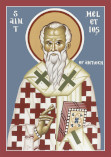 This great and holy man was an outstanding interpreter
and defender of Orthodoxy. The whole of his life was devoted to the fight against the Arian
heresy, which did not recognize the Son of God and blasphemed against the Holy Trinity.
Originally living in Armenia, he was appointed to shepherd the Church of Antioch. In that place,
the struggle between the Orthodox and the heretics was so bitter that the first time St. Meletius
preached to the people in church on the divine Trinity in unity, the deacon, a heretic, ran up to
the bishop and shut his mouth with his hand. Being unable to preach with words, Meletius preached
by signs. Thus, he raised his arms on high, opened three fingers to their fullest extent and
showed them to the people, then closed his hand and raised the one fist. He was three times
removed from his archiepiscopal throne by the heretics, and driven off into Armenia. He took part
in the Second Ecumenical Council in 381, where the Emperor Theodosios showed him especially great
honor. At that council, God showed a mystery through His archbishop. When Meletius was
propounding the doctrine of the Holy Trinity to the Arians, he first raised three fingers,
separated one by one, then brought them together; and at that moment lightning flashed from his
hand before the gaze of all present. At that council, Meletius established Gregory the Theologian
in the seat of Constantinople. While the council was still in session, St. Meletius finished his
earthly course in Constantinople. His relics were taken to Antioch.
2. St. Alexis (Alexei), Metropolitan of Moscow.
St. Alexis was a great hierarch of the Russian Church during a difficult period of Cossack warfare with the Russian people. Once in childhood he went bird hunting, and then went to sleep. In a dream he heard a voice that said, ‘Alexis, why rush around so fruitlessly? I will teach you to catch men!’ He became a monk at the age of twenty, and in time became Metropolitan of Moscow. He twice went among the Cossack Horde: once to sooth the wrath of Verdevir Khan against the Russian people, and the second time at the invitation of Amurat Khan, to cure his wife’s blindness. This woman had been blind for three years, but she was healed and her vision restored when Alexis prayed and anointed her with holy water. After a life of great endeavor and fruitfulness, Alexis entered into rest in 1378 at the age of 85, and went to the court of the Lord.
3. Our Holy Mother Mary (Marius).
Mary was a woman with great courage. After the death of her mother, her father desired to become a monk. Mary would not be separated from him, so they decided to go together to a men’s monastery—Mary with short hair and in man’s raiment as a youth. Her father died, and Mary became a monk and received the name Marius. There was an inn near the monastery, and the innkeeper’s daughter fell in love with the pious monk Marius. After pursuing him without success, she accused Marius of unlawful relations with her, because she had known some other man and borne him a son. Mary did not defend herself and was driven forth with scorn from the monastery. With the strange child in her care, she lived for three years in a grove belonging to the monastery, enduring hunger and hatred, and every sort of hardship and privation. As a result of all this, the innkeeper’s daughter became deranged. A little later, Mary died. Immediately after her death it was discovered that the ‘Monk Marius’ was a woman. As soon as the innkeeper’s daughter touched the relics of St. Mary, she was healed of her insanity and confessed her terrible sin. St. Mary entered into rest and went to eternal joy in 508.
4. St. Anthony, Patriarch of Constantinople.
A man of great compassion, he was at first an ascetic and then patriarch in the time of Emperor Leo the Wise (889-912). He professed his father a monk and built a monastery over the relics of St. Callia.
5. St. Callia.
Callia was generous to the poor from pure Christian compassion, both as a young girl and later as a married woman. Her husband was rich, but he was a hard man. Returning on one occasion from his work, he found that his wife had given away all his wealth to the poor. He thereupon killed her. But God glorified this compassionate soul, in that her relics healed many of the sick. Convinced by this of her sanctity, the holy Patriarch Anthony built a monastery over her relics.
FOR CONSIDERATION
St. John Chrysostom quotes the following example from the life of St. Meletius, demonstrating the true nobility of this great hierarch: Meletius was unjustly exiled from Antioch. When the governor got into the coach, seated the saint beside him and then began to drive hurriedly through the square, the citizens rushed from all sides with pebbles, which fell like hail on the governor’s head, the people being loath to part with their archbishop, and being ready to part with life rather than with this saint. But what did the blessed man do? Seeing the stones flying, he covered the governor’s head with his cloak. He thus shamed his enemy by his great meekness and gave his followers a lesson in the goodness we must show to those who insult us; how it is not enough just to do them no evil, but to use our strength to protect them from those dangers that threaten them. On Meletius’ outward appearance, St. Chrysostom writes further: ‘It was truly the greatest delight to see his holy face, and not only when he taught or spoke; when people only looked at him he brought virtue to the soul of the beholder.’
Daily Scripture Readings taken from The Orthodox New Testament, translated and published by Holy Apostles Convent, Buena Vista, Colorado, copyright © 2000, used with permission, all rights reserved.
Daily Prologue Readings taken from The Prologue of Ochrid, by Bishop Nikolai Velimirovic, translated by Mother Maria, published by Lazarica Press, Birmingham, England, copyright © 1985, all rights reserved. Edited by Dormition Skete.