

Daily Devotional
Friday, February 23, 2035 (NS), February 10, 2035 (OS)
No Fasting.
Friday of the Thirty-Fourth Week
The commemoration of our holy father among the saints, Haralampos, Bishop of Magnesia in Thessaly.
Scripture Readings
Paschalion — Movable Calendar
Friday of the Thirty-Fourth Week
Epistle
The Reading is from the First General Epistle of Saint John [§ 70].
2 7Brethren, I write no new commandment to you, but an old commandment which ye had from the beginning; the old commandment is the word which ye heard from the beginning. 8Again, a new commandment I write to you, which thing is true in Him and in you, because the darkness is passing on its way, and the true light already shineth. 9The one who saith he is in the light, and hateth his brother, is in the darkness until now. 10The one loving his brother abideth in the light, and there is not an occasion of stumbling in him. 11But the one hating his brother is in darkness, and walketh in the darkness, and knoweth not where he goeth, because the darkness blinded his eyes.
12I write to you, little children, because ye have been forgiven your sins for His name’s sake. 13I write to you, fathers, because ye have come to know Him Who is from the beginning. I write to you, young men, because ye have overcome the evil one. I am writing to you, little children, because ye have come to know the Father. 14I am writing to you, fathers, because ye have come to know Him Who is from the beginning. I am writing to you, young men, because ye are strong, and the word of God abideth in you, and ye have overcome the evil one. 15Do not keep on loving the world, nor the things in the world. If anyone love the world, the love of the Father is not in him. 16For all that is in the world—the desire of the flesh, and the desire of the eyes, and the false pretensions of life—is not of the Father, but is of the world. 17And the world is passing on its way, and the desire of it; but the one doing the will of God abideth forever.
Gospel
The Reading is from the Holy Gospel according to Saint Mark [§ 63]. At that time:
14 3While Jesus was in Bethany in the house of Simon the leper, reclining at table, there came a woman having an alabaster flask of pure, costly perfumed ointment of spikenard. And she broke the alabaster flask and poured it down upon His head. 4And some were feeling indignant within themselves, and saying, “For what hath this waste of the perfumed ointment taken place? 5“For it was possible for this perfumed ointment to have been sold for above three hundred denarii, and to have been given to the poor.” And they were snorting with indignation at her. 6But Jesus said, “Let her alone; why do ye cause her trouble? She wrought a good work toward Me. 7“For ye have the poor among yourselves always, and whenever ye wish ye are able to do them good; but Me ye have not always. 8“What she could do, she did; she undertook beforehand to anoint My body for the burial. 9“Verily I say to you, wheresoever this Gospel shall be proclaimed in all the world, also what she did shall be spoken of for a memorial of her.”
Menaion — Fixed Calendar
The commemoration of our holy father among the saints, Haralampos, Bishop of Magnesia in Thessaly.
No readings given.
Lives of the Saints (Prologue)
February 23rd – Civil Calendar
February 10th – Church Calendar
1. The Hieromartyr Haralambos (Charalampus).
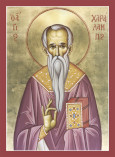 This great saint was a priest in Magnesia, and suffered for
Christ at the age of 113. When a violent persecution broke out under Emperor Septimus Severus,
the aged Haralambos did not hide from his persecutors, but freely and openly preached the
Christian Faith. He endured all tortures as though not in the body, and when they flayed the
living flesh from him, the godly saint said to the emperor’s soldiers: ‘Thank you, my
brethren, for scraping off the old body and renewing my soul for new and eternal life.’ He
performed many wonders and brought many to the Faith. Even the emperor’s daughter, Gallina,
repudiated the paganism of her father and became a Christian. Condemned to death and led to the
place of execution, St. Haralambos raised his arms to heaven and prayed for all men, that God
would give them bodily health and salvation of soul, and that He would grant them the fruits of
the earth in abundance: ‘Lord, Thou knowest that men are flesh and blood; forgive them
their sins and pour out Thy blessing on all.’ After praying thus, the saintly elder gave
his soul to God before the executioner had laid his sword to his neck. He suffered in 202.
Gallina took his body and buried it.
2. Our Holy Father Prochorus the Orach-Eater.
A wonder-worker of the Monastery of the Caves in Kiev, he was named the Orach-eater because the whole time he lived in the monastery he never tasted bread, but fed himself on orach prepared according to his own particular method as a sort of bread. When he gave someone some of this bread with his blessing, it was as sweet as honey, but if anyone stole some, it was as bitter as wormwood.
Once, when there was a dearth of salt in Russia, Prochorus distributed ashes to the people for salt. The ashes that he distributed with his blessing became salt; however, ashes that anyone took for himself remained ordinary ashes. Prince Svyatopolk ordered that all the ashes from Prochorus’ cell be brought to the court without his permission, let alone his blessing. When the ashes were brought there, it was obvious to everyone that they were ashes and not salt. Then Prochorus told all the people who came to him for salt to go to the prince’s court, and when the prince threw the ashes away, to take them and use them as salt. This they did, and the ashes again became salt. The prince himself, learning of this, was filled with a deep respect and love for him. When Prochorus died in 1107, Prince Svyatopolk placed him with his own hands in a grave near the great Russian Saints Anthony and Theodosius.
FOR CONSIDERATION
Many of the great infirmities to which man is subject have their origin, known or unknown, in his past. The origins of these great infirmities, such as madness for example, are none other than violations of the moral law of God. While St. Haralambos was undergoing martyrdom, the royal torturer learned of his wonder-working power and ordered that a madman be brought before him, to find out if Haralambos could heal him. The devil had tormented this man for 35 years, driving him into the deserts and mountains and casting him into mires and abysses. When this madman drew near to Haralambos, the demon smelled the fragrance of the holy man and cried out: ‘I beg thee, O servant of God, do not torment me before the time, but order me and I will come out; and if thou desirest, I will tell thee how I entered into the man.’ And the saint ordered him to speak. The demon said: ‘This man desired to rob his neighbor, and thought within himself: “If I don’t first kill the man, I shall not be able to take all his goods.” So he went and killed his neighbor. Catching him in such an act. I entered into him and have been residing here these 35 years.’ Hearing this, the saint of God ordered the demon to come out of the man at once and leave him in peace, and the man was healed and became calm.
Daily Scripture Readings taken from The Orthodox New Testament, translated and published by Holy Apostles Convent, Buena Vista, Colorado, copyright © 2000, used with permission, all rights reserved.
Daily Prologue Readings taken from The Prologue of Ochrid, by Bishop Nikolai Velimirovic, translated by Mother Maria, published by Lazarica Press, Birmingham, England, copyright © 1985, all rights reserved. Edited by Dormition Skete.