

Daily Devotional
Friday, February 9, 2035 (NS), January 27, 2035 (OS)
Fast Day, but Wine and Olive Oil Allowed.
Friday of the Thirty-Seventh Week
The commemoration of the translation of the relics of our father among the saints, John Chrysostom, Archbishop of Constantinople.
Scripture Readings
Paschalion — Movable Calendar
Friday of the Thirty-Seventh Week
Epistle
The Reading is from the Epistle of Saint Paul to the Philippians [§ 245]. Brethren:
3 8I suffered the loss of all things, and deem them to be dung, that I might win Christ, 9and might be found in Him, not having a righteousness of mine own, which is of the law, but that which is through faith in Christ, the righteousness of God on the basis of faith, 10to come to know Him, and the power of His resurrection, and the partaking of His sufferings, being conformed to His death, 11if by any means I might attain to the resurrection of the dead. 12Not that I already received, or already have been perfected; but I pursue, if I might also apprehend that for which I also was apprehended by the Christ, Jesus. 13Brethren, I count not myself to have apprehended; but one thing I do, forgetting the things which are behind, and stretching forth to those things which are before, 14I pursue toward the mark for the prize of the high calling of God in Christ Jesus. 15Let us therefore, as many as are perfect, be of this mind; and if ye are otherwise minded in anything, God shall reveal even this to you. 16Only to what we attained, let us walk by the same rule, let us mind the same thing.
17Brethren, keep on becoming imitators together of me and look to those who so walk, as ye have us for an example. 18For many walk about, of whom I was telling you often, and now tell even weeping, that they are the enemies of the Cross of Christ: 19whose end is destruction, whose god is the belly, and who glory in their shame—they who mind earthly things!
Gospel
The Reading is from the Holy Gospel according to Saint Luke [§ 32].
7 31The Lord said, “To what then shall I liken the men of this generation? And to what are they like? 32“They are like little children sitting in a marketplace and calling to one another, and saying, ‘We played on the flute to you, and ye danced not; we sang a dirge to you, and ye wept not.’ 33“For John the Baptist hath come neither eating bread nor drinking wine, and ye say, ‘He hath a demon.’ 34“The Son of Man hath come eating and drinking, and ye say, ‘Behold, a man, a glutton and a wine-drinker, a friend of tax collectors and sinners.’ 35“And yet wisdom is justified by all of her children!”
Menaion — Fixed Calendar
The commemoration of the translation of the relics of our father among the saints, John Chrysostom, Archbishop of Constantinople.
Epistle
The Reading is from the Epistle of Saint Paul to the Hebrews [§ 318]. Brethren:
7 26Such a High Priest was fitting for us: holy, guileless, undefiled, Who hath been separated from the sinners and hath become higher than the heavens, 27Who hath no need daily, even as the high priests, to offer up sacrifices, first for his own sins, then for those of the people; for this He did once for all after He offered up Himself. 28For the law appointeth men high priests who have weakness; but the word of the oath, which is after the law, appointeth the Son, Who hath been perfected forever.
8 1Now in reference to the things being spoken of, the chief point is: We have such a High Priest, Who sat down on the right of the throne of the majesty in the heavens, 2a Liturgist of the holies and of the tabernacle, the true one, which the Lord pitched, and not man.
Gospel
The Reading is from the Holy Gospel according to Saint John [§ 36]. The Lord said to the Jews who had come to Him:
10 9“I am the door; by Me if anyone should enter, he shall be saved, and shall go in and go out and find pasture. 10“The thief cometh not, except that he might steal, and slay, and destroy. I came that they may have life, and may have it abundantly. 11“I am the good shepherd. The good shepherd layeth down his life for the sheep. 12“But the hireling, who indeed is not a shepherd, whose own the sheep are not, seeth the wolf coming, and leaveth the sheep and fleeth; and the wolf seizeth them and scattereth the sheep. 13“Now the hireling fleeth, because he is a hireling and careth not about the sheep. 14“I am the good shepherd; and I know those that are Mine, and am known of those that are Mine. 15“Even as the Father knoweth Me, I also know the Father; and I lay down My life for the sheep. 16“And I have other sheep which are not of this fold; them also it is needful for Me to bring, and they shall hear My voice; and there shall be one flock and one Shepherd.”
Lives of the Saints (Prologue)
February 9th – Civil Calendar
January 27th – Church Calendar
1. St. John Chrysostom, the Golden Mouth of Orthodoxy.
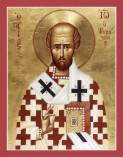 The Church celebrates the memory of this saint on November 13th and
January 30th, but on this day is celebrated the translation of his honored relics from the
Armenian village of Comana, where he died in exile in 407, to Constantinople where earlier, as
patriarch, he had governed the Church. Thirty years after his death, Patriarch Proklos made a
speech in memory of his spiritual father and mentor, and by this speech so roused the love of the
people and the emperor, Theodosios the Younger, towards the great saint that they all wanted the
relics of St. Chrysostom to be translated to Constantinople. It is related that the coffin
containing the relics could not be shifted from its place until the emperor had written a letter
to St. Chrysostom, begging his forgiveness (for Theodosios’ mother, Evdoxia, was guilty of
having persecuted the saint) and appealing to him to return to Constantinople, his former
residence. When this repentant letter was placed on the coffin, the latter became light in
weight. Before the translation, many of the sick, on touching the coffin, were healed. When the
relics arrived at the capital, the emperor again begged forgiveness over them in his
mother’s name, as though it were she herself speaking: ‘While I lived in this
temporal life, I acted in malice towards thee; but now that thou livest in eternal life, be thou
of help to my soul. My glory passes and there is nought to help me; help me, father, in thy
glory; help me before I come to be condemned before the judgment of Christ.’ When the saint
was carried into the Church of the Holy Apostles and placed on the patriarchal throne, the
assembled throng heard these words from his mouth: ‘Peace be unto all!’ The
translation of the relics of St. John Chrysostom was carried out in the year 438.
2. Our Holy Father Titus of the Kiev Caves.
He was at first a soldier, but receiving a wound in the head in battle, he retired from the world to the monastery of the Caves in Kiev, there to be healed and to receive the monastic schema. He spent his time in ceaseless mourning over his former sins. Before his death he was shown by a heavenly vision that all his sins had been forgiven. His relics lie in the caves of Theodosius.
FOR CONSIDERATION
Fasting is a great thing, but love is greater. If it is by fasting that devils are driven out, passions tamed, the body calmed, the spirit steadied, it is by love that God makes His abode with men. The Lord Himself emphasized fasting as necessary, but proclaimed love as the greatest commandment. In the first half of last century, Jeladin Bey, a Turk, ruled over Ochrid. He was a rebel against the sultan and an independent governor. At that time the Church was ruled by Metropolitan Kalinik. Jeladin and Kalinik, although of different faiths, were very good friends and often visited each other. It happened that Jeladin Bey condemned twenty-five Christians to death by hanging, and the execution was to take place on Great Friday. The metropolitan, deeply distressed by this event, went to Jeladin and besought him to mitigate the sentence. While they were talking, the hour of the midday meal arrived, and the bey invited the metropolitan to eat with him. A dish of lamb had been prepared for the meal. The metropolitan excused himself, as the fast (of the monastic rule, as well as of Holy Friday) prevented him from remaining to eat, and prepared to leave. The bey was angered and said to him: ‘Choose; either you eat with me and free twenty-five people from hanging, or you refrain and they hang.’ The metropolitan crossed himself and sat down to lunch, and Jeladin freed the people from the death sentence.
Daily Scripture Readings taken from The Orthodox New Testament, translated and published by Holy Apostles Convent, Buena Vista, Colorado, copyright © 2000, used with permission, all rights reserved.
Daily Prologue Readings taken from The Prologue of Ochrid, by Bishop Nikolai Velimirovic, translated by Mother Maria, published by Lazarica Press, Birmingham, England, copyright © 1985, all rights reserved. Edited by Dormition Skete.