

Daily Devotional
Tuesday, December 19, 2034 (NS), December 6, 2034 (OS)
Fast Day, but Fish, Wine and Olive Oil Allowed.
Tuesday of the Thirtieth Week
The commemoration of our father among the saints, Nicholas, Bishop of Myra of Lycia, the Wonder-worker.
Scripture Readings
Paschalion — Movable Calendar
Tuesday of the Thirtieth Week
Epistle
The Reading is from the Epistle of Saint Paul to the Hebrews [§ 321]. Brethren:
For Gk. usage, see Heb. 9:8-23; for Sl. usage, see Heb. 9:8-10, 15-23.
9 8The Holy Spirit signifieth that the way into the Holies hath not yet been made manifest while the first tabernacle still hath a standing, 9which was a type for the time then present, according to which both gifts and sacrifices are being offered, which is not able to perfect the one who worshippeth, as concerning conscience, 10only in foods and drinks, and diverse ablutions, and ordinances of the flesh being imposed on them, until the time of setting things straight. 11But Christ, Who came as High Priest of the coming good things, by means of the greater and more perfect tabernacle—not made by hand, that is, not of this creation, 12nor by blood of goats and of calves, but by His own blood—entered once for all into the Holies, having Himself obtained eternal redemption. 13For if the blood of bulls and of goats and ashes of a heifer, sprinkling those who have been defiled, sanctifieth to the purity of the flesh, 14how much more shall the blood of the Christ, Who through the eternal Spirit offered Himself without blemish to God, purify your conscience from dead works in order to worship the living God? 15And for this cause He is Mediator of a new testament, so that by means of a death which took place for redemption from the transgressions under the first testament, they who have been called might receive the promise of the eternal inheritance. 16For where a testament is, it is necessary for the death of the one who made a disposition for himself to be brought forward. 17For a testament is confirmed over those dead, since it never hath strength when the one who maketh the disposition liveth. 18Wherefore neither hath the first been inaugurated without blood. 19For after Moses spoke every command to all the people according to the law, he took the blood of the calves and goats, with water, and scarlet wool, and hyssop, and sprinkled both the book itself and all the people, 20saying, “This is the blood of the testament which God enjoined concerning you [cf. Exod. 24:8].” 21And in like manner he sprinkled with blood both the tabernacle and all the vessels of the service. 22And I may almost say all things are being purified with blood according to the law, and without shedding of blood no remission taketh place. 23It was therefore necessary on the one hand that the patterns of the things in the heavens be purified with these, but on the other hand the heavenly things themselves with better sacrifices than these.
Gospel
The Reading is from the Holy Gospel according to Saint Luke [§ 106]. The Lord said to His disciples, “Be taking heed of men:
21 12“For they shall lay their hands upon you and persecute you, delivering you up to synagogues and prisons, bringing you before kings and governors on account of My name; 13“but it shall prove to be a testimony for you. 14“Therefore settle it for yourselves in your hearts not to premeditate to make a defense; 15“for I will give you a mouth and wisdom, which all those who oppose you shall not be able to contradict nor withstand. 16“And ye shall be delivered up also by parents, and kinfolk, and friends, and brethren; and they shall put some of you to death. 17“And ye shall be hated by all for My name’s sake. 18“But a hair of your head in no wise shall perish. 19“In your patience win your souls.”
Menaion — Fixed Calendar
The commemoration of our father among the saints, Nicholas, Bishop of Myra of Lycia, the Wonder-worker.
Epistle
The Reading is from the Epistle of Saint Paul to the Hebrews [§ 335]. Brethren:
13 17Be obedient to those who lead you, and keep on submitting, for they are watchful for your souls, as those about to render an account, that they may do this with joy, and not groaning; for this would be unprofitable for you. 18Keep on praying for us; for we trust that we have a good conscience, in all things wishing to conduct ourselves well. 19But I beseech you more abundantly to do this, that I might be restored more quickly to you.
20Now the God of peace Who brought up from the dead our Lord Jesus, the Shepherd of the sheep, the great One, in the blood of an everlasting covenant, 21may He render you perfect in every good work, in order to do His will, doing in you that which is well-pleasing before His face, through Jesus Christ, to Whom be glory to the ages of the ages. Amen.
Gospel
The Reading is from the Holy Gospel according to Saint Luke [§ 24]. At that time:
6 17Jesus stood upon a level place. And there was a crowd of
His disciples, and a great multitude of the people from all of Judæa and Jerusalem and the
seacoast of Tyre and Sidon, who came to hear Him, and to be healed of their diseases—
18even those who were troubled by unclean spirits; and they were cured.
19And all the crowd was seeking to touch Him, for power was coming forth from Him and
healing all. 20And He lifted up His eyes to His disciples, and began to say:
“Blessed are the poor, for yours is the kingdom of God.
21“Blessed are ye who hunger now, for ye shall be
filled.
Blessed are ye who weep now, for ye shall laugh.
22“Blessed are ye whenever men hate you, and whenever they
separate you, and reproach you, and cast out your name as evil, on account of the Son of
Man.
23“Rejoice in that day and leap for joy, for behold, your
reward is great in the heavens.”
Lives of the Saints (Prologue)
December 19th – Civil Calendar
December 6th – Church Calendar
1. St. Nicholas the Wonder-worker, Archbishop of Myra in Lycia.
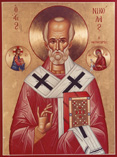 This saint, famed throughout the
entire world today, was the only son of his eminent and wealthy parents, Theophanes and Nona,
citizens of Patara in Lycia. They dedicated to God the only son He gave them. St. Nicholas was
instructed in the spiritual life by his uncle Nicholas, Bishop of Patara (see below), and became
a monk at ‘New Sion,’ a monastery founded by his uncle. On the death of his parents,
Nicholas distributed all the property he inherited to the poor and kept nothing back for himself.
As a priest in Patara, he was known for his charitable works, fulfilling the Lord’s words:
‘Let not thy left hand know what thy right hand doeth’ (Matt. 6:3). When he embraced
a life of solitude and silence, thinking to live in that way until his death, a voice from on
high came to him: ‘Nicholas, set about your work among the people if you desire to receive
a crown from Me.’ Immediately after that, by God’s wondrous providence, he was chosen
as archbishop of the city of Myra in Lycia. Merciful, wise and fearless, Nicholas was a true
shepherd to his flock. He was cast into prison during the persecutions of Diocletian and
Maximian, but even there continued to instruct the people in the law of God. He was present at
the First Ecumenical Council in Nicaea in 325, and in his zeal, struck Arius with his hand. For
this act, he was removed from the council and from his episcopal duties, until some of the chief
hierarchs had a vision of our Lord Christ and His most holy Mother showing their sympathy with
Nicholas.
This wonderful saint was a defender of the truth of God, and was ever a spirited champion of justice among the people. On two occasions, he saved three men from undeserved sentences of death. Merciful, trustworthy and loving right, he walked among the people like an angel of God. People considered him a saint even during his lifetime, and invoked his aid when in torment or distress. He would appear both in dreams and in reality to those who called upon him for help, responding speedily to them, whether close at hand or far away. His face would shine with light as Moses’ did aforetime, and his mere presence among people would bring solace, peace and goodwill. In old age, he sickened of a slight illness, and went to his rest in the Lord after a life full of labor and fruitful toil. He now enjoys eternal happiness in the kingdom of heaven, continuing to help the faithful on earth by his miracles, and to spread the glory of God. He entered into rest on December 6th, 343.
2. St. Nicholas, Bishop of Patara.
The uncle of the great St. Nicholas, he set his nephew on the spiritual path and ordained him priest.
3. The Holy Martyr Nicholas of Karamanos.
He was harshly tortured by the Turks, and was hanged in Smyrna in 1657.
4. St. Theophilus, Bishop of Antioch.
A man well-versed in Hellenistic philosophy, he became a Christian through reading the holy Scriptures and became a great champion of the Christian Faith. His work ‘On the Faith’ is extant today. He governed the Church in Antioch for thirteen years, and went to his rest in the year 181.
FOR CONSIDERATION
On icons of St. Nicholas, our Lord and Savior will often be seen on one side with the Gospels in His hand, and the most holy Mother of God on the other with an episcopal omophorion in hers. This has a twofold historical significance: it denotes, firstly, Nicholas’ calling to the episcopal office, and secondly his vindication and reinstatement following the punishment for his clash with Arius. St. Methodius, Patriarch of Constantinople, writes: ‘One night, St. Nicholas saw our Savior in glory, standing by him and holding out to him the Gospels adorned with gold and pearls, and the Mother of God standing on his other side and placing an omophorion on his shoulders. Shortly after this vision, John, the then Archbishop of Myra, died, and Nicholas was installed as Archbishop of that city.’ That was the first occasion. The second occurred at the time of the First Ecumenical Council in Nicaea. Unable to put a stop by argument to the senseless blasphemy of Arius against the Son of God and His most pure Mother, St. Nicholas struck Arius in the face. The holy fathers at the council strongly disapproved of such behavior, and they banned Nicholas from the council and stripped him of all marks of his episcopal rank. That very night, several of the fathers had the selfsame vision: how the Lord stood on one side of Nicholas with the Gospels and the Mother of God on the other with an omophorion, offering to the saint those marks of rank that had been stripped from him. Seeing this, the fathers were amazed, and quickly returned to Nicholas that which they had taken from him. They began from that time to respect him as a great man, and to interpret his action against Arius not as some senseless rage but as the expression of great zeal for God’s truth.
Daily Scripture Readings taken from The Orthodox New Testament, translated and published by Holy Apostles Convent, Buena Vista, Colorado, copyright © 2000, used with permission, all rights reserved.
Daily Prologue Readings taken from The Prologue of Ochrid, by Bishop Nikolai Velimirovic, translated by Mother Maria, published by Lazarica Press, Birmingham, England, copyright © 1985, all rights reserved. Edited by Dormition Skete.