

Daily Devotional
Wednesday, December 13, 2034 (NS), November 30, 2034 (OS)
Fast Day, but Wine and Olive Oil Allowed.
Wednesday of the Twenty-Ninth Week
The commemoration of the holy, glorious, and all-famed Apostle Andrew the First-called.
Scripture Readings
Paschalion — Movable Calendar
Wednesday of the Twenty-Ninth Week
Epistle
The Reading is from the Epistle of Saint Paul to the Hebrews [§ 312]. Brethren:
5 11Concerning Melchisedek there is much for our discourse and difficult in interpretation to speak, since ye have become dull in hearing. 12For though you even ought to be teachers by reason of the time, ye have need of one to teach you again what are the elements of the beginning of the oracles of God; and ye have come to be in need of having milk and not of solid food. 13For everyone who partaketh of milk is inexperienced in the word of righteousness, for he is an infant; 14but solid food is for the mature who, by reason of habit, have the senses exercised for discernment of both good and evil.
6 1Wherefore having left the discourse of the beginning principle of the Christ, let us be borne on to perfection, not laying down again a foundation of repentance from dead works, and of faith in God, 2of the teaching of baptisms, and of laying on of hands, and of resurrection of the dead, and of eternal judgment. 3And this we will do if indeed God permit. 4For it is impossible for those who were enlightened once for all, and who tasted of the gift, the heavenly one, and became partakers of the Holy Spirit, 5and tasted the good word of God and the powers of the age to come, 6and who fell away, to renew them again to repentance, since they crucify anew to themselves the Son of God and make a public example of Him. 7For the earth which drinketh up the oft coming rain, and produceth herbage fit for those by whom it is cultivated, receiveth blessing from God; 8but that which shooteth forth thorns and thistles is not approved and near cursing, of which the end is for burning.
Gospel
The Reading is from the Holy Gospel according to Saint Luke [§ 99]. At that time:
20 1As Jesus taught the people in the temple and preached the Gospel, the chief priests and the scribes, with the elders, suddenly came upon Him, 2and spoke to Him, saying, “Tell us, by what authority doest Thou these things? Or who is the one who gave Thee this authority?” 3And He answered and said to them, “I also will question you for one word, and tell Me: 4“The baptism of John, was it from heaven or from men?” 5And they deduced for themselves, saying, “If we should say, ‘From heaven,’ He will say, ‘Why then did ye not believe him?’ 6“But if we should say, ‘From men,’ all the people will stone us to death; for they have been persuaded that John was a prophet.” 7And they answered that they knew not from what place it was. 8And Jesus said to them, “Neither do I tell you by what authority I am doing these things.”
Menaion — Fixed Calendar
The commemoration of the holy, glorious, and all-famed Apostle Andrew the First-called.
Epistle
The Reading is from the First Epistle of Saint Paul to the Corinthians [§ 131]. Brethren:
4 9I think that God showed forth us the apostles last, as condemned to death; for we became a spectacle to the world, both to angels and to men. 10We are fools for Christ’s sake, but ye are wise in Christ. We are weak, but ye are strong. Ye are held in honor, but we are dishonored. 11Until the present hour, we both hunger and thirst, and are naked, and are being buffeted, and never at rest. 12And we toil working with our own hands. Being reviled, we bless; being persecuted, we bear up; 13being evilly spoken of, we beseech. We became as the filth of the world, the off-scouring of all until now. 14I do not write these things shaming you, but admonishing you as my beloved children. 15For if ye have myriads of tutors in Christ, yet ye have not many fathers; for in Christ Jesus I begot you through the Gospel. 16Therefore, I beseech you, keep on becoming imitators of me.
Gospel
The Reading is from the Holy Gospel according to Saint John [§ 4]. At that time:
1 35John was standing, and two of his disciples. 36And having looked at Jesus walking, he saith, “Behold, the Lamb of God!” 37And the two disciples heard Him speaking, and they followed Jesus. 38And Jesus turned, and beheld them following, and saith to them, “What seek ye?” And they said to Him, “Rabbi” (which is to say, being interpreted, Teacher), “where art Thou staying?” 39He said to them, “Come and see.” Then they went and saw where He was staying. And they stayed with Him that day; and it was about the tenth hour. 40Andrew, the brother of Simon Peter, was one of the two who heard this from John, and followed Him. 41This same one first findeth his own brother Simon, and saith to him, “We have found the Messiah” (which is, being interpreted, the Christ), 42and he led him to Jesus. And having looked at him, Jesus said, “Thou art Simon, the son of Jonas. Thou shalt be called Kephas” (which is interpreted, a stone).
43On the morrow Jesus intended to go forth into Galilee; and He findeth Philip, and saith to him, “Follow thou Me.” 44Now Philip was from Bethsaida, of the city of Andrew and Peter. 45Philip findeth Nathanael, and saith to him, “We have found the One of Whom Moses in the law, and the prophets, wrote—Jesus the son of Joseph, Who is from Nazareth.” 46And Nathanael said to him, “Out of Nazareth can there be any good thing?” Philip saith to him, “Come and see.” 47Jesus saw Nathanael coming toward Him, and saith concerning him, “Behold, truly an Israelite in whom is no guile.” 48Nathanael saith to Him, “From what place knowest Thou me?” Jesus answered and said to him, “Before Philip called thee, when thou wast under the fig tree, I saw thee.” 49Nathanael answered, and saith to Him, “Rabbi, Thou art the Son of God; Thou art the King of Israel.” 50Jesus answered and said to him, “Because I said to thee, ‘I saw thee underneath the fig tree,’ believest thou? Thou shalt see greater things than these.” 51And He saith to him, “Verily, verily, I say to thee, henceforth ye shall see the heaven having been opened, and the angels of God ascending and descending upon the Son of Man.”
Lives of the Saints (Prologue)
December 13th – Civil Calendar
November 30th – Church Calendar
1. The Holy Apostle Andrew the First-Called.
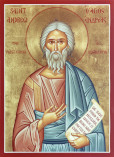 He was the son of Jonah and brother of Peter,
born in Bethsaida and a fisherman by profession. He was first a disciple of St. John the Baptist,
but when John pointed to the Lord Jesus and said: ‘Behold the Lamb of God’ (Jn.
1:36), St. Andrew left his first teacher and followed Christ. After that, Andrew brought his
brother Peter to the Lord. After the descent of the Holy Spirit, it fell to the lot of the first
of Christ’s apostles, St. Andrew, to preach the Gospel in Byzantium and Thrace, then in the
lands along the Danube, in Russia and around the Black Sea, and finally in Epirus, Greece and the
Peloponnese, where he suffered. In Byzantium he installed St. Stachys as its first bishop; in
Kiev he raised the Cross on high and prophesied a Christian future for the Russian people; in
Thrace, Epirus, Greece and the Peloponnese, he brought many people to the Faith and gave them
bishops and priests. In the city of Patras he performed many wonders in the name of Christ and
brought many to the Lord, among whom were the brother and wife of the imperial governor,
Aegeatus. Aegeatus, infuriated by this, put Andrew to torture and then crucified him. While he
was still alive on the cross, the apostle of Christ taught the Christians who were gathered round
him. The people wanted to take him down from the cross, but he would not let them. Finally, the
apostle prayed to God and a strange radiance surrounded him. This light lasted for half an hour,
and when it disappeared, the apostle gave his holy soul into God’s hands. Thus the
first-called apostle, who first of the twelve great apostles came to know the Lord and followed
Him, finished his earthly course. St. Andrew suffered for his Lord in the year 62. His relics
were translated to Constantinople, but his head was later taken to Rome and one hand to
Moscow.
2. St. Frumentios, the Enlightener of Abyssinia.
In the time of the Emperor Constantine the Great, a learned man from Tyre called Meropios traveled to India. He took with him two young Christians, brothers called Edessios and Frumentios. On the journey, the ship foundered in a storm on the Abyssinian coast, and the wild Abyssinians killed all the people from the ship except these two brothers, Edessios and Frumentios. They lived in Abyssinia for several years and succeeded in entering the service of the king. Frumentios began to preach the Christian Faith, at first fairly cautiously, and became convinced that the land was ripe for such preaching. The two brothers then took ship, Edessios to Tyre to his parents and Frumentios to Alexandria, to Patriarch Athanasius the Great. Frumentios described the situation in Abyssinia to the patriarch and sought pastors to bring the people to the Faith. St. Athanasius consecrated Frumentios bishop, and he returned to Abyssinia where, by his zeal and his miracles, he brought the whole of Abyssinia to the Faith during his lifetime. This great pastor of Christ’s flock and enlightener of Abyssinia died peacefully in the year 370, and entered into the kingdom of his Lord.
FOR CONSIDERATION
‘All is given to the apostles,’ says St. John Chrysostom. This means: all gifts, all powers, all the fullness of the grace that God gives to all the faithful is given to the apostles. We see this in the life of the great Apostle Andrew the First-Called: how he is apostle and evangelist, prophet, pastor and teacher (Eph. 4:11). As an evangelist, he carried the good news of the Gospel to the four corners of the earth; as a prophet he prophesied the Baptism of the Russian people and the greatness of Kiev as a city and as a center of Christianity; as a pastor he founded and organized many churches; as a teacher he tirelessly taught right up to his crucifixion, and then on the cross till his last breath. And, on top of this, he was a martyr. This was by a gift of the Holy Spirit that is not given to all. We see in this apostle, as in all the others, the fullness of the grace of the Holy Spirit.
That every act performed by a follower of Christ must be supported by grace is testified to by St. Frumentios. When he returned to Abyssinia from Alexandria as a consecrated bishop, he began to perform great wonders, thus bringing the people to the Faith in great masses. The envious king then asked him: ‘You lived among us for so many years, and we never saw you work such wonders. Whence is it that you do so now?’ To this blessed Frumentios replied: ‘This is not my action, but that of the grace of the priesthood,’ and the saint then explained to the king how he had, for the sake of Christ, forsaken his parents, marriage and the whole world, and how he had, through consecration at the hands of St. Athanasius, received the grace of priesthood, the grace of wonder-working.
Daily Scripture Readings taken from The Orthodox New Testament, translated and published by Holy Apostles Convent, Buena Vista, Colorado, copyright © 2000, used with permission, all rights reserved.
Daily Prologue Readings taken from The Prologue of Ochrid, by Bishop Nikolai Velimirovic, translated by Mother Maria, published by Lazarica Press, Birmingham, England, copyright © 1985, all rights reserved. Edited by Dormition Skete.